
The short answer
Choose by window, not by house. In Batley's stone terraces and 1930s semis, a front bay suits shutters or Roman blinds; a small bathroom window suits a waterproof roller blind; shallow UPVC frames on newer homes suit perfect-fit blinds that clip into the frame. Have every window measured on its own, because older openings are rarely square.
- About a third of households in Batley live in a terraced house, against fewer than a quarter across England (Census 2021).
- Front bays on terraces and 1930s semis suit shutters made for bay windows or Roman blinds, one per window face.
- Small bathroom windows need something that copes with steam: a waterproof roller or a faux-wood venetian.
- Shallow UPVC recesses on newer estates suit perfect-fit blinds, which clip into the window frame with no drilling.
- The home visit is free: samples in your own light, every window measured, and a written price before the advisor leaves.
Batley's homes in numbers
34%
of households in Batley live in a terraced house, against 23% across England
36%
live in a semi-detached house, against 31% across England
32%
of homes in central Batley were built before 1919, against 20% across England
Households: Census 2021, Batley East and Batley West wards. Build dates: Valuation Office Agency council tax records at 31 March 2024, for the Batley Central, Batley Carr and Mount Pleasant, and Upper Batley and Soothill neighbourhoods. Full sources at the end of this post.
What kind of homes does Batley have?
Batley grew up around its mills, and its housing still shows it. Rows of Victorian stone terraces climb the hillsides around the town centre, many built for the families who worked in those mills, with tall window openings set deep into thick stone walls. Many of the original sashes have since been replaced with UPVC, but the deep reveals remain, and after a century and more of settling, few of those openings are perfectly square.
The interwar years added streets of semi-detached houses, many with a bay window to the front room. More recently, new estates have brought brick-built homes with UPVC casement windows set in shallow, plastered recesses.
The numbers bear this out. In the 2021 Census, about a third of households in Batley's two wards lived in a terraced house, compared with fewer than a quarter across England. In central Batley, almost a third of homes were built before 1919, and in Batley Carr and Mount Pleasant the figure is 41%.
Which window dressing suits each type of Batley window?
Most homes have a mix of the windows below, so it pays to think room by room rather than choosing one style for the whole house. This is what we usually suggest for each.
Front bay
- Where you find it
- Victorian terraces with bays and 1930s semis
- What we usually suggest
- Shutters or Roman blinds, one per window face
- Why
- Each face is dressed on its own, so the bay keeps its shape and opens section by section
Deep stone reveal
- Where you find it
- Victorian and Edwardian terraces
- What we usually suggest
- A Roman or roller blind fitted inside the recess
- Why
- The depth hides the headrail and lets the blind sit neatly within the wall
Small bathroom window
- Where you find it
- Almost every Batley home
- What we usually suggest
- A waterproof roller or a faux-wood venetian
- Why
- Neither soaks up steam, and both wipe clean
Shallow UPVC recess
- Where you find it
- Newer estates and replacement windows
- What we usually suggest
- Perfect-fit blinds
- Why
- They clip into the window frame itself, so a shallow recess does not matter
Street-facing front window
- Where you find it
- Terraces that open straight onto the pavement
- What we usually suggest
- Day and night or top-down blinds, or café-style shutters
- Why
- Privacy at street level while daylight still comes in at the top
| Window | Where you find it | What we usually suggest | Why |
|---|---|---|---|
| Front bay | Victorian terraces with bays and 1930s semis | Shutters or Roman blinds, one per window face | Each face is dressed on its own, so the bay keeps its shape and opens section by section |
| Deep stone reveal | Victorian and Edwardian terraces | A Roman or roller blind fitted inside the recess | The depth hides the headrail and lets the blind sit neatly within the wall |
| Small bathroom window | Almost every Batley home | A waterproof roller or a faux-wood venetian | Neither soaks up steam, and both wipe clean |
| Shallow UPVC recess | Newer estates and replacement windows | Perfect-fit blinds | They clip into the window frame itself, so a shallow recess does not matter |
| Street-facing front window | Terraces that open straight onto the pavement | Day and night or top-down blinds, or café-style shutters | Privacy at street level while daylight still comes in at the top |
What works best in a front bay window?
A bay is usually the window people care about most. It is the first thing you see from the street and the main source of light in the front room.
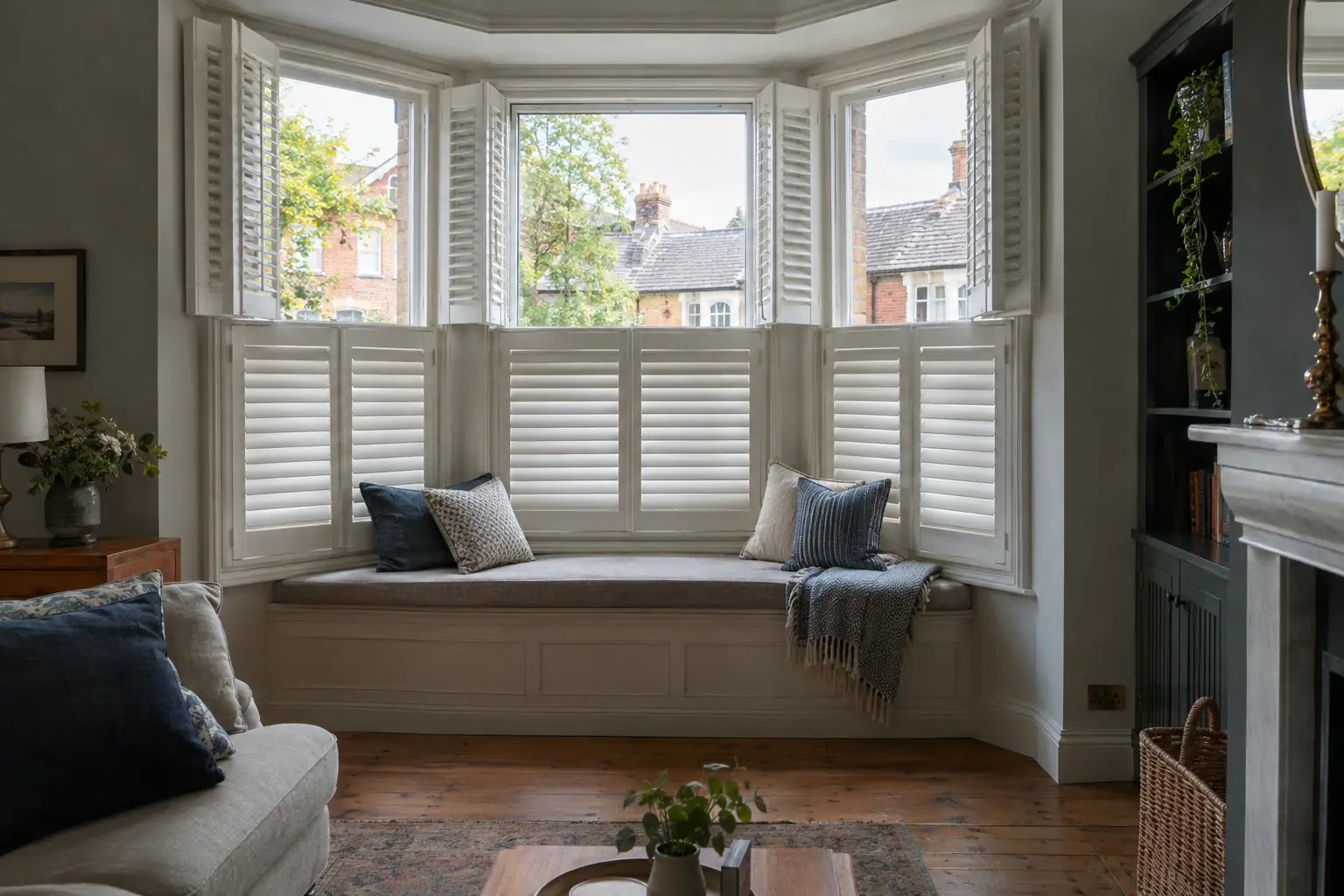
Shutters for bay windows are made as a separate set of panels for each face of the bay, so they follow the angles exactly and open face by face. Tier-on-tier shutters work well on terraces that open onto the pavement: close the bottom half for privacy and fold the top half back for light. Shutters are fixed and built to each opening, so they suit homeowners who want something permanent.
Roman blinds give a softer look and bring fabric, pattern and colour into the room. In a bay, the usual approach is a separate blind for each window, so each one sits neatly in its own section. Curtains on a bay pole are another option, and they can be layered over blinds for extra warmth in winter.
Our guide to bay window ideas compares the options side by side.
Which blinds suit a small bathroom window?
Bathroom windows in Batley's terraces and semis are often small, frosted and right next to the bath or shower, so the blind has to cope with steam and splashes.
A waterproof roller blind is the simplest answer: the fabric is made to resist moisture, it wipes clean and it rolls up out of the way. A faux-wood venetian also copes well with damp, and its slats tilt for privacy while still letting light in. Fabric Roman blinds are best kept out of bathrooms, because steam can mark the fabric and its lining over time.
Where the glass is already frosted, a blind may only be needed in the evening or to cut glare, so a simple roller is often all it takes. Our bathroom blinds guide goes into more detail.
How do you dress shallow UPVC windows on newer homes?
Newer homes, and older homes with replacement windows, often have UPVC casements in shallow, plastered recesses. A standard blind may not fit inside the recess, and many owners would rather not drill into a new window frame.
Perfect-fit blinds solve both problems. Each blind comes in its own slim frame that clips into the beading of the window, so it sits against the glass, moves with the window when you open it, and needs no drilling into the frame. With no loose cords, they are also a sensible choice for children's bedrooms. Our perfect-fit range includes pleated blinds and venetians in wood and metal finishes.
If you are not sure whether a blind should sit inside the recess or over it, our guide to recess or exact fit explains the difference.
How does a home visit work in Batley?
Because our workshop is on Bradford Road in Batley, a home visit here is about as local as it gets. You can read more about our work in the town on our Batley page, or see the other towns we cover across West Yorkshire.
The visit follows the same four steps wherever you live:
1. Book a date. Put your postcode into the booking form to see the days we are in your area. Appointments need at least a day's notice.
2. See the samples in your own light. Your advisor brings the full sample range and holds fabrics and finishes against your own windows, so you see how they look in the room they are going into.
3. Every window measured. The advisor measures each opening on its own, including the depth of the reveal and anything that affects the fit, such as handles, sills and radiators. That matters in older Batley homes, where no two windows are quite the same.
4. A written price on the spot. Before the advisor leaves, you get a written price, itemised per window, covering the product, the fitting and the guarantee. There is nothing to pay on the day and no obligation to order.
If you go ahead, everything is made to those measurements in our Batley workshop and fitted by our own team, usually a few weeks later. Read more about what happens at a home appointment, or visit the Impress Blinds homepage.