The short answer
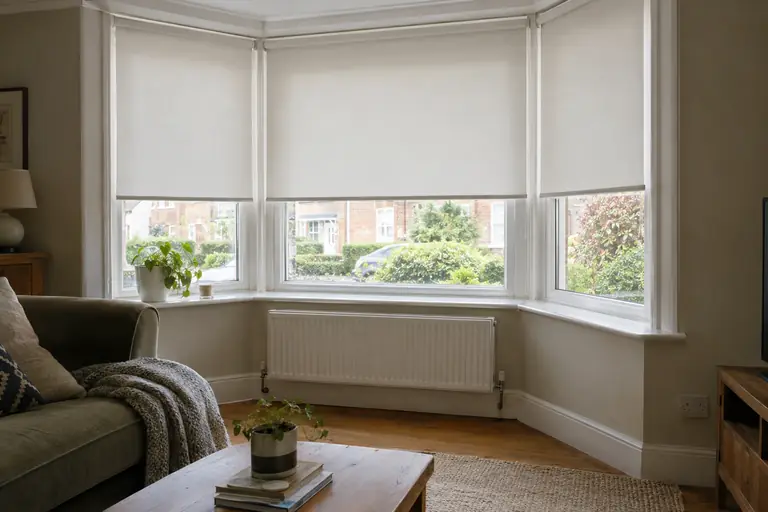
Most bays are dressed pane by pane: a blind for each window, made to its own measurements and set so the whole run lines up. Curtains can run on a track that follows the bay, or hang straight across its mouth. Shutters are templated and built as a set for the whole bay. Many bays combine blinds on the panes with curtains for warmth. Your advisor measures every pane and angle on the day.
- Each pane of a bay is a slightly different size, so blinds are made one per pane and set to line up.
- Curtains can follow the bay on a track or hang straight across its mouth.
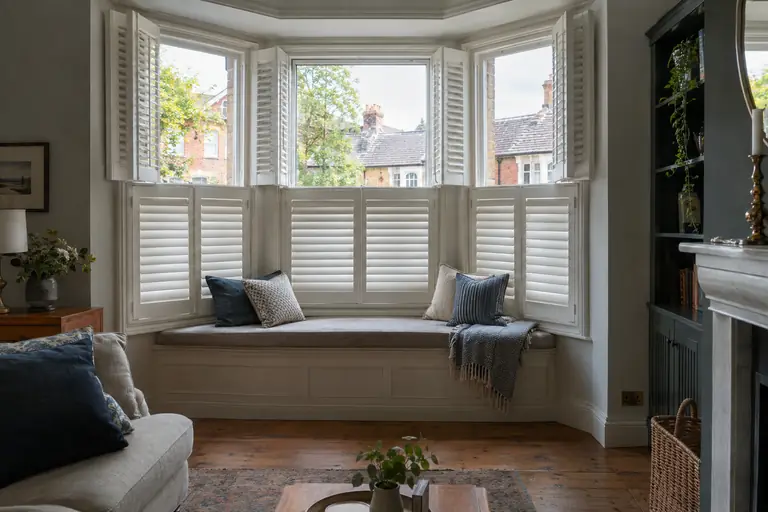
- Shutters for a bay are templated on site and built as a set.
- Bays lose a lot of heat through the glass; lined curtains or shutters help at night.
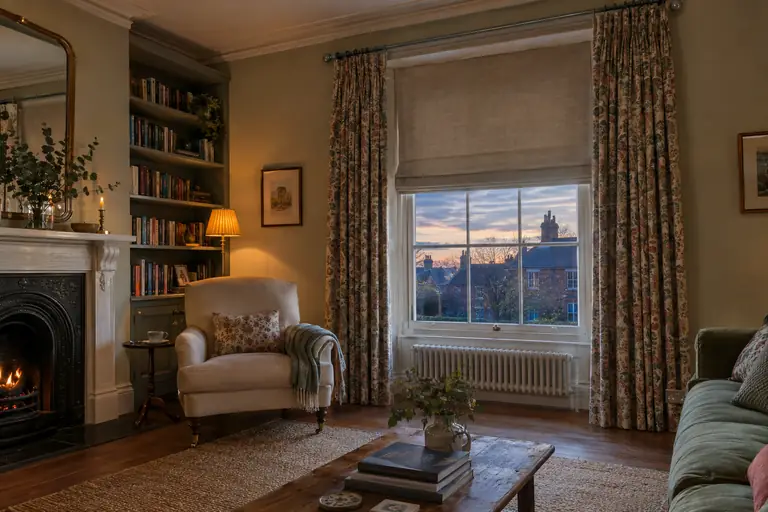
- Blinds on the panes with dress curtains at the ends is a practical pairing.
Bay windows, seen from above
Swipe to see the whole diagram
Each pane of a bay is measured and made on its own, and the blinds are set so they clear each other at the corners.
Why bays are harder than they look
A bay is often the reason someone fell for the house. It catches the sun from three directions, brings the street or the garden into the room and makes space for a window seat, a desk or a reading chair. It is also three or more windows at angles to each other, with glass on three sides and the cold that comes with it.
That asks a lot of one scheme. The centre pane usually faces the street and needs privacy; the side panes catch the morning or evening sun and need glare control; the whole bay needs warmth on a winter night. That is why the answer is usually a combination rather than a single product.
It also means the panes are dealt with one by one. The centre is usually wider than the sides, the returns are seldom square, and the eye notices at once when the blinds in a bay do not line up. Your advisor measures every pane and every angle on site, which is also why a bay cannot sensibly be quoted from a photograph. Our guide to measuring bay windows explains what gets measured and why.
Blinds, pane by pane
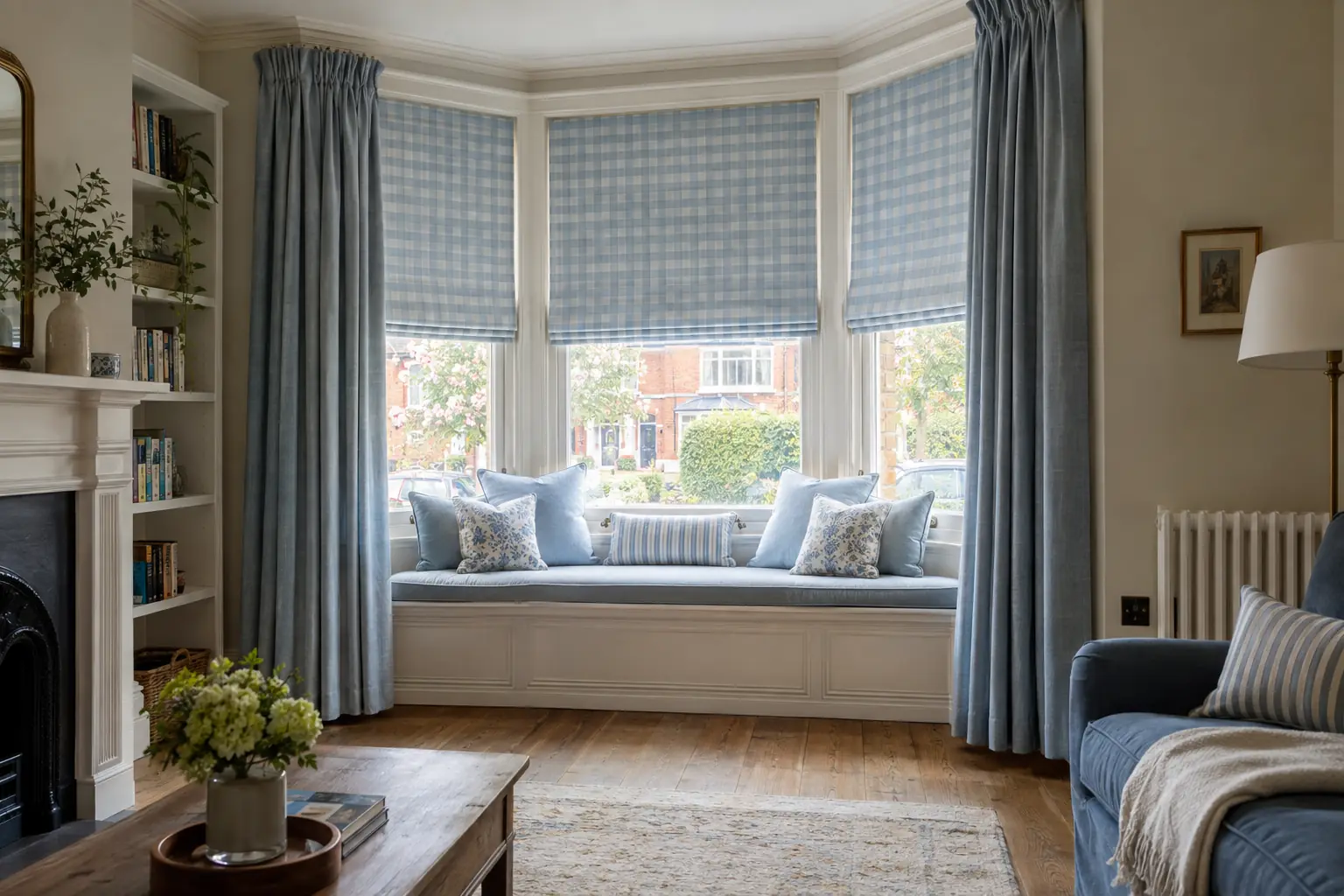
A separate blind on each pane is the most common way to dress a bay, and it gives you the most control. You can lower the blind on the sunny side and leave the others up, or close the side panes for privacy while the centre stays open to the view.
The corners are where a bay shows whether it was planned. Neighbouring blinds have to clear each other as they move, so each corner is worked out when the bay is measured rather than left to chance.
Most types of blind work in a bay. Rollers are neat and compact. Roman blinds bring softness and suit a bay with a window seat, because they stop at the sill and leave the seat clear to sit on. Venetians, in real or faux wood, give fine control of light and suit period bays, with the slats lining up across all the panes when the set is made together. On a uPVC bay, perfect fit blinds that clip into each frame are another option.
Keep to one type and one colour across the bay. A mixture of blinds in a single bay tends to look accidental.
Curtains: round the bay or across it
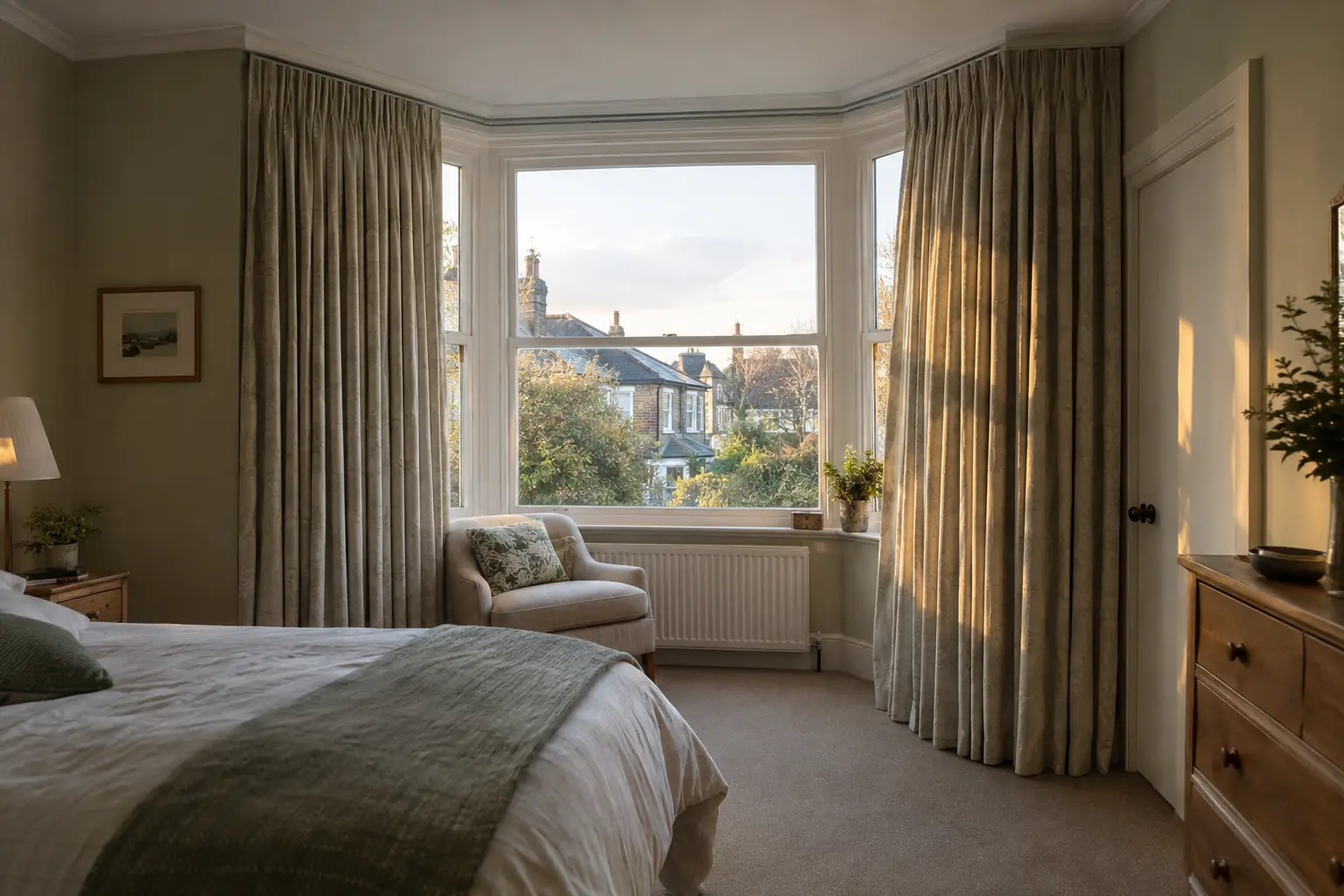
There are two main ways to hang curtains in a bay, and they give quite different rooms.
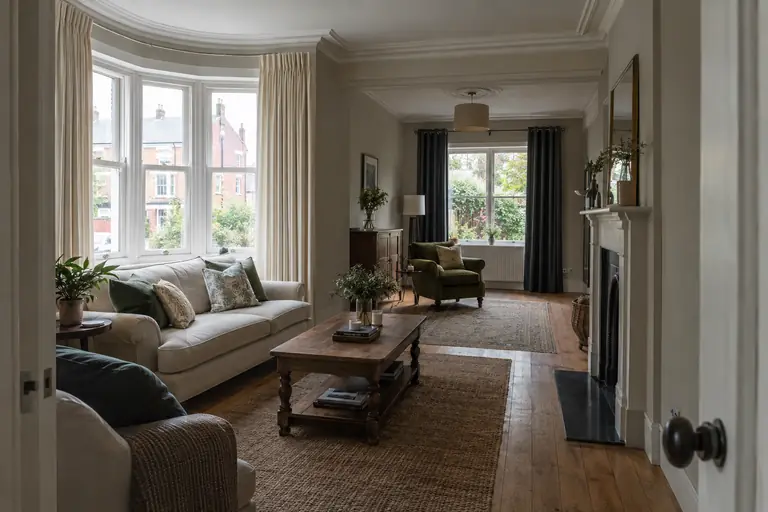
A track that follows the shape of the bay lets the curtains run round the angles and draw close to the glass. The bay stays part of the room when the curtains are drawn, and the curtains stack at each end or on the narrow piers between the panes. Pencil pleat and wave headings both hang from a track. Ask your advisor what your bay can take, because its angles and fixing points decide it.
A pole or track straight across the mouth of the bay, where it meets the room, is simpler. Drawn at night, the curtains close the bay off altogether: the room feels smaller but snugger, and the cold glass is shut away behind a wall of fabric. By day the curtains stack on the wall either side of the bay and the whole window is clear.
Where the curtains will stack is the key question either way. If the piers between the panes are narrow, curtains stacked on them will cover part of the glass even when open. Your advisor will show you where each option leaves the fabric.
Shutters in a bay
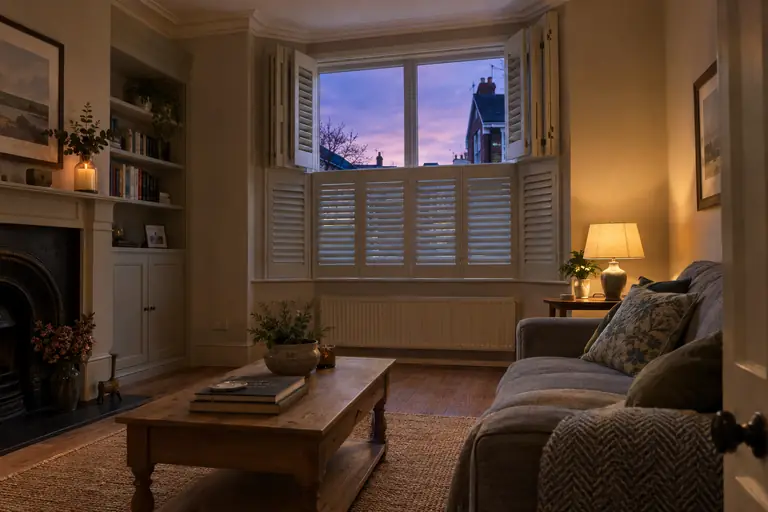
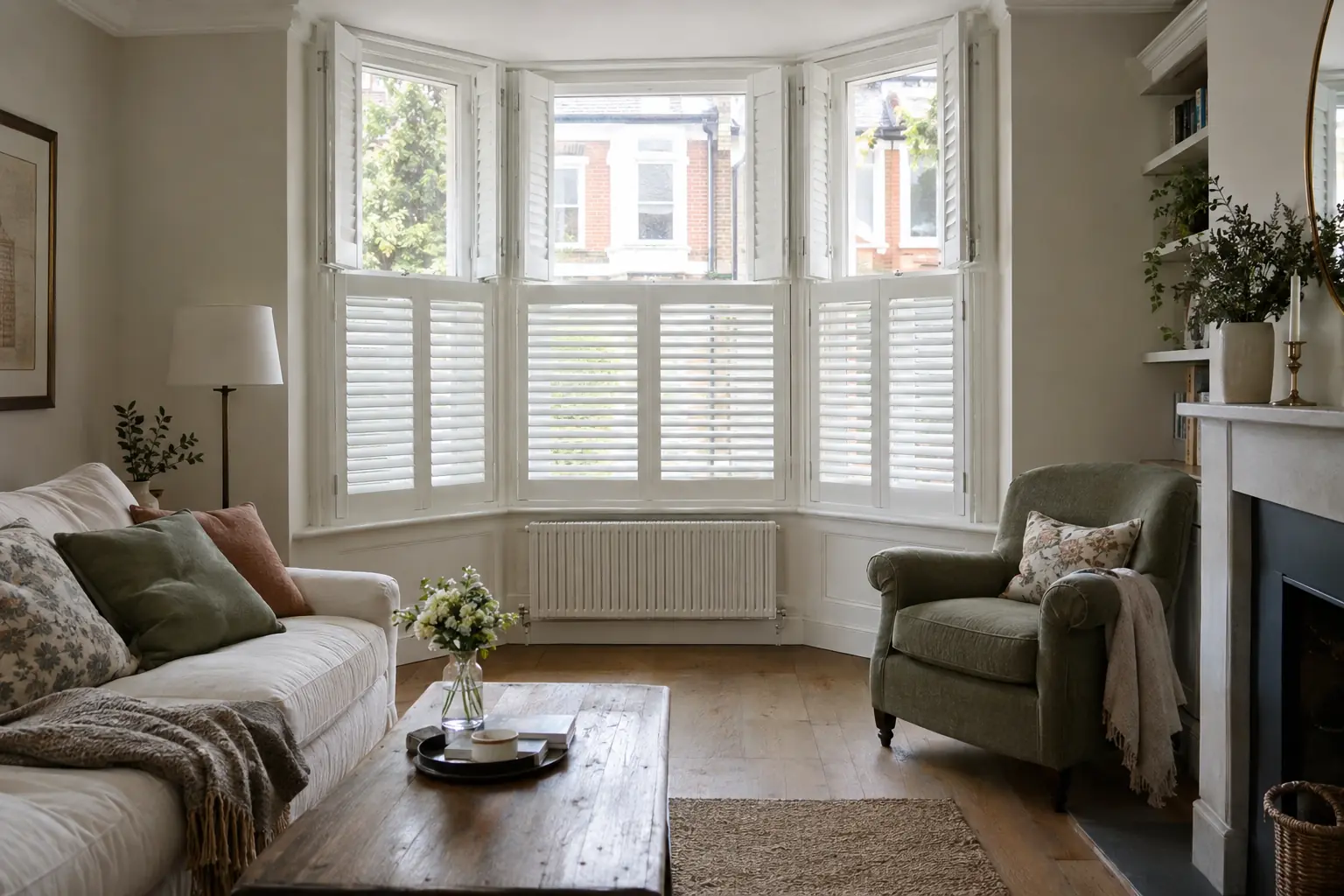
Shutters suit bays particularly well, because they are made for the opening rather than hung in front of it. The frames are templated to each pane and the angles between them, then built as a set so the panels line up and close properly across the whole bay. Get the angles of a splayed bay wrong and the frames simply will not close, which is why the survey matters so much here.
The style depends on the room. Full-height shutters give the cleanest look. Tier-on-tier shutters, with independent top and bottom panels, are the usual choice for a front-room bay on a street: the bottom stays closed for privacy while the top lets in the light. Café-style shutters cover only the lower half. All of them add insulation and need no cords.
Hardwood gives the finest finish and allows wider panels; engineered wood is stable and usually costs less. Our guide to shutters for bay windows covers styles, materials and the survey in more depth.
Keeping a bay warm
A bay has glass on three sides and often stands proud of the main wall, so it can be the coldest part of the room. In a Victorian or Edwardian house the windows may still be the original single-glazed sashes.
Historic England's research into traditional windows found that heat loss can be significantly reduced by using curtains, interior shutters and blinds, and that adding an insulating liner to curtains or fitting cellular blinds helps even more. Cellular blinds are what we call honeycomb blinds: the pleats form pockets that trap air. The research was about traditional windows, and the effect on modern double glazing is likely to be smaller, but the principle holds: covering the glass at night keeps more warmth in the room.
In practice that points to lined curtains, with a thermal lining or interlining, drawn at night, or shutters closed at dusk. Curtains across the mouth of the bay shut the cold glass away entirely. If there is a radiator under the bay, though, curtains across the mouth leave it on the cold side; sill-length curtains on a track round the bay, or blinds on the panes, keep its heat in the room.
Mixing layers in a bay
The most practical bays often use two layers. Blinds on each pane handle privacy and light through the day, and curtains add warmth and softness at night. The blinds sit in each pane's recess; the curtains hang outside on a track or pole.
Dress curtains are a lighter version of the same idea. They hang at each end of the bay and are not drawn at all; they frame the window, soften the angles and bring colour and pattern into the room, while blinds on the panes do the work. It is a common pairing in period rooms: wooden or faux-wood slats on the panes, and lined curtains in a heavier fabric at the ends.
Voiles are the other layer worth considering. In a street-facing bay, voile curtains or voile roman blinds give daytime privacy without darkening the room, with heavier curtains or blinds for the evening. Our guide to layering blinds and curtains goes through the combinations, and curtain headings explained covers which heading suits a track or a pole.
Checklist
- Count the panes and note which ones open, and where their handles sit.
- Decide whether curtains should follow the bay or close across it.
- Look at the width of the piers between panes, where curtains would stack.
- Note a window seat or a radiator under the bay.
- Keep one blind type and colour across every pane.
- Plan for night-time warmth: lined curtains or shutters.