The short answer
Choose a material that does not mind water: faux-wood or PVC venetians, aluminium venetians, or a roller in a wipeable fabric. Keep real wood and fabric roman blinds out, because steam bows timber and puckers linings. For privacy with daylight, tilt venetian slats upwards or use a top down bottom up blind. And make sure the blind still lets you open the window after a shower.
- Faux wood, PVC, aluminium and wipeable roller fabrics cope with steam; real wood and romans do not.
- Condensation forms on the window first, so the blind hangs in the dampest air in the room.
- Tilt venetian slats upwards to keep daylight and lose the view in from outside.
- A bathroom blind must never stop you opening the window after a bath or shower.
- Frosted glass blurs detail by day but can still show silhouettes at night with the light on.
Why a bathroom is hard on a blind
Every bath and shower fills the room with warm, wet air. When that air meets something cold it condenses, and in most bathrooms the coldest thing is the window. Government guidance on damp and mould describes condensation forming on colder surfaces such as window frames, and calls it the most common form of damp. A blind hanging a few centimetres from the glass sits in exactly that air, several times a day.
Materials cope with that in very different ways. Timber takes on moisture and gives it up again, and on a real-wood slat the result, over months, is a gentle bow that does not come back out. Fabric with a separate lining, as on a roman blind, shrinks at two different rates and starts to pucker. And anything absorbent can go mouldy: the same guidance notes that soft furnishings may have to be thrown away if they become mouldy, because the mould can be difficult or impossible to remove completely.
So the first decision in a bathroom is not colour or style. It is choosing something that does not mind being damp.
Materials that cope with steam
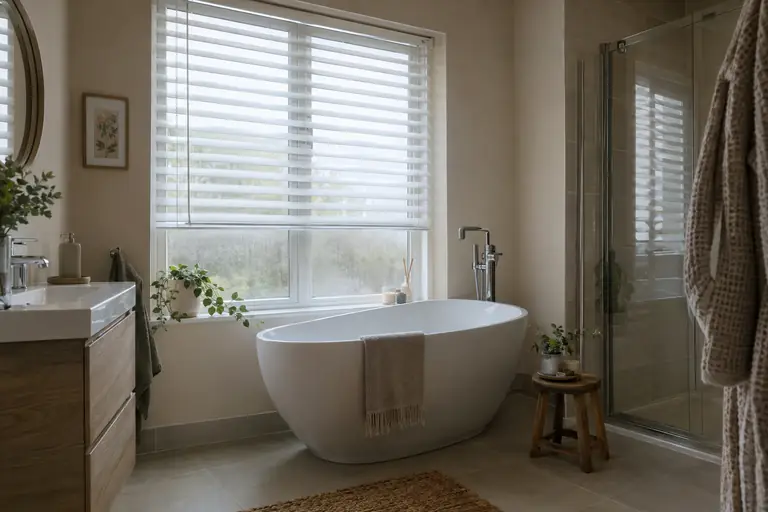
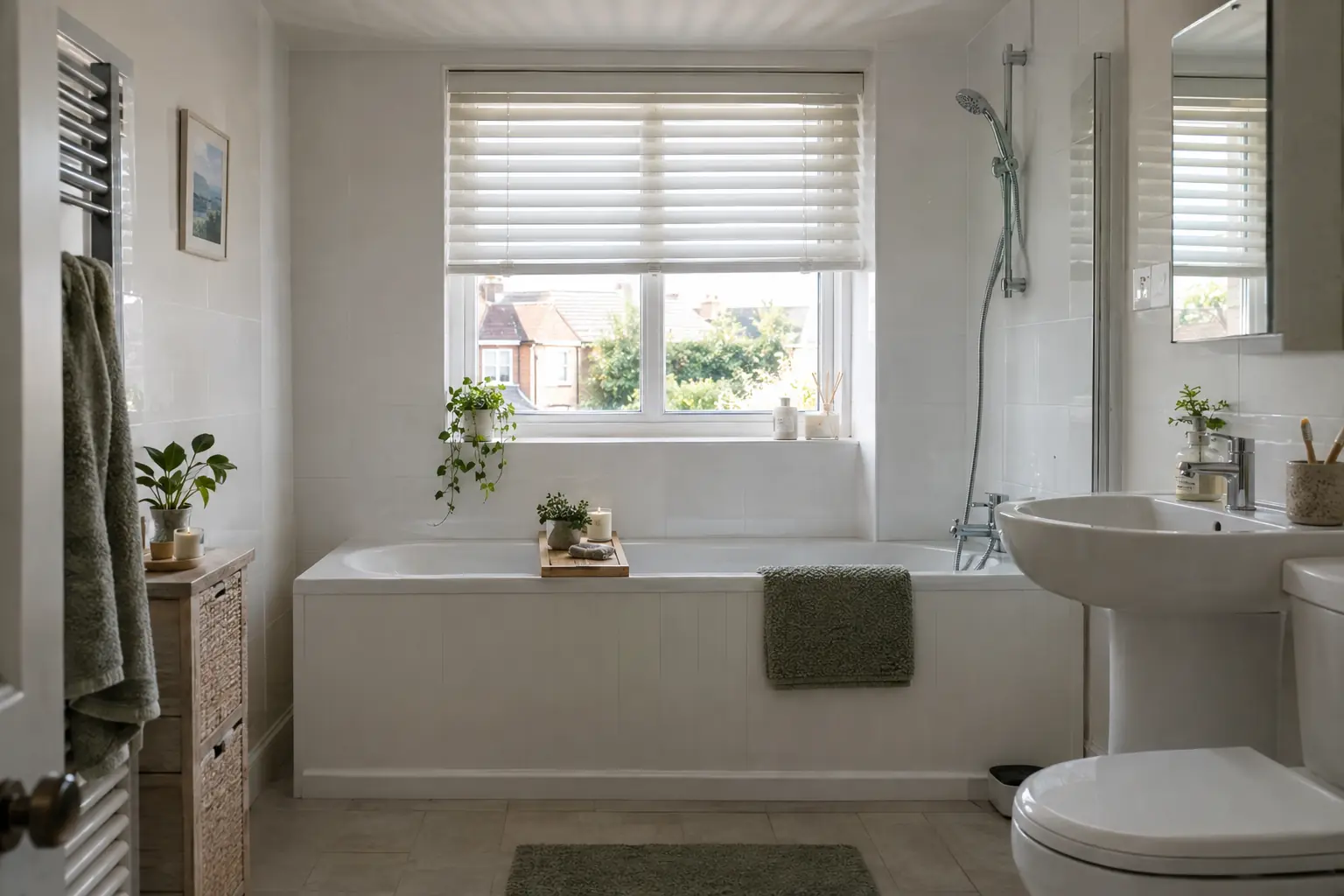
Venetian blinds in faux wood or PVC are the usual answer. Waterproof faux wood is moulded rather than cut from timber, so it takes the steam without swelling, wipes clean with a damp cloth and, once it is up, is hard to tell from real wood at a glance. Aluminium venetians are slimmer and lighter and just as happy in the damp, and suit a modern bathroom or a small window where a chunky slat would feel heavy.
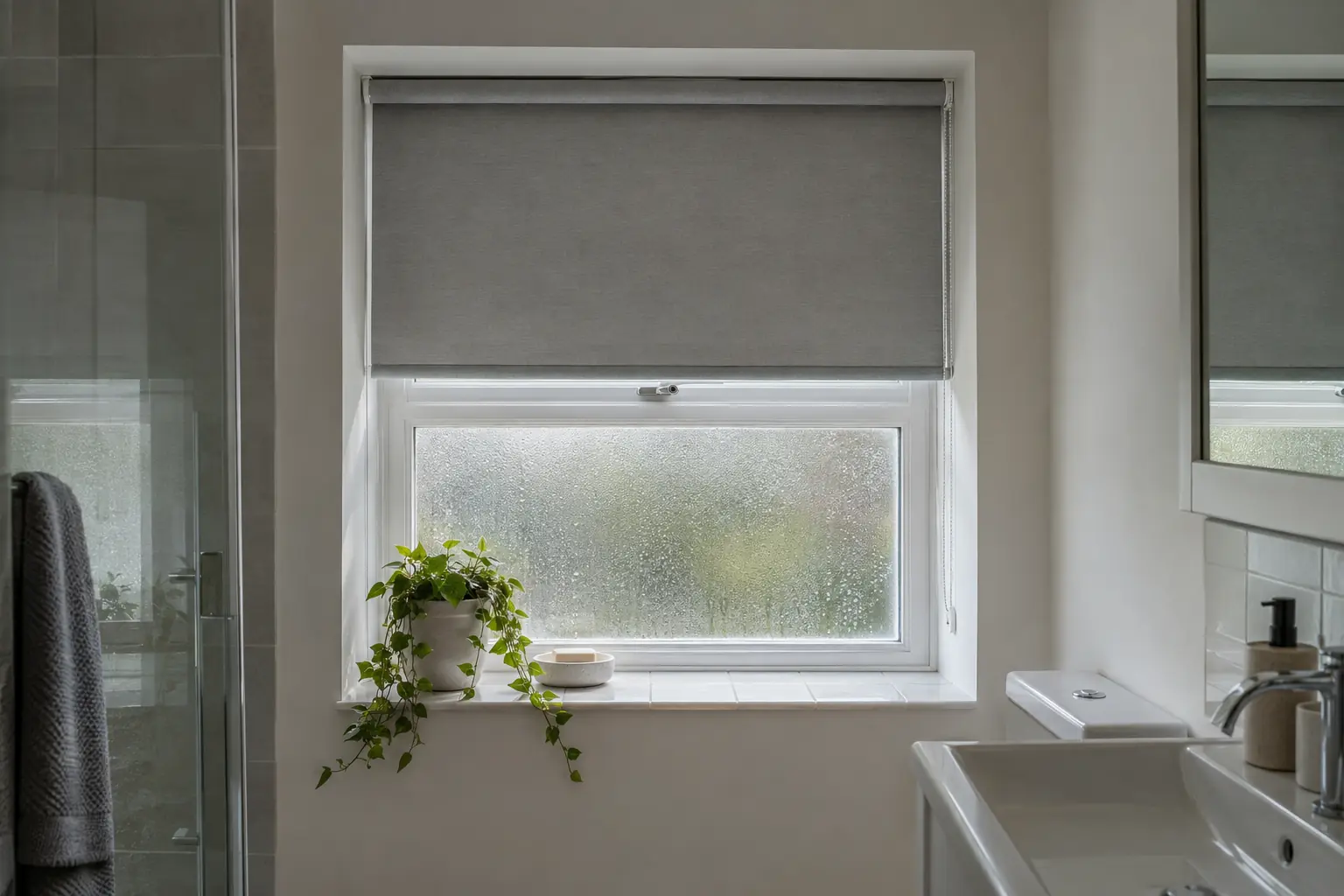
Roller blinds work well too, in a wipeable or PVC-coated fabric. A roller is one flat surface with nothing to trap moisture, and it is the simplest bathroom blind to keep clean. Look for fabrics made to be wiped rather than a soft furnishing weave; your advisor will point you to the right ones in each range.
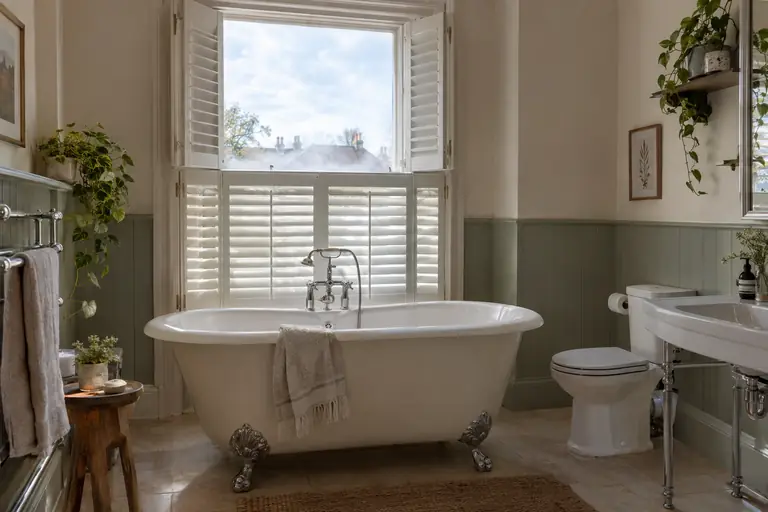
Shutters can go in a bathroom as long as they are made for it. Waterproof ABS or vinyl shutters cope with a wet room in a way a hardwood shutter would not, and they suit a period bathroom where a blind feels too slight. Our guide to shutters in bathrooms and kitchens covers them in more detail.
What to leave out: real-wood blinds, fabric roman blinds and ordinary lined curtains anywhere near the bath or shower.
Privacy that keeps the daylight
Most bathroom windows need cover for a small part of the day and light for the rest, and a blind pulled fully down all day makes a small room gloomy. There are better ways to manage it.
A venetian gives you something a roller cannot. Tilt the slats upwards and daylight is thrown up onto the ceiling, while the view up from the ground outside is angled away towards the ceiling rather than into the room. On an upstairs window overlooked by another upstairs window the geometry changes, so once the blind is up, go outside and see which angle works for yours.
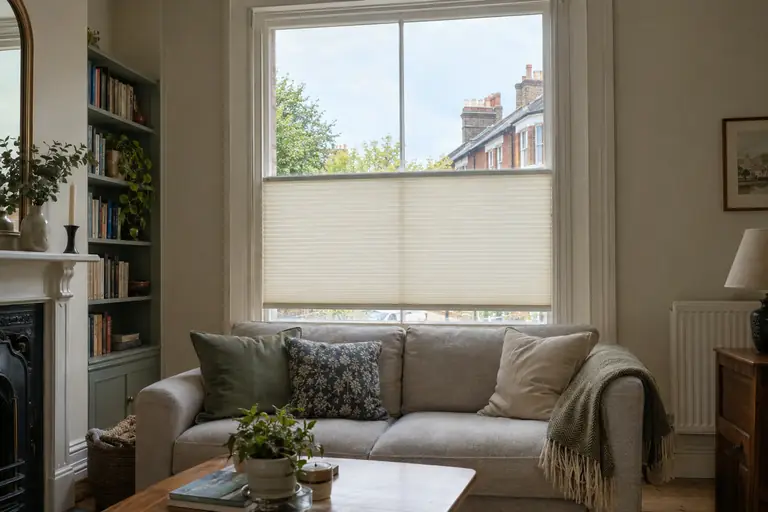
A top down bottom up blind can be lowered from the head of the window as well as raised from the sill, so you can cover the lower part of the window, where the privacy problem is, and leave the top open to the sky. On a bathroom window facing a neighbour's side wall it is often the neatest solution.
Obscured glass helps by day, but do not rely on it at night. With the light on inside and dark outside, frosted or patterned glass can still show shapes and movement to anyone looking in. A blind that closes fully is the evening answer, even on frosted glass.
Let the window open
The single most useful thing a bathroom window can do is open. Government guidance says rooms that produce a lot of moisture, such as kitchens and bathrooms, particularly need adequate ventilation, and the Centre for Sustainable Energy advises opening bathroom windows so the steam from a bath or shower can leave the building. A blind that makes that awkward ends up with the window left shut.
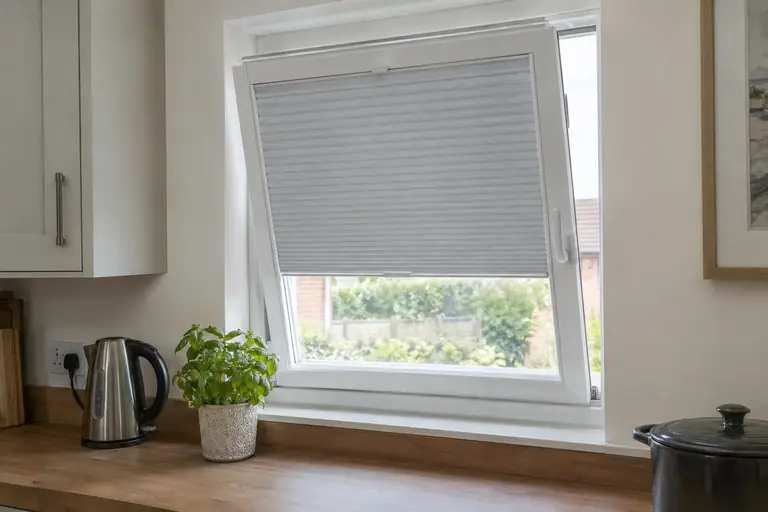
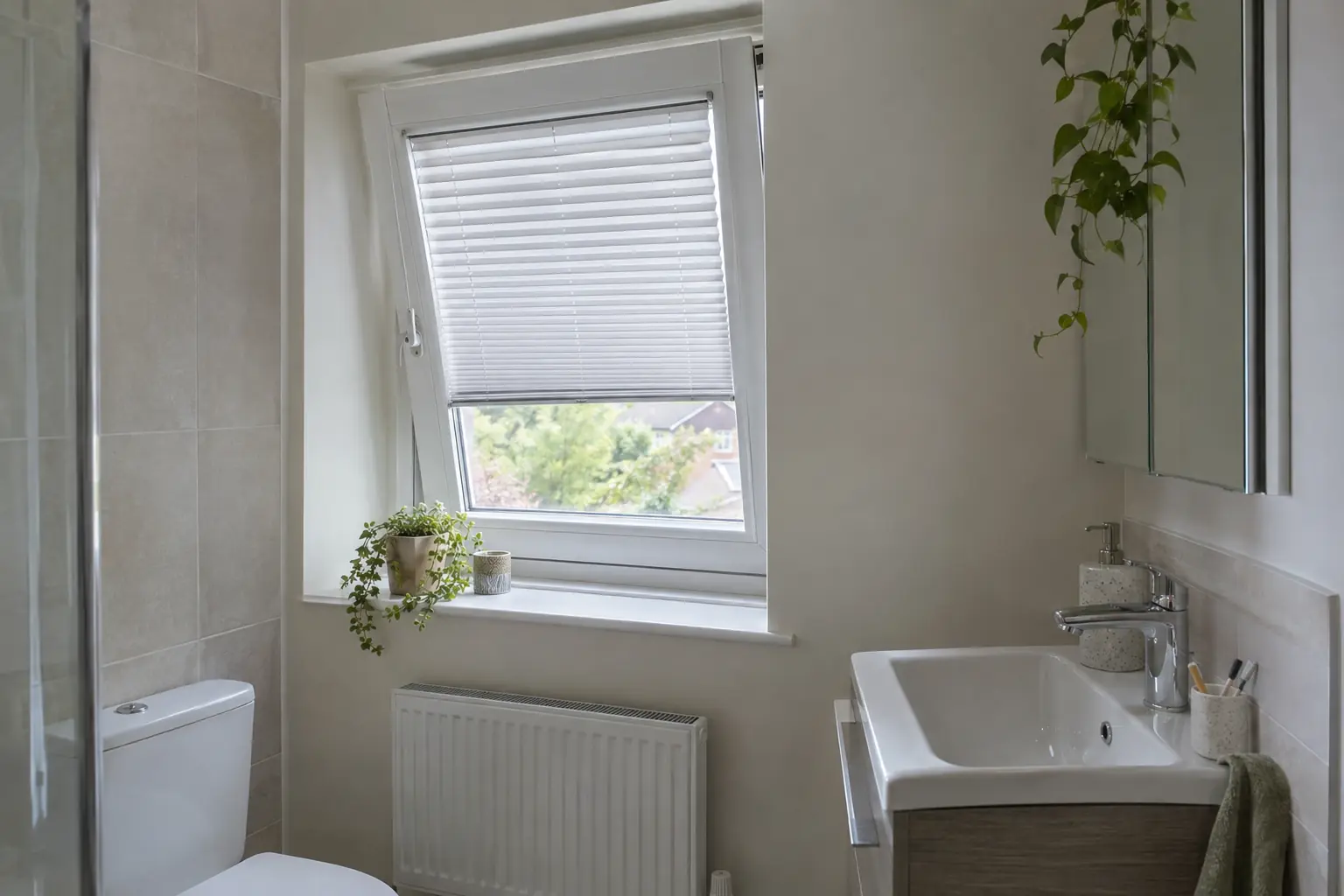
Check three things. First, can you reach the handle with the blind down, or does the whole blind have to go up every time? A venetian tilted open, or a top down bottom up blind lowered from the top, often leaves enough room. Second, does the window open inwards? Tilt-and-turn windows swing into the room, and a blind in the recess can get in the way. A perfect fit blind, which clips into the frame of a uPVC window and moves with the sash, avoids that. Third, does anything stick out into the recess, such as a trickle vent or a stay, that a recess blind has to clear?
Your advisor looks at all of this when measuring, but it helps to open and close the window yourself before the appointment and notice what you do with your hands.
The bath, the basin and the tiles
Where the window sits in the room changes the choice. A window over the bath is often reachable only by leaning across it, which makes a control on the accessible side, a wand or a motor worth considering. A window behind a basin or a toilet has its own reach problem, and the sill is usually where the toiletries live. A recess blind dropping onto a crowded sill will not close properly; a blind fitted outside the recess and finishing below the sill, or one made to stop just above it, may suit better.
Tiled reveals need care. The fixings have to suit the tile and the wall behind it, and drilling in the wrong place can crack a tile that is hard to replace. That is one of the less visible reasons fitting is included in our price: the fixing is part of the job, and the fit is our responsibility rather than yours. Mention tiled reveals or a tiled sill to your advisor so they are measured with that in mind.
Small, high windows in en-suites and cloakrooms are often the easiest of all: a simple roller or venetian in the recess, with a control you can reach standing on the floor.
Motorised blinds in a bathroom
A motor makes sense in a bathroom more often than people expect: a window above the bath, a tall window in a loft en-suite, or a roof window over the shower. Battery motors need no wiring at all and are recharged with a lead every so often, and in a bathroom that is usually the simplest route.
If a motor would need a new mains supply, that is a job for a registered electrician, and in a bathroom it matters more than elsewhere. In England, the Building Regulations treat the space around a bath or shower as a special location, reaching 2.25 metres up from the floor, or higher where the shower head is fixed above that, and 0.6 metres out from the edge of the bath or shower tray. Adding to or altering circuits in a special location is notifiable work. Your electrician will know the rules; for choosing a blind, the useful point is that battery power sidesteps the question.
Motorised blinds work from a remote or an app, can be grouped with other blinds in the house, and the motor carries the same 1-year guarantee as the blind.
Keeping a bathroom blind clean
The best bathroom blind is the one you can clean in two minutes. Wipe faux wood, PVC and aluminium with a damp cloth; on a venetian, tilt the slats shut, wipe the face, then tilt them shut the opposite way and wipe again. Sponge a mark on a roller fabric lightly and never soak it, because the stiffening in the fabric is what keeps it hanging flat.
After a shower, open the window and, if you can, leave the blind down until the room has dried. A roller blind rolled up tight while it is still damp can hold that moisture in the roll. A quick wipe of the sill and the bottom of the blind, where condensation runs down the glass and collects, does more than an occasional deep clean.
Our guide to cleaning and caring for blinds covers every type in more detail.
Checklist
- Choose faux wood, PVC, aluminium or a wipeable roller fabric.
- Keep real wood, romans and lined fabric away from the bath and shower.
- Open and close the window and note how you reach the handle.
- Look at the window from outside at night with the light on.
- Tell your advisor about tiled reveals or a crowded sill.
- If a motor is needed, start with battery power.