
The short answer
Goods made to your specification are exempt from the usual 14-day cooling-off right, so once a made-to-measure order is placed the law gives you no right to cancel just because you have changed your mind. Your other rights are untouched. Under the Consumer Rights Act 2015, what you buy must be of satisfactory quality, match its description, be fit for any purpose you made known, and be installed correctly. Our 1-year guarantee sits alongside those rights.
- Made-to-measure blinds, curtains and shutters carry no statutory cooling-off period, so be sure before you order.
- A free home appointment carries no obligation: take the written quote away and decide in your own time.
- The Consumer Rights Act still applies in full: satisfactory quality, as described, fit for a purpose you made known.
- If the trader fits the goods and fits them incorrectly, the goods do not conform to the contract.
- Our 1-year guarantee on every blind, shutter and motor we supply and fit sits alongside your legal rights.
Why made-to-measure has no cooling-off period
Most people know they can change their mind about something bought online or at the door. Citizens Advice puts it simply: you automatically get a 14-day cooling-off period when you buy something you have not seen in person, unless it is bespoke or made to measure.
That exception comes from the Consumer Contracts Regulations 2013. Regulation 28 says the cancellation rights do not apply to the supply of goods that are made to the consumer's specifications or are clearly personalised. Trading Standards guidance gives made-to-measure curtains as a direct example, alongside a made-to-measure suit.
The reasoning is practical. A blind cut to the width of your bay, or a shutter frame built to a reveal that is out of square, has no second customer. Once the fabric is cut, it cannot go back on the shelf.
The same guidance adds a limit: the exemption does not cover things made to a specification simply by combining stock items, such as a computer put together from stocked parts. Made-to-measure curtains are the guidance's own example of goods the exemption does cover.
The upshot is simple. Take whatever time you need before you order, because after that, changing your mind is not a legal right.
The home visit, the quote and when you commit
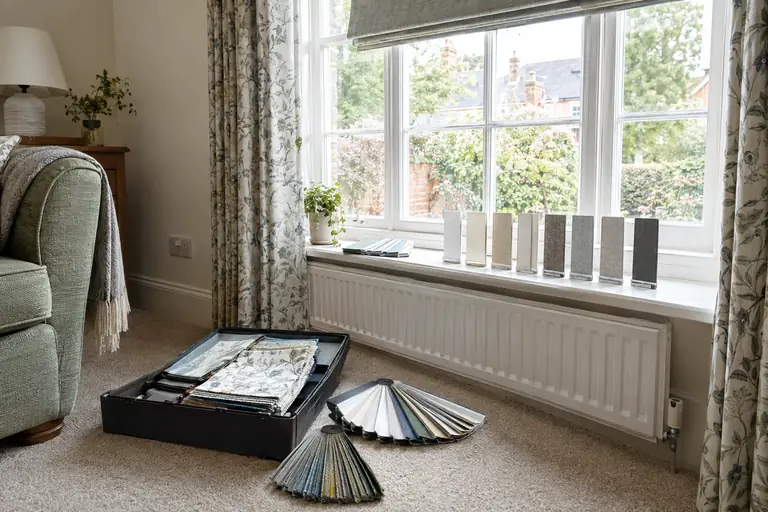
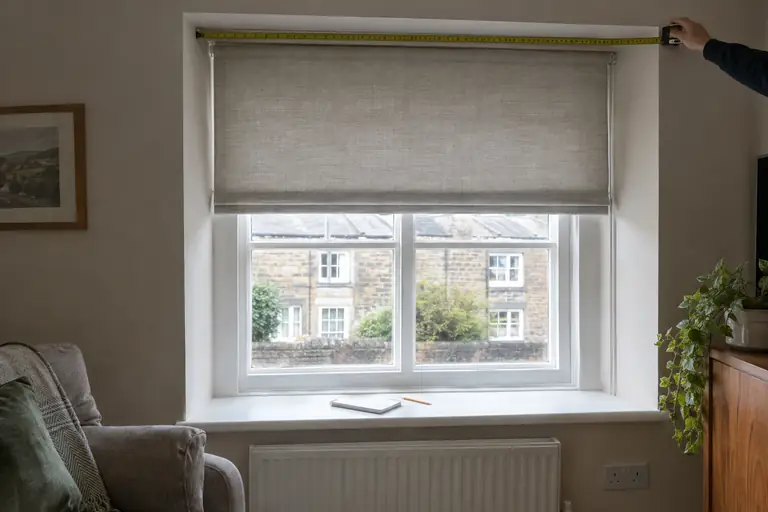
Our appointment is free and carries no obligation. An advisor comes to you with the full sample range, holds fabrics against your own windows, measures every opening and leaves a written price, itemised per window, covering the product, the fitting and the guarantee. There is nothing to pay on the day, and you can take the quote away and think about it.
That matters legally as well as practically. Trading Standards guidance explains that when a trader visits your home, leaves a quotation and lets you decide and enter into a contract when you are ready, the sale is treated as an on-premises contract, which does not carry statutory cancellation rights. If you agree the contract there and then during the visit, it is an off-premises contract instead. Either way, made-to-measure goods carry no statutory right to cancel.
So the moment to be sure is before you say yes, not after. Read the quote window by window. Check the product, the fabric or finish, the fit and the operation for each one. Ask about anything you do not understand, including how payment works. If you want to see a fabric in daylight again, order free samples and look at them on the actual window. There is no pressure to decide on the day, and a good decision is worth a few days.
The rights you keep under the Consumer Rights Act
The lack of a cooling-off period is about changing your mind. It does not touch your rights if something is wrong, and those come from the Consumer Rights Act 2015.
Three terms are treated as part of every contract to supply goods. The goods must be of satisfactory quality. Goods supplied by description must match the description, so what the quote describes is what you should get. And if you told the trader before the contract about a particular purpose, the goods must be reasonably fit for that purpose, even if it is not what goods of that kind are usually for.
Two more matter for anything that is fitted. If installation is part of the contract and the trader installs the goods incorrectly, the goods do not conform to the contract. And any service, including the fitting itself, must be performed with reasonable care and skill.
For made-to-measure goods, the practical effect is that responsibility sits where the work was done. Our advisor measures every opening for your order, so the fit is our responsibility rather than yours, and our own fitters install what our workshop has made.
This guide summarises the law as the official sources state it. It is not legal advice, and Citizens Advice can help with a specific problem.
Tell us what each blind is for
The fitness-for-purpose rule has a condition that is easy to miss: it applies to a particular purpose that you made known to the trader before the contract. That makes the conversation at the appointment worth more than it might seem.
Say what each window needs to do, in plain terms. A nursery blind that has to get the room dark for daytime naps. A bathroom blind that will be in steam every morning. A blind over a sink that has to clear the tap. Shutters on a window you need to open for air. Curtains for a cold north-facing bedroom that has to hold in heat.
Your advisor uses exactly that information to recommend the product, the fabric and the fit, and it is worth checking, before you order, that anything important to you is reflected in the written quote, or asking for a note of it.
Be honest about the limits too. Some things a blind cannot do however it is made: it cannot seal a draughty frame, and a blind inside a recess will let a little light in at the sides. Your advisor will say so on the day. A clear conversation before the order is the best protection both of us have.

If something is wrong after fitting
Check every blind, curtain and shutter as soon as the fitter has finished. The fitter checks the operation with you before leaving, and that is the best moment to raise anything: a blind that runs unevenly, a louvre that will not close, a colour that is not the one on the quote.
If you find a fault later, ring the office. Our 1-year guarantee covers every blind, shutter and motor we supply and fit, and since the same company made, measured and fitted it, you deal with one business rather than a chain of suppliers.
The law has a clock of its own for goods that do not conform to the contract. The Consumer Rights Act gives a short-term right to reject, and for goods the trader installs, its 30 days begin only on the day after all of these have happened: ownership has passed to you, the goods have been delivered, and the trader has told you the installation is done. That right is for goods that are faulty or not as described, not for a change of mind.
Our guarantee does not replace any of this. The Consumer Rights Act terms are part of every contract to supply goods, so they apply alongside the guarantee rather than being swapped for it.
Deposits, card payments and finance
Nothing is paid at the appointment. If you go ahead, ask how payment works for your order, and make sure the paperwork says what you are paying, what it covers and when anything else falls due. Keep the quote, the order confirmation and every receipt together.
How you pay can add a layer of protection. Citizens Advice explains that if you pay any part of the cost by credit card, you can use Section 75 to claim from the card provider, as long as the total cost of the item is more than £100 and no more than £30,000. That can apply even when only part of the cost, such as a deposit, went on the card. Section 75 is specific to credit cards, so ask your card provider if you plan to pay another way.
Finance options are available on larger orders, and your advisor will talk you through what is available for your job. Read any finance agreement as carefully as the quote itself.
Finally, the price promise: same product, same service, and we will match the price. When you compare quotes, check that each one covers the same things, including the measuring, the fitting and a guarantee.
Checklist
- Read the written quote window by window before you agree to anything.
- Tell the advisor what each blind, curtain or shutter needs to do, and check the quote reflects it.
- Take the quote away and decide in your own time; there is no obligation on the day.
- Keep the quote, order confirmation and receipts together.
- Try every blind with the fitter before they leave, and report a problem straight away.
- If you pay part of the cost by credit card, keep the statement with your paperwork.