The short answer
Most blind faults come down to one worn or broken part, and parts such as chains, brackets, wands, motors and vertical slats can usually be replaced without remaking the blind. If we supplied it, ring the office with the reference on your paperwork and we will identify the part from the original order. Inside the 1-year guarantee, we come back out. When the fabric has faded unevenly or several parts have failed at once, a new blind is often the better answer.
- Chains, brackets, wands, motors and vertical slats can usually be replaced without remaking the blind.
- If we supplied the blind, the reference on your paperwork lets us identify the part from the original order.
- Replacement vertical slats are listed under the fabric they belong to, so a new louvre matches its neighbours.
- Measure a vertical slat across its face and from hook hole to the bottom of the weight pocket.
- Once the fabric has faded unevenly or several parts have gone, a new blind usually makes more sense.
What usually goes, type by type
Blinds rarely fail all at once. They wear at the points that move or take the load, and each type has its usual suspects.
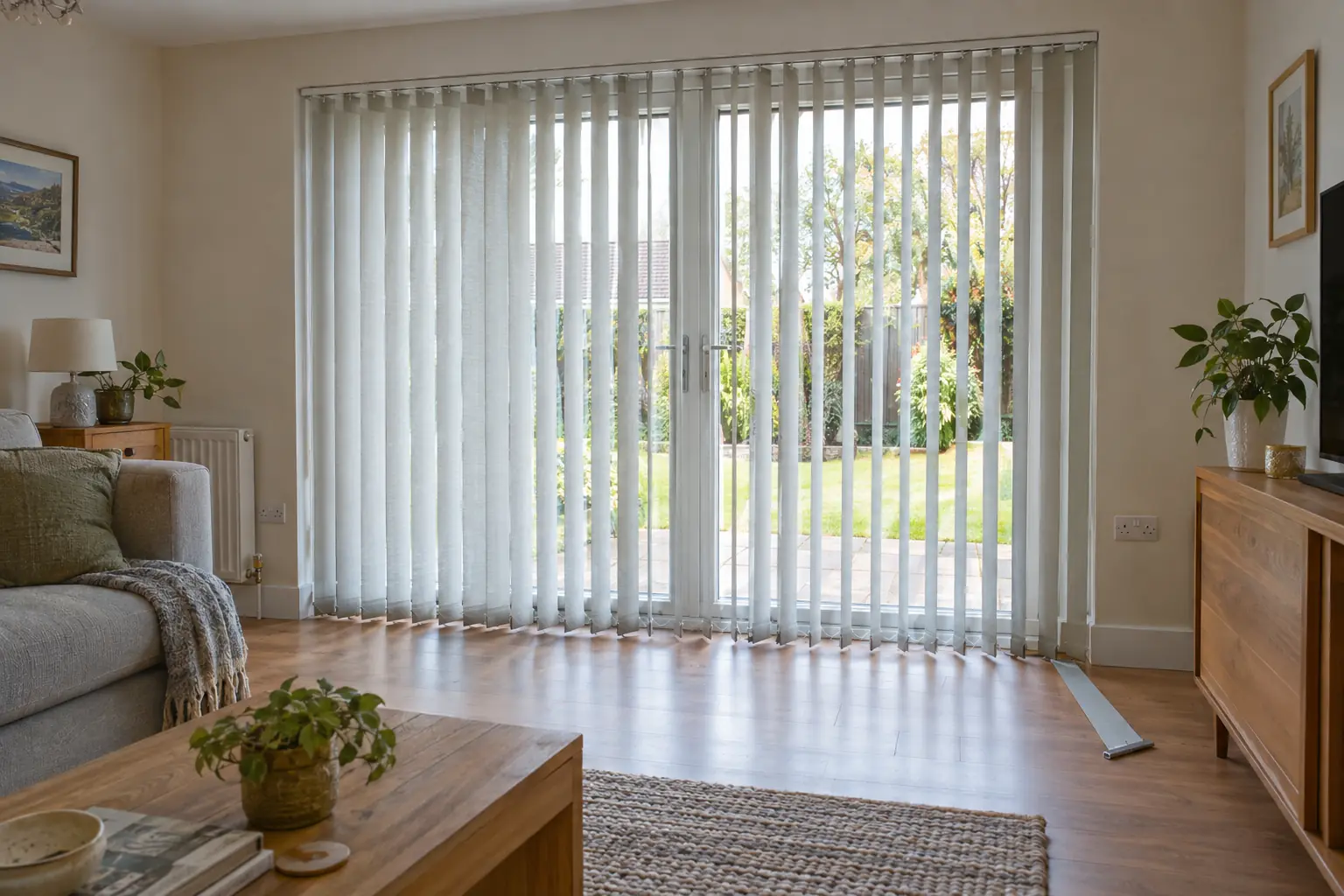
On a vertical blind, it is nearly always a louvre: split, creased, curled at the edge or stained beyond cleaning. The hanger clips that hold each louvre in the headrail can snap, the bottom weights can drop out of their pockets, and the chain linking the weights together can break.
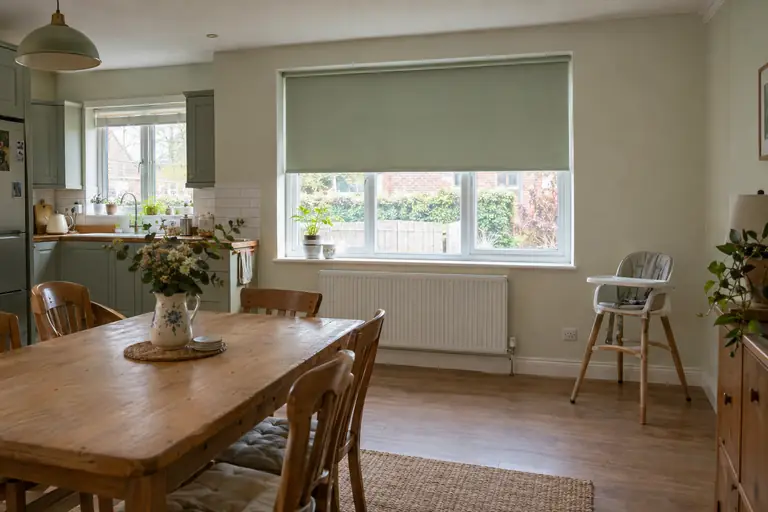
On a roller blind, the chain, the brackets and the side winder wear out before the fabric does. A chain that slips, a blind that will not stay where you leave it, or a roll that has dropped out of a cracked bracket is usually a part rather than a new blind.
On a venetian, the tilt rod, the wand and the ladder cord are the usual failures, and the slats themselves rarely need touching. Wooden blinds are similar, except that timber slats and tapes age differently to the mechanism.
On a perfect fit blind, the frame clips into the gasket of a uPVC window, and a cracked clip is a small fix rather than a reason to take the whole frame down.
Motorised blinds add a motor, a battery and a handset. Those can be replaced too, and are covered below.
If we supplied the blind
Because we make, measure and fit, there is no manufacturer to chase. The job stays with us, and so does the record of what was made.
Ring the office with the reference on your paperwork. From the original order we can identify the part, which takes the guesswork out of ordering one. Say which room and which window, and describe what the blind is doing, or not doing, as precisely as you can: it slips, it will not tilt, it has dropped at one end, one louvre has come off.
If the blind is inside its 1-year guarantee, the guarantee covers every blind, shutter and motor we supply and fit. Ring the office and we come back out to put it right.
Outside the guarantee, parts such as chains, brackets, wands and motors can usually be replaced without remaking the blind. The office will tell you what the part is. Some parts, like a replacement louvre, simply clip into place; for others, such as a bracket or a motor, ask the office how it is best fitted.
If you cannot find your paperwork, ring anyway and tell us when and where the blinds were fitted; it helps us trace the order.
Replacement vertical slats
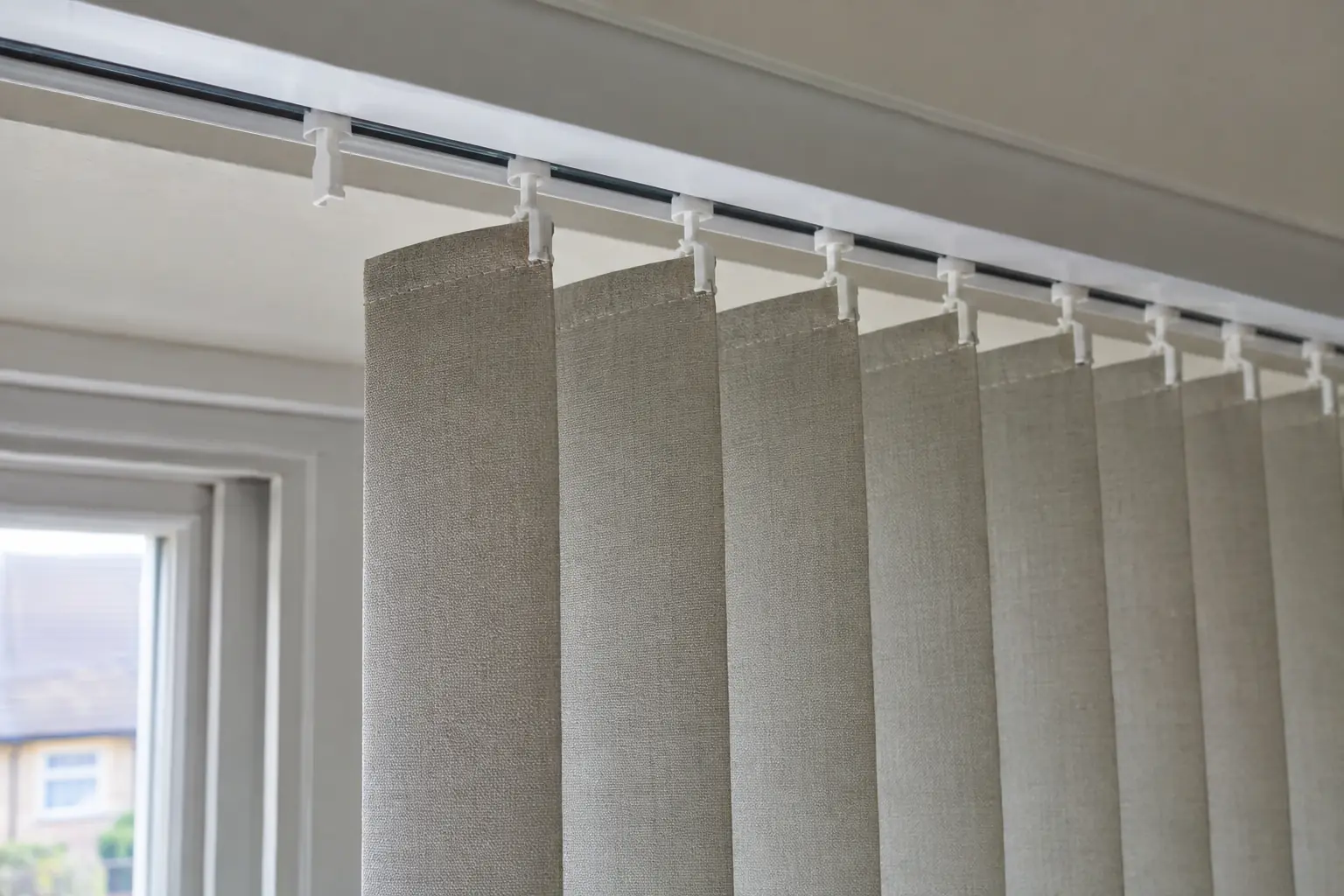
Vertical blinds are the most repairable blinds there are, because every louvre is a separate piece. One damaged louvre does not mean a new blind; it means one new louvre.
Replacement slats are listed under the fabric they belong to, so a new louvre matches the ones either side of it rather than standing out as the obvious repair. To order the right one, you need two measurements and the fabric.
Width first. Take an existing louvre off the headrail and measure straight across its face. Vertical louvres come in more than one width, and this is the measurement people most often get wrong, usually because a curled edge makes the louvre look narrower than it is. Flatten it and measure again.
Then the drop. Measure from the hook hole at the top to the bottom of the louvre, including the pocket that holds the weight. Replacement louvres are cut to that length, and a louvre ordered short cannot be rescued afterwards.
Finally, the fabric. If the blind came from us, the range name is on your paperwork. One caution: fabric fades in the sun, so a brand-new louvre in a set that has hung for years may look a shade brighter at first. Hanging it at the stacking end, where it is least noticed, helps. Where a fabric has been discontinued, we will say so rather than send a near-match.
Identifying a part on a blind we did not supply
Parts for blinds that did not come from us are more of a puzzle, but often a solvable one. The questions are the same: what type of blind, what mechanism, what fabric, what size.
Start with a photograph. Take it in daylight, against a white surface if you can, with the part and the blind both in shot. That is usually enough for us to place the weave, the colour and the mechanism. Take a second, closer photograph of the broken part itself, and of any markings on the headrail or the brackets.
Then measure. For a vertical blind, measure a louvre across its face and from hook hole to the bottom of the weight pocket, as above. For a roller, measure the width of the fabric and the length of the chain loop. For a bracket, note whether it fixes to the top of the recess or the face of the wall.
If the problem is bigger than a single part, such as a bowed headrail or a mechanism that has gone altogether, bring it up at a home appointment. An advisor can look at the blind on the window, and it is often better value to replace one blind than to keep feeding parts into it. If a part will fix it, we would rather sell you the part.

Motors, batteries and handsets
Before you report a motorised blind as broken, check the simple things. Most motorised blinds run on a rechargeable battery motor in the headrail, charged with a lead every few months. A blind that has slowed down, stopped part way or stopped answering the handset is very often a flat battery. Charge it fully and try again.
Next, the handset. If it has its own battery, try a fresh one. Some small handsets use button or coin batteries, and the Child Accident Prevention Trust advises storing button batteries up high and out of children's reach, which applies as much to spares in a kitchen drawer as to the one in the handset.
If the blind still will not move, or moves on its own, makes an unusual noise or stops at the wrong point, ring the office with your reference. A motor carries the same 1-year guarantee as the blind, and because we supply and fit it there is no manufacturer to chase. Motors, like other parts, can usually be replaced without remaking the blind.
If a mains-powered blind stops, check the supply first: a switch turned off or a blown fuse is quicker to rule out than a motor fault. Any work on the wiring itself is a job for a registered electrician.
Repair or replace?
A single broken slat, chain or bracket is worth repairing every time. The rest of the blind is sound, the part is small, and a working blind stays on the window.
The balance shifts when several things go at once, or when the fabric itself is the problem. Fabric that has faded unevenly, stretched, rippled or gone brittle cannot be put right with parts, and a bowed headrail usually means the whole mechanism is tired. At that point a new made-to-measure blind often costs less than the parts and the time, and it comes with a new 1-year guarantee. Send a photograph and we will say plainly which it is.
Safety is the other reason to replace. RoSPA's position on corded blinds from before 2014 is that many may lack safety features altogether, and that where adding safety devices will not make one safe, the blind should go. If an older corded blind in a child's room is failing anyway, that is the moment to look at a cordless or motorised replacement rather than repairing it.
Whichever you choose, when a part goes back on, the safety device goes back too. A chain tensioner must be refitted to the wall or frame, and a cleat belongs at least 1.5 metres from the floor, with the cord wound round it in a figure of eight.
Checklist
- Find your paperwork and the order reference before you ring the office.
- Note the room, the window and exactly what the blind is doing, or not doing.
- For a vertical slat, measure a louvre across its face and from hook hole to the bottom of the weight pocket.
- Photograph the blind and the broken part in daylight against a white surface.
- Charge a battery motor and try a fresh handset battery before reporting a motor fault.
- Refit any child-safety device exactly where it was once the part is replaced.