The short answer
Use a steel tape and work in millimetres. For a recess fit, measure the width at the top, middle and bottom of the opening and the drop at the left, centre and right, and keep the smallest of each. For an exact fit, measure the area you want the blind to cover, overlap included. Then note the depth of the reveal and anything that sticks out into it. For an order, our advisor measures every window again.
- Measure in millimetres with a steel tape. A fabric tape stretches and centimetres invite rounding.
- For a recess fit, take three widths and three drops and use the smallest of each.
- Measure the depth of the reveal and everything that projects into it: handles, locks, vents and tiles.
- Write down the opening exactly as it is. Never take anything off for clearance yourself.
- For an order, your advisor measures every window, so the fit is our responsibility rather than yours.
Measuring for a blind
Swipe to see the whole diagram
Measure the width in three places and the drop in three places, in millimetres. For a recess fit, the smallest of each is what counts.
Step by step
- 1
Get the right tape
Use a steel tape measure and work in millimetres throughout. A fabric tape stretches, and centimetres encourage rounding to the nearest tidy number.
- 2
Sketch and number every window
Draw a rough box for each window, number them round the room and write every measurement on the sketch where you took it, width first and drop second.
- 3
Measure the width three times
For a recess fit, measure between the side walls of the opening at the top, middle and bottom. Keep all three figures and circle the smallest.
- 4
Measure the drop three times
Measure from the top of the recess to the sill at the left, centre and right. The smallest figure is the one that counts for a recess fit.
- 5
Measure the depth of the reveal
Measure from the window frame to the front edge of the reveal at the top and at each side. This tells you whether a blind can sit inside the opening.
- 6
Record anything that projects
Note handles, locks, trickle vents, stays, tiled sills, window boards, radiators and sockets, with how far each one sticks out into the room or the recess.
- 7
For an exact fit, decide the coverage
Choose how far past each side of the opening the blind should reach and where the top should sit, then measure that area rather than the opening alone.
- 8
Note how you will use it
Write down which side you want the controls on, anything standing near the window, and whether the room needs to be dark. Then book the advisor to measure for the order.
Why measure if the advisor does it anyway
Because it is the quickest way to understand your own windows. Ten minutes with a tape tells you which openings are generous and which are tight, whether the reveals are deep enough for a blind to sit inside them, and which windows have a handle or a vent that will decide the fit for you. You arrive at the appointment knowing what to ask, and you can use our online measuring tool to get a rough idea of sizes before anyone visits.
What your numbers are not is an order. When you book, the advisor measures every opening themselves, on its own, and those are the measurements the blind is made to. That matters for more than convenience. If a blind is made to your measurements and does not fit, the problem is yours. Because we take the measurements, the fit is our responsibility.
So measure to learn, and measure carefully, but do not worry about getting the last millimetre right. That part is our job.
Kit, units and the habit that saves you
You need a steel tape measure, a pencil, some paper and, for anything tall, a step ladder. A fabric or sewing tape stretches and sags across a wide window, so leave it in the drawer. For a wide opening, a second pair of hands at the far end of the tape stops it bowing in the middle.
Work in millimetres. A figure like 1,214 leaves no room for doubt, whereas 121 and a bit centimetres, or four foot, invites rounding, and rounding is how a blind ends up catching on one side.
The habit that saves you is to sketch every window before you measure it. Number the windows round the room, draw a rough box for each, and write each figure where it was taken. Always record the width first and the drop second, and label them. Swapping the two is the most common mistake there is, and a sketch makes it obvious.
Measure every window, even the ones that look identical. Two windows on the same wall of an older house are often a few millimetres apart, and a few millimetres is the difference between a blind that runs sweetly and one that rubs.
Measuring inside the recess
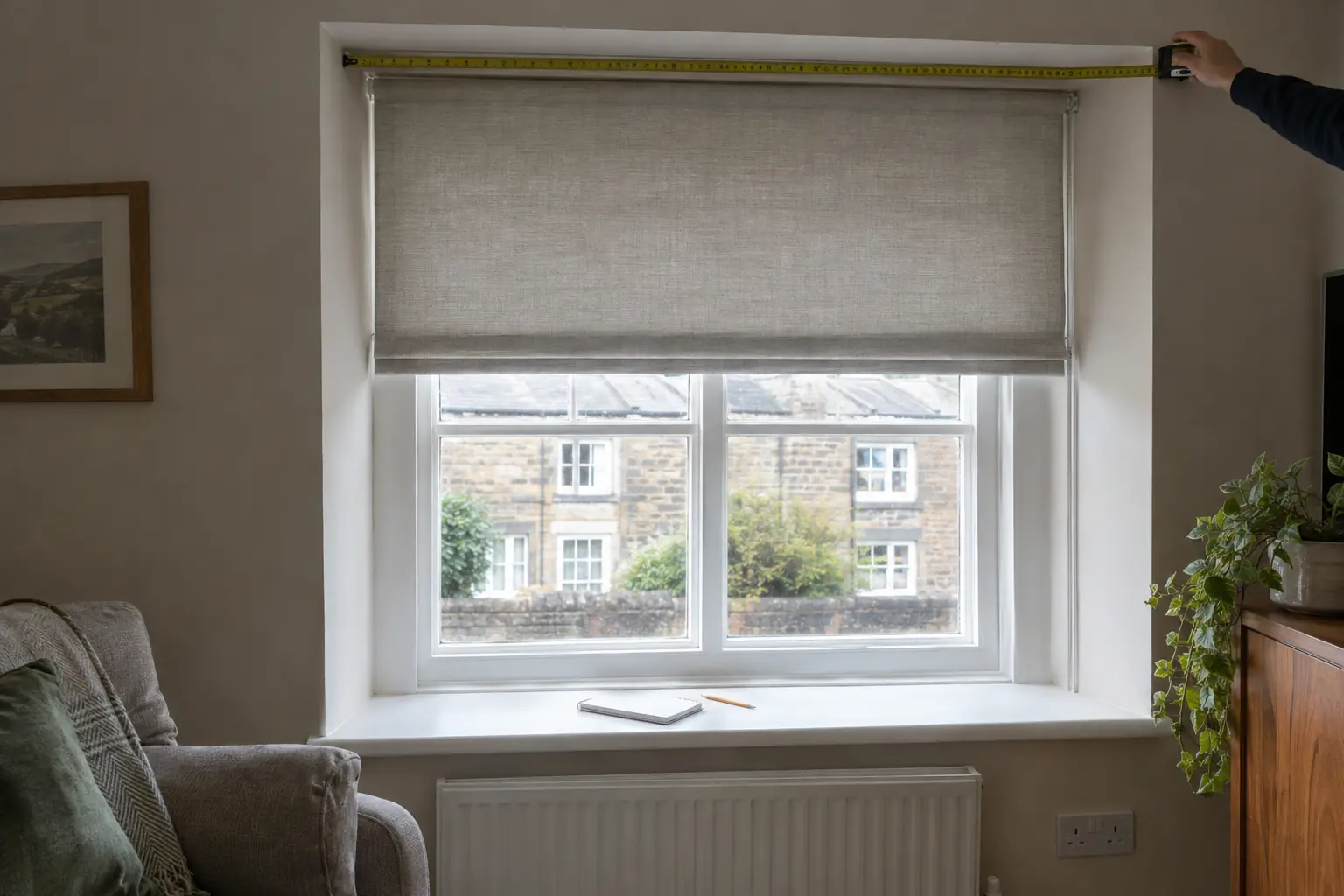
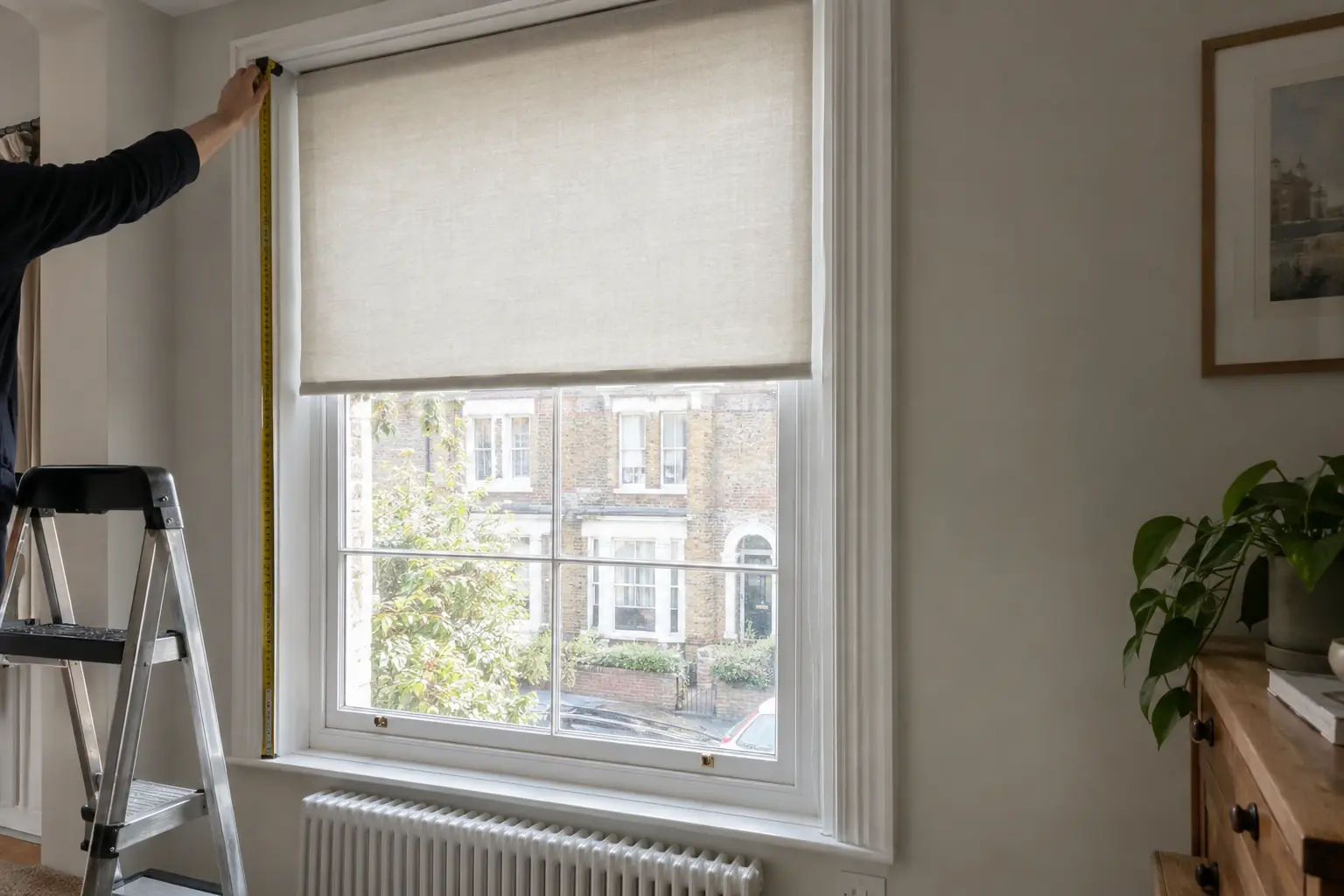
For a recess fit, the blind hangs between the side walls of the opening, so those walls are what you measure between, not the window frame. Measure the width across the top of the recess, across the middle and across the bottom. Then measure the drop from the top of the recess down to the sill at the left, in the centre and at the right.
Keep the smallest width and the smallest drop. A blind made to the widest point will bind at the narrowest, and one made to the longest drop will sit on the sill wherever the opening is shallower. If your three widths are close, the opening is near enough square. If they differ by more than a little, write all three down: your advisor will want to see how the opening tapers, and where it tapers a lot, an exact fit may hide it better.
Finally, measure the depth. Put the end of the tape against the window frame and measure to the front edge of the reveal, at the top and at each side. That figure decides whether a recess blind has room to hang at all, so it is worth taking carefully.
Measuring for an exact fit
An exact fit (you will also hear it called a face fit) sits outside the opening and is made larger than it, so there is no single right size to find. You are deciding how much wall the blind should cover, then measuring that.
Start with the opening itself: its full width and height, edge to edge of the reveal. Then decide how far past each side you want the blind to reach. More overlap means less light round the edges and a bigger-looking window; less keeps the blind neat on a tight wall. Measure the total width you want covered.
For the drop, decide where the top of the blind will sit, usually a little above the opening, and measure from there to where you want it to finish. If the sill projects into the room, the blind has to stop just above it or be made narrow enough to fall inside it. If there is no sill, you can take the blind down below the opening.
Look at what surrounds the window before you settle on a size: coving or a ceiling close above, a curtain pole you are keeping, a light switch or an adjoining wall that the overlap would run into. Note all of them on your sketch.
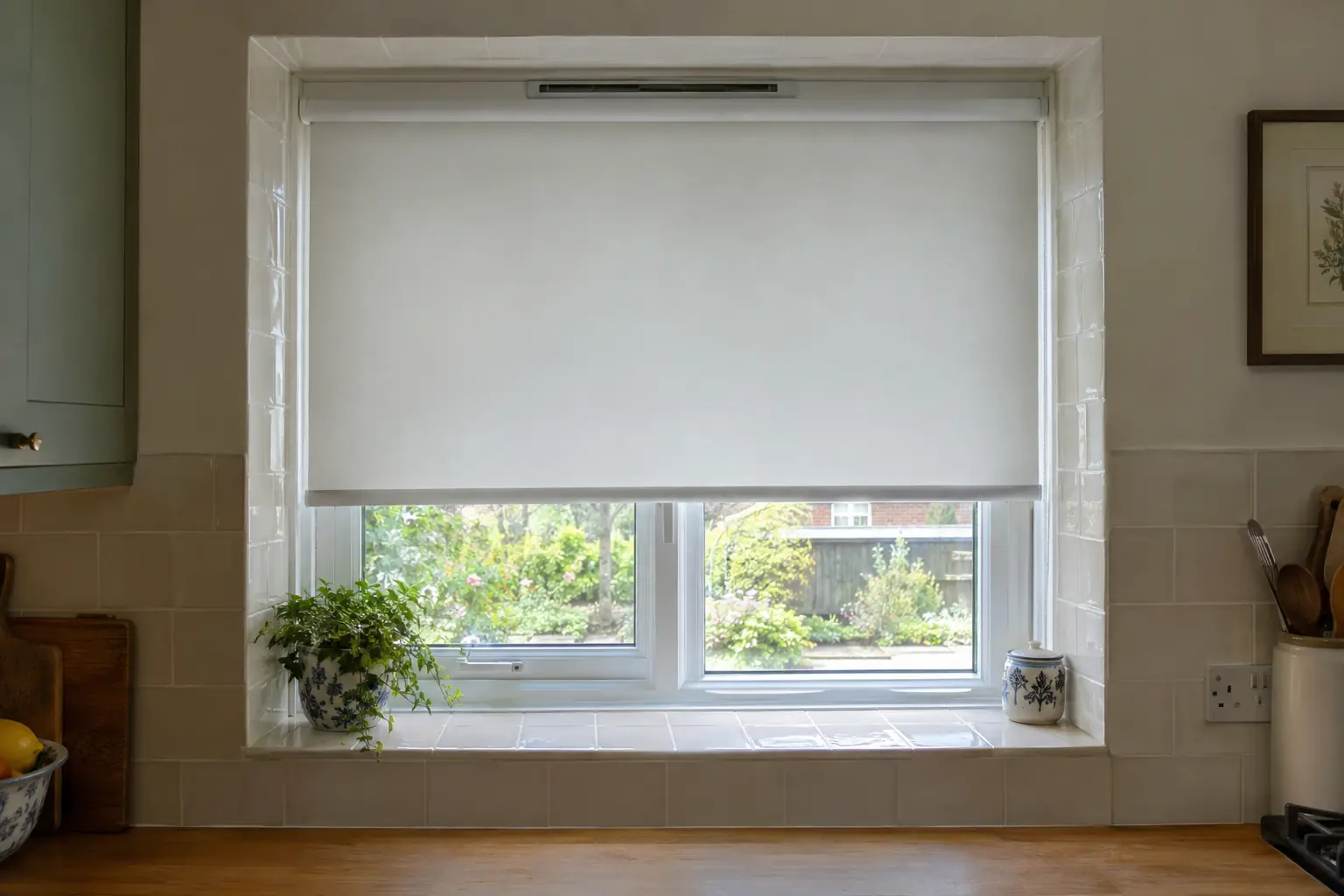
Everything else that is in the way
Width and drop tell you the size of a blind. What is in and around the opening tells you whether it will work. Before you put the tape away, look for anything that projects and write down how far it sticks out.
Handles and locks are the usual culprits. On uPVC and aluminium windows the handle often stands proud of the frame, and a recess blind has to hang in front of it without touching. Trickle vents along the top of the frame can sit exactly where a headrail wants to go. Window stays, restrictors and the catches on a sash window all count.
Then look below and around. A tiled or stone sill, a deep window board, a radiator directly under the window, a socket in the reveal, an alarm sensor on the frame, a curtain pole or track you intend to keep: each changes what can go where. Tiled reveals in kitchens and bathrooms are worth a note too, because they change how the blind is fixed.
None of this rules out a blind. It is what our advisor looks for on the day, and knowing about it beforehand makes the conversation quicker.
Leave room for the blind to open
A blind that fits when it is down still has to go somewhere when it is up, and the space it needs is easy to forget when you are measuring.
A roller blind winds onto a tube at the top, and the longer the drop and the thicker the fabric, the fatter that roll becomes. In a shallow recess, a long blackout roller can run out of depth before it runs out of width. A roman blind folds up into a stack of fabric that sits across the top of the window, which is why a roman on a short window is often fitted above the opening so the stack sits on the wall. Venetian and wooden blinds gather their slats into a stack at the top, and the slats need depth to tilt without touching the glass or the handle. Vertical blinds stack to one or both sides, so they need wall space beyond the opening if you want the glass completely clear.
If a window is shallow, short or crowded, mention it when you book. The advisor can show you how each type behaves in that particular opening, which is far easier than working it out from a tape.
Mistakes that cost a blind
Most measuring errors are small and predictable, and all of them are avoidable.
Taking your own deductions is the big one. For a recess fit, write down the opening exactly as it is. The small clearance a blind needs to run freely is allowed for when it is made, and if you take some off as well, the blind comes out short at both sides.
Measuring the glass instead of the opening is the next. The glass is always smaller than the recess, and a blind made to the glass leaves the frame on show all round.
Then there is assuming. Measuring one window and copying the figures for its neighbour, measuring only the middle of an old opening, or rounding 1,214 to 1,200 because it looks tidier. Each one produces a blind that is almost right, and almost right is what you see every time you draw it.
The last is forgetting how you want to use the blind: which side the chain or control should hang, and whether a piece of furniture sits against one side of the window. Note it on the sketch while you are standing there.