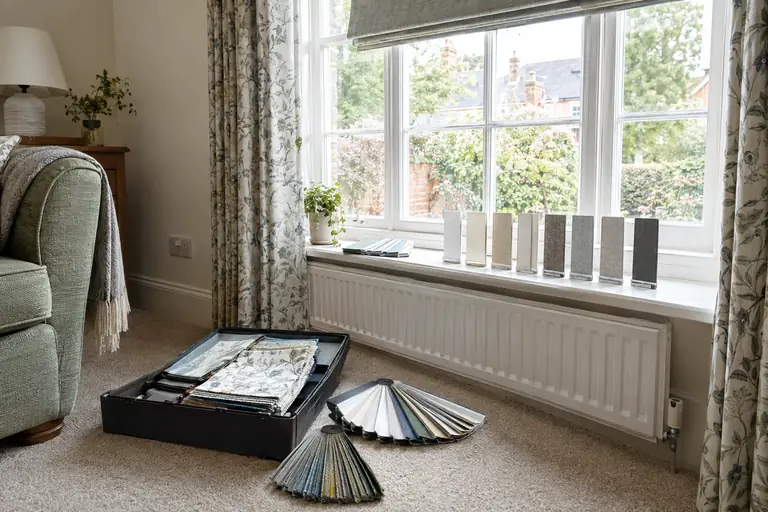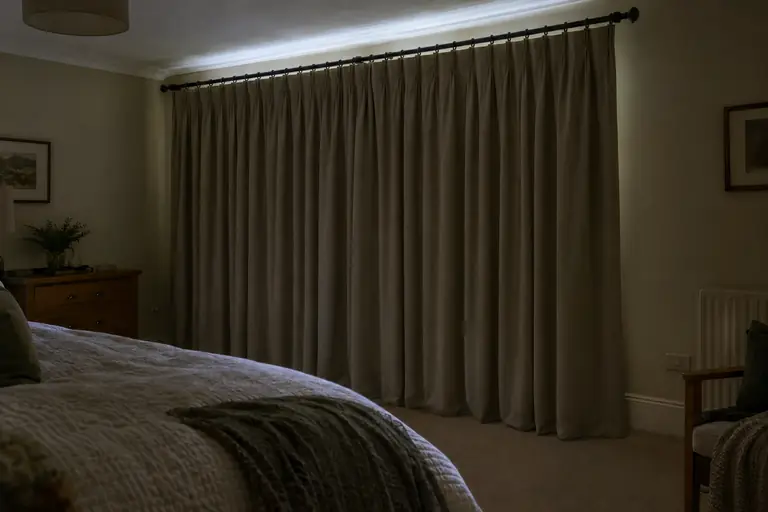
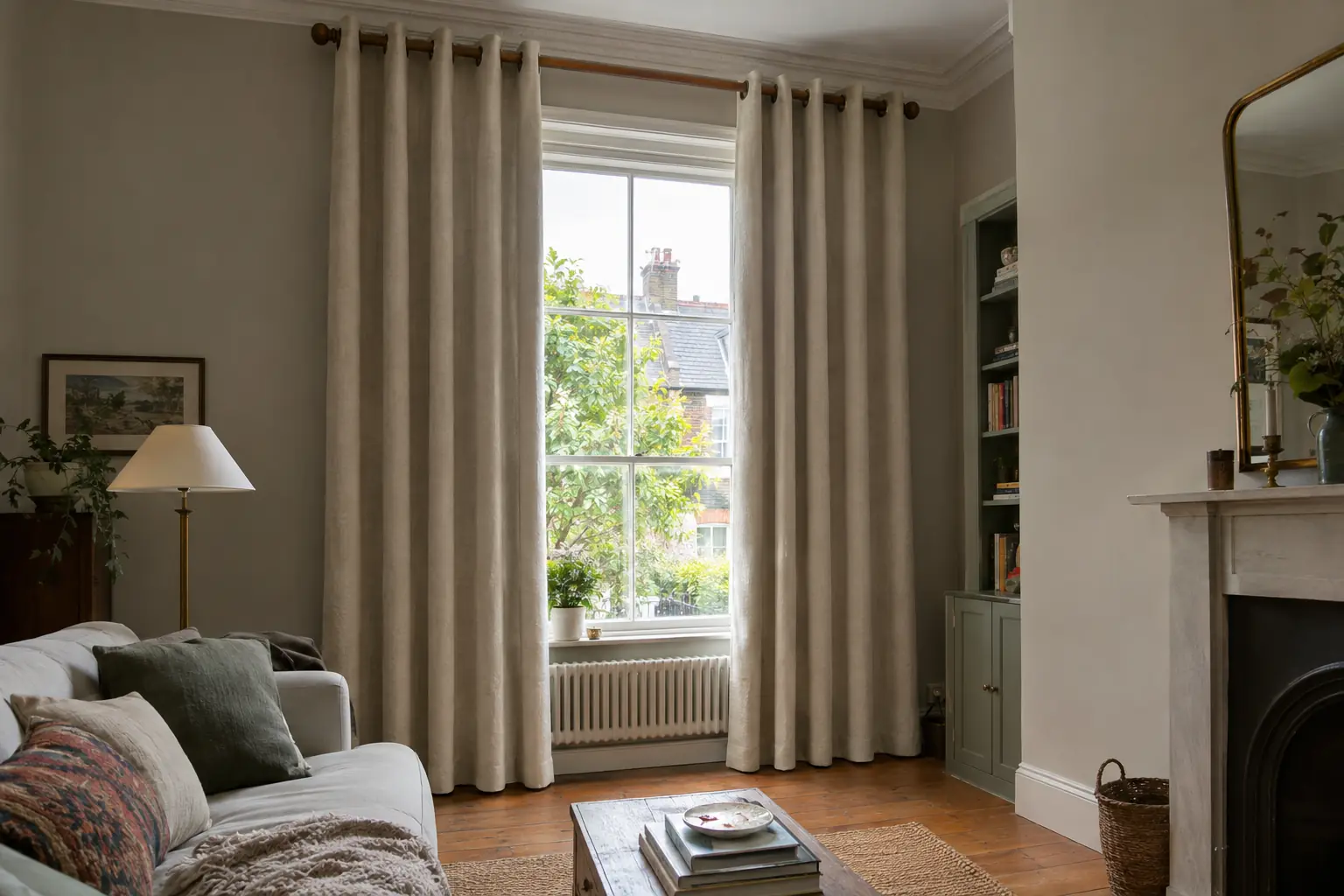
The short answer
Measure the pole or track rather than the window. It should run past the opening on each side so the curtains can stack back off the glass, and sit far enough above the frame for the curtains to hang clear of it. Measure the width along the pole or track, leaving out any decorative ends. Measure the drop from the pole or track to where you want the curtains to finish. For an order, your advisor measures it all.
- Curtains are sized from the pole or track, so decide where that goes before you measure anything else.
- Run the pole or track past the window so the curtains stack on the wall, not across the glass.
- Where you measure the drop from depends on the heading: the top of the pole, the ring or the track.
- Measure the drop at both ends and in the middle. Floors and ceilings in older houses are rarely level.
- Poles and tracks are supplied and fitted with our curtains, and the advisor measures for the order.
Curtain widths and drops
Swipe to see the whole diagram
The pole or track runs past the window each side so the curtains can stack off the glass. The drop is measured from the pole or track to where you want the curtain to finish.
Step by step
- 1
Choose pole or track and the heading
Eyelet curtains need a pole, wave curtains need a track and pencil pleat works on either. The heading affects how much wall the curtains stack onto and where the drop is measured from.
- 2
Fix the position of the fittings
Decide how far above the window the pole or track will sit and how far past each side it will run. Check for coving, a nearby ceiling, adjoining walls or furniture that limit either.
- 3
Measure the width of the pole or track
Measure between the finials on a pole, or the full length of a track. If the fittings are not up yet, measure the length they will be.
- 4
Check the stack space either side
Look at the wall beside the window. The curtains need somewhere to gather when open, or they will sit across the glass and take daylight.
- 5
Measure the drop from the right point
For eyelets, start at the top of the pole. For pleated headings on rings, start at the bottom of a ring. On a track, start at the top of the track.
- 6
Take the drop three times
Measure at the left, in the middle and at the right, down to the sill, below the sill or to the floor. Write all three down if they differ.
- 7
Note what is under and around the window
Record radiators, deep or projecting sills, window seats, sockets and any furniture that will stand in front of the curtains.
- 8
Let the advisor measure for the order
Bring your notes to the appointment. The advisor measures for the curtains, pole or track and heading you choose, so the finished length is our responsibility.
Start with the pole or track, not the window
A blind is made to fit a window. A curtain is made to hang from a pole or a track, and the window only tells you the least it has to cover. Where the fittings go decides almost everything else: how much daylight you keep when the curtains are open, how tall the window looks, whether the fabric clears the frame, the handles and the sill, and how far the curtains have to drop.
That is why the first question is not how big the window is, but where the pole or track will be. If you are keeping an existing pole that is sound and sits where you want it, measure from it. If you are starting again, decide the position first, then measure from there.
We supply and fit the poles and tracks that go with our curtains, so if you are replacing yours, the advisor measures from where the new fittings will go rather than the old ones. It is worth knowing before you spend an evening measuring a pole that is coming down.
How far past the window the pole should run
When curtains are open, the fabric gathers into a stack at each side. If the pole stops level with the edge of the window, that stack sits across the glass and takes a strip of daylight off each side, every day, for as long as the curtains hang there. Running the pole or track past the opening lets the curtains stack on the wall instead, so the whole window is clear when they are open.
How much wall the stack needs depends on the curtains. A heavy lined or interlined fabric stacks bulkier than a light unlined one, and the heading matters too: pinch pleats stack the tightest, while eyelets fold back into deeper loops that need more wall. A wide window with full curtains needs more room either side than a narrow one.
Before settling on a width, look at what is beside the window. An adjoining wall, a chimney breast, an alcove, a wardrobe or a door frame can all stop a pole short. In a tight corner, a single curtain drawn to one side, or a heading that stacks more neatly, is often the better answer than a stack that eats the glass.
How high above the window
The pole or track sits above the window so the heading clears the top of the frame and the curtains hang in front of the glass rather than catching on it. Beyond that, height is a choice. Fixing higher makes a window look taller and a low room feel less squat, which is why curtains in a modest room often look better hung nearer the ceiling than the frame.
The practical limits are what is above the window. Coving, a ceiling that is close to the top of the frame, a picture rail, a boxed-in pipe or a cable run can all decide the height for you. A pole also needs space above it for the brackets and the rings or eyelets to slide freely. A track can sit tighter to the ceiling, or be fixed to it.
If you want a blind in the reveal as well as curtains, the pole or track has to stand far enough off the wall for the curtains to hang clear of the blind and its roll or stack. Your advisor checks the reveal and the wall together, so both work on the same window.
Measuring the width
Measure the length of the pole or track, not the window. On a pole, measure between the finials, the decorative ends, because the curtains can only travel between them. On a track, measure the full length of the track itself. If the pole or track is not up yet, measure the length it will be once it is: the width of the window plus the wall you want covered on each side.
That figure is the width the curtains have to cover, not the width of the fabric. Curtains are made wider than the pole so that they fall in folds rather than hanging flat, and how much wider depends on the heading you choose. With made-to-measure curtains, that sum is ours to do: we work out the fabric width from your heading so the folds stay deep even when the curtains are drawn. Our curtain length and fullness guide explains the effect of that choice.
Decide as well whether you want a pair that meets in the middle or a single curtain drawn to one side. A single curtain often suits a narrow window, or one tucked against a wall.
Where to measure the drop from
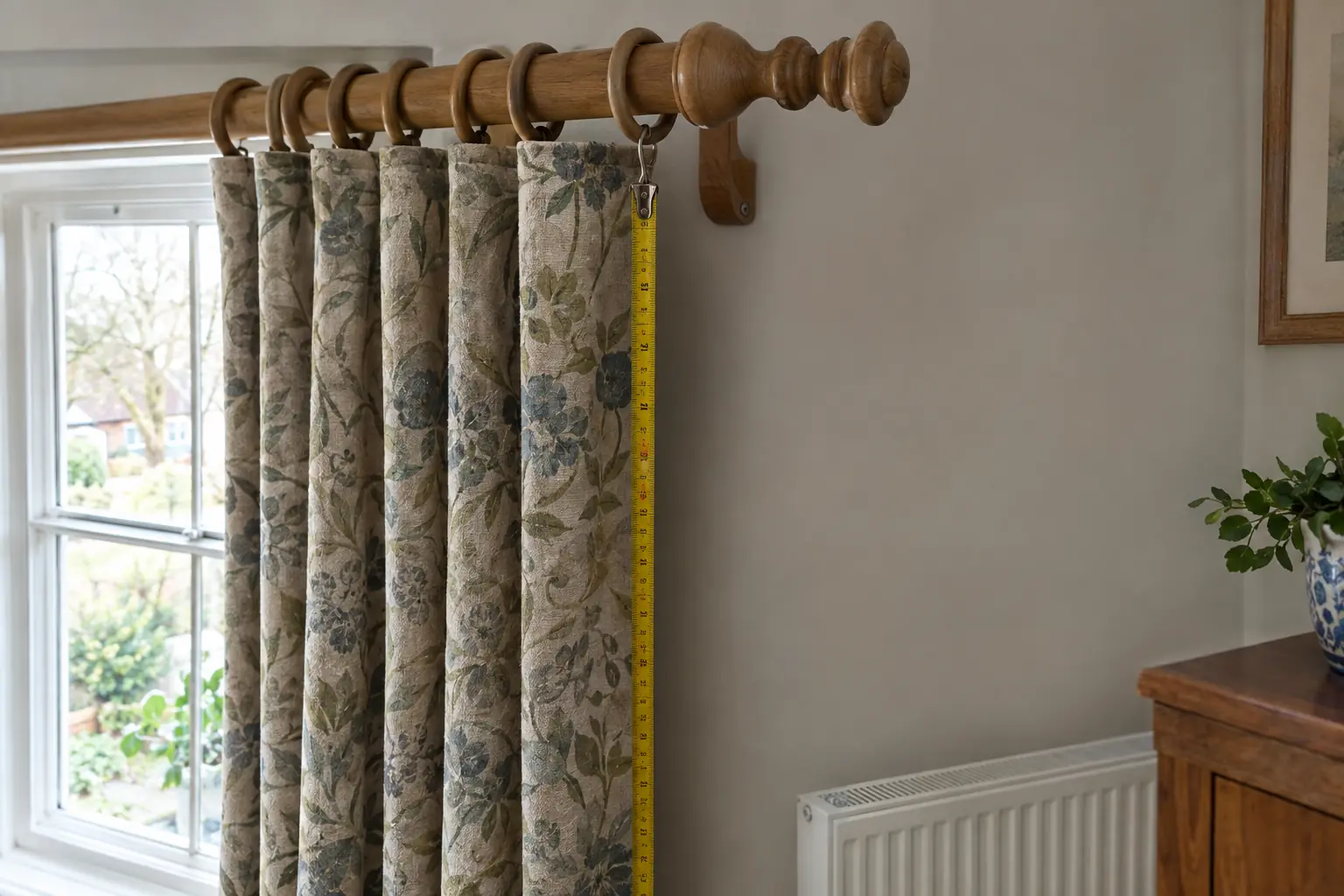
The drop is measured from the pole or track to where you want the curtains to finish, but the exact starting point depends on how the curtains hang.
Eyelet curtains thread straight onto the pole, and the fabric above each eyelet stands up past it. Measure from the top of the pole. Pencil pleat and pinch pleat curtains on a pole hang from hooks in the rings, so measure from the bottom of a ring, where the hook sits. On a track, measure from the top of the track, because the heading usually rises to hide it. Wave curtains hang from carriers on their own track system, and the starting point depends on the track, which is a good reason to leave the final figure to the advisor.
Whichever heading you choose, measure the drop at the left, in the middle and at the right. Ceilings and floors in older British houses are seldom level, and a floor-length curtain made to one measurement can brush the boards at one end and hover at the other. If the three figures differ, write them all down so the difference can be allowed for.
Where the curtains should finish
There are three usual lengths, and the right one is often decided by what is under the window.
Sill length finishes just above the sill, not resting on it. It suits kitchens, windows above a worktop and cottage windows with a deep sill you want to keep in use.
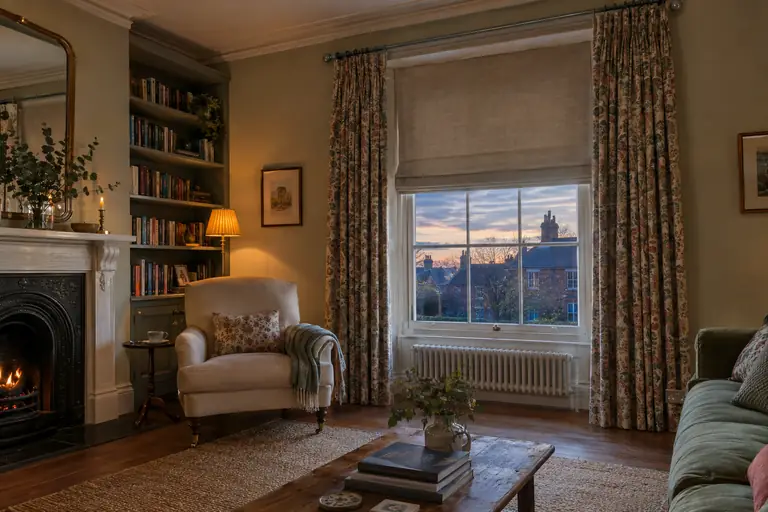
Below-sill length drops past the sill and stops above whatever is beneath it. If the sill projects into the room, the pole or track has to stand far enough forward for the curtains to fall past its edge. Below-sill is the usual answer where a radiator sits under the window: a floor-length curtain drawn over a radiator sends the warmth up behind the fabric towards the glass rather than into the room.
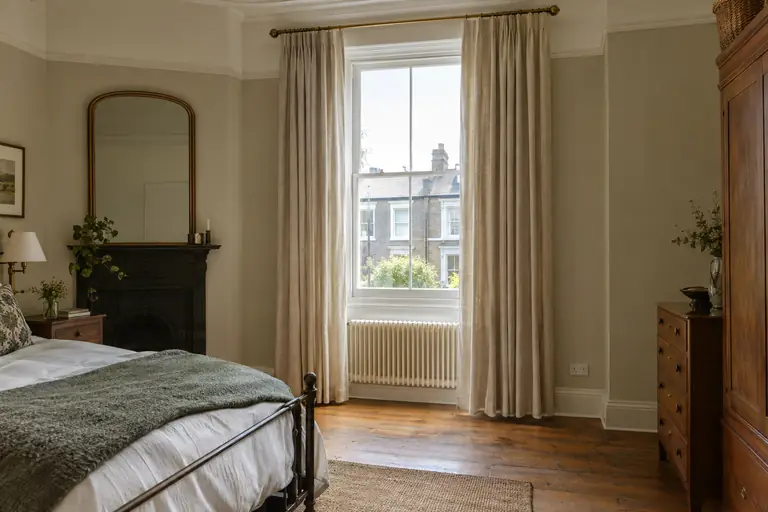
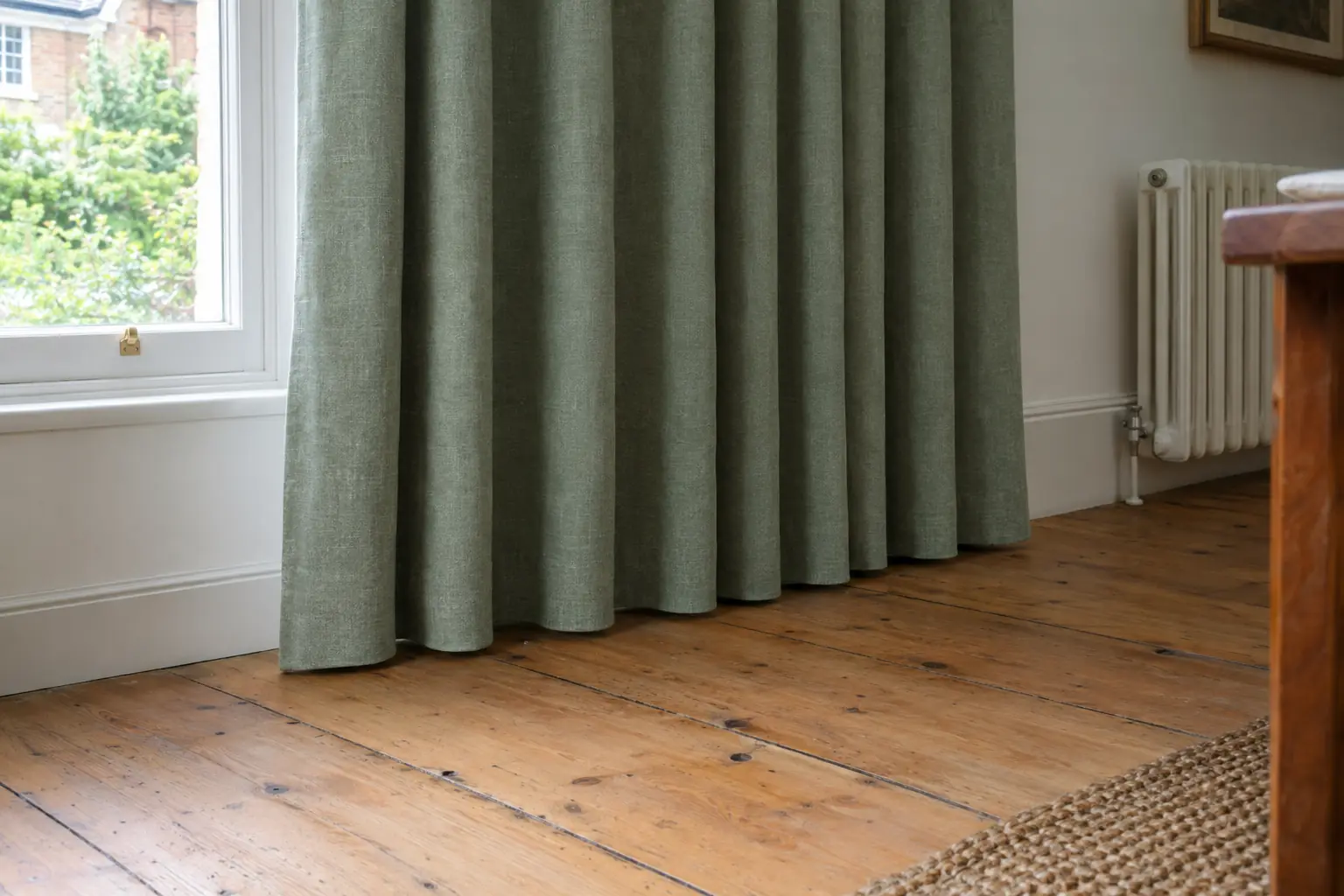
Floor length finishes just clear of the floor, which is the most generous look and the one that makes a window feel tallest. It needs clear wall below the window and a floor that is near enough level for the hem to look even.
A window seat, a desk or a bed pushed against the wall can rule out a long curtain altogether. That is where a roman blind in the same fabric earns its place.