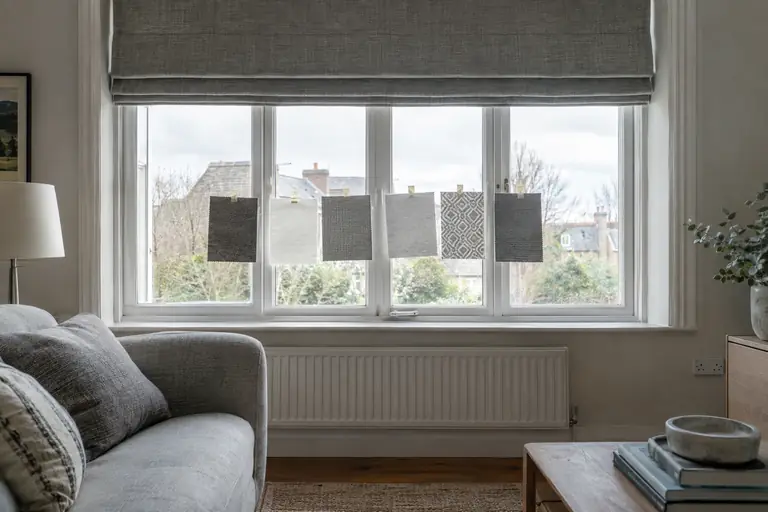
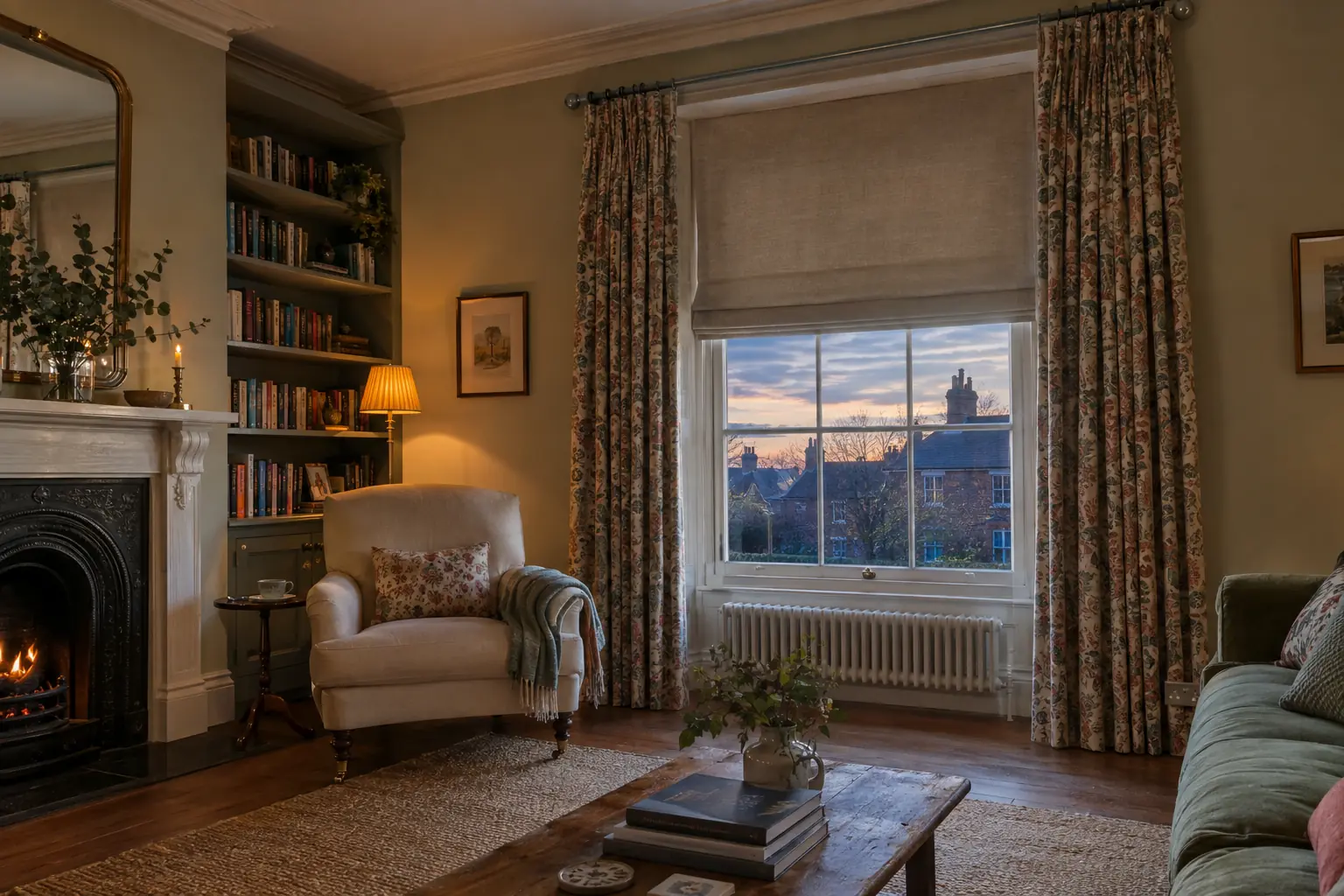
The short answer
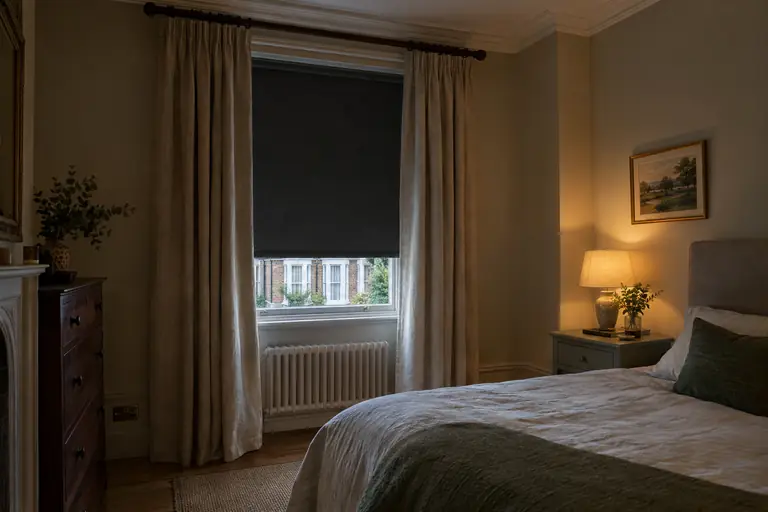
Put a slim blind inside the reveal and curtains on a pole or track outside it. The blind handles privacy, light control or blackout close to the glass; the curtains add warmth and softness and cover the gap round the edges of the blind. The reveal must be deep enough for the blind to clear the handles, and the pole needs to sit high and wide enough for the curtains to clear the blind. Your advisor checks both.
- Blind inside the reveal, curtains outside it: each layer does its own job.
- The reveal needs enough depth for the blind to clear the handles and window board.
- Set the pole wider and higher than the reveal so the curtains stack clear of the blind.
- A voile roman behind dress curtains gives daytime privacy with the curtains left open.
- Two layers mean two sets of controls, so plan where each one sits.
A blind and curtains on one window, from the side
Swipe to see the whole diagram
A slim blind inside the reveal gives privacy and blackout; curtains on a pole outside it add warmth and close the light gap round the edges.
Why two layers work better than one
Every window dressing is a compromise. A blind is slim, precise and tidy, but on its own it can look bare, and a recess blind always lets a little light down each side. Curtains are warm, soft and generous, but they are either open or closed, and on their own they do little for privacy on a bright afternoon.
Put the two together and the compromises cancel out. The blind sits close to the glass and handles the precise jobs: privacy by day, blackout at night, glare on a screen. The curtains hang outside the reveal and handle the rest: warmth on a cold evening, softness in the room, and covering the light that creeps round the edges of the blind.
It also gives you more ways to use the window. On a summer morning the blind alone might be enough; on a winter night both are closed; in the afternoon the curtains stay open as a frame while the blind is half down against the sun. That flexibility is why a layered window is what so many people ask for in bedrooms and living rooms.
Reveal depth: the first thing to check
The blind goes inside the reveal, so the reveal has to be deep enough to take it. Measure from the glass or the window frame to the front edge of the plaster. The blind's headrail needs room at the top, and when the blind is down it has to hang clear of everything that sticks out: handles, locks, stays, trickle vents and sash lifts.
Roller blinds are the slimmest option and need the least depth. Roman blinds need more, because the folds gather at the top and stand proud of the fabric when the blind is raised. Venetian and wooden blinds need room for the slats to tilt without catching on the handles.
The curtains need depth of a different kind. They hang in front of the reveal, so the pole or track must stand far enough off the wall for the curtains to clear the blind, its headrail and anything the reveal does not quite contain. Where the reveal is too shallow for a blind to sit clear of the handles, the blind can go outside the reveal instead, with the curtains in front of it. Your advisor will tell you which your window can take.
Where the pole or track goes
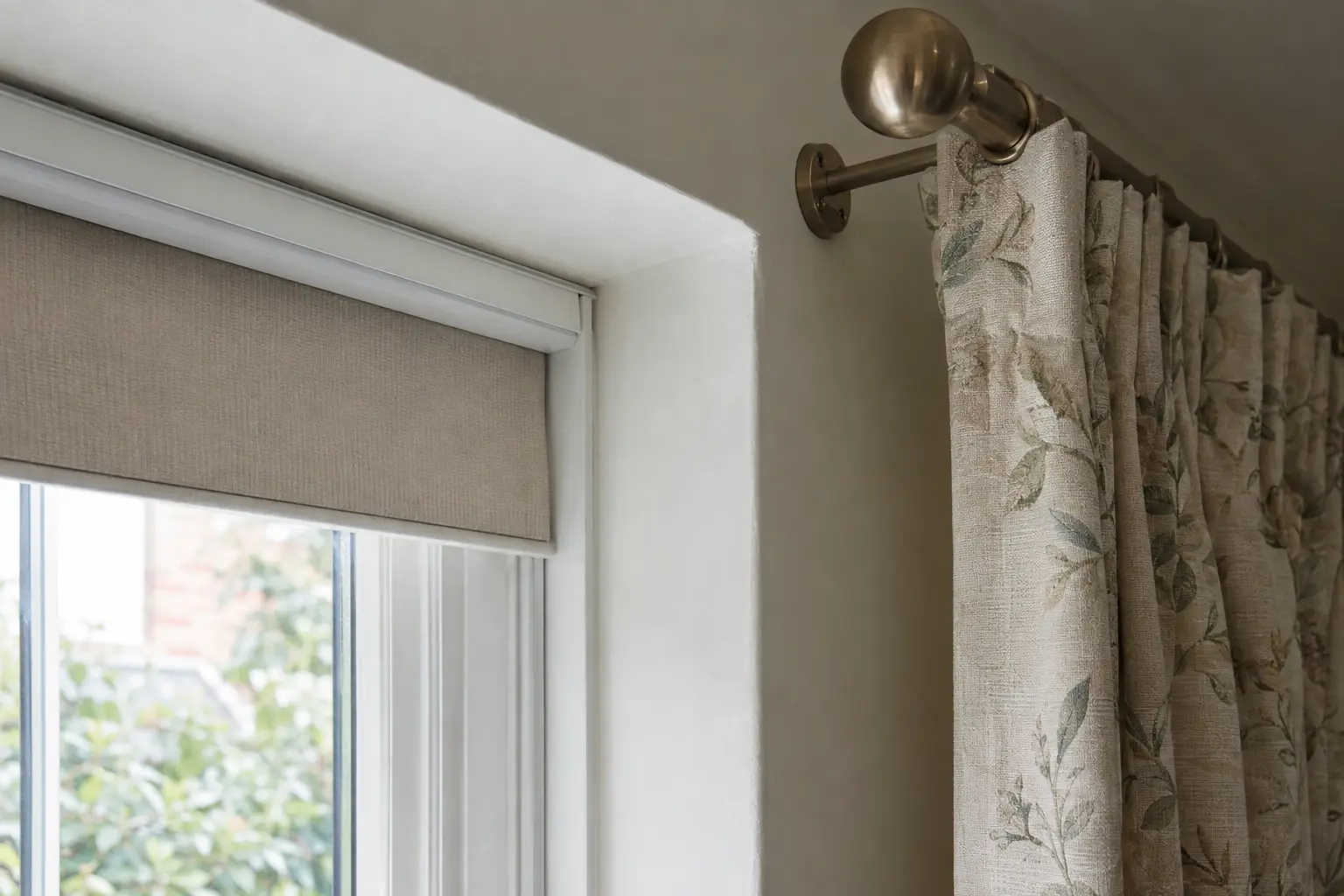
With a blind in the reveal, the pole or track goes on the wall above the window, and its position does most of the work.
Width comes first. The pole should run past the reveal on each side, far enough that the curtains, when open, stack on the wall rather than across the glass. That keeps daylight coming in, keeps the blind's controls reachable, and lets the curtains overlap the edges of the reveal when they are closed, which is where they stop the light that gets round a recess blind.
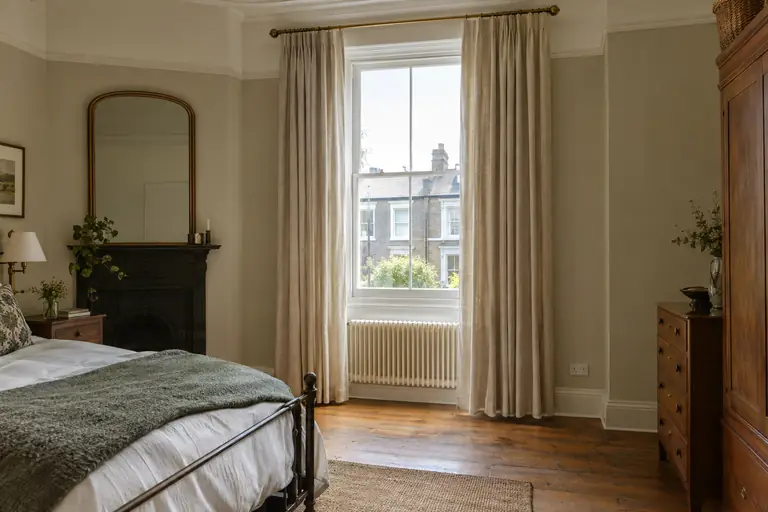
Height comes next. Set the pole a little above the top of the reveal and the curtains cover the blind's headrail and the light that leaks over the top. Set it higher, towards the ceiling, and the window looks taller and the room more generous. Leave room for the brackets and finials to clear the ceiling and any coving.
We supply and fit poles and tracks, and getting the width and height right is part of the job, which is why your advisor measures the wall as well as the window.
Pairings that work
Some combinations come up again and again because they suit particular rooms.
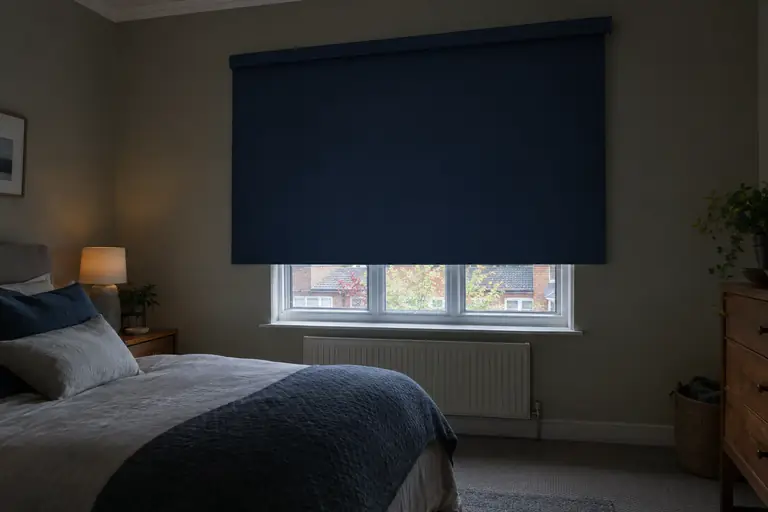
In bedrooms, a blackout roller in the reveal with lined eyelet or pinch pleat curtains outside it is the combination that finally gets a room properly dark. The roller stops light through the glass, and the curtains close the gap round it.
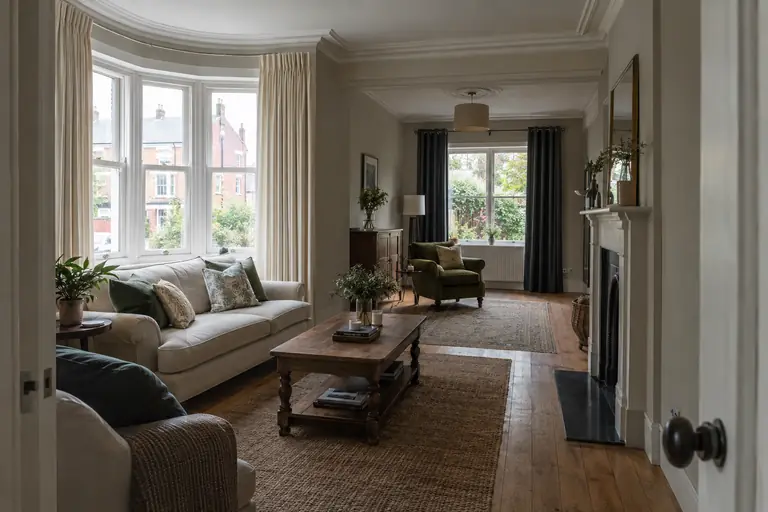
In living rooms, a roman blind in the reveal with dress curtains is a softer version. The roman can be in a plain fabric that picks up a colour from the curtains, and lowered for privacy while the curtains stay open as a frame.
In period rooms, a wooden blind under a dress curtain is a common pairing where shutters would be too big a change: the slats tilt for light, and the curtain softens the hard lines.
On a large single-glazed window or a bay, a thermal or honeycomb blind with thermal-lined curtains gives two insulating layers working together.
Eyelet curtains are the easiest partner for a blind, because they run on a pole, draw with one pull and stack neatly, but any heading works if the pole or track is placed well.
Voile layers for daytime privacy
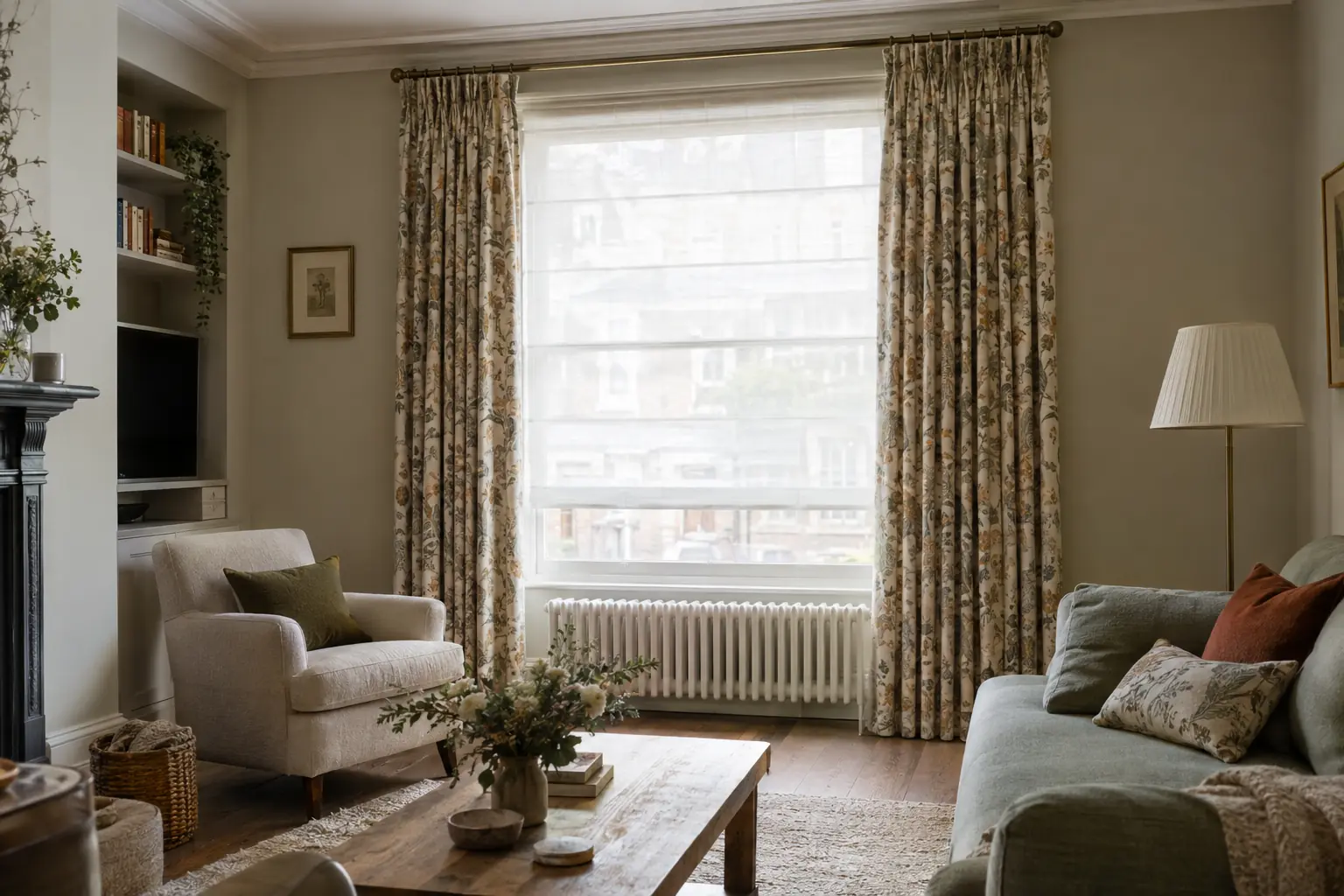
The other classic layer is a sheer one. A voile roman blind in the reveal gives soft daytime privacy: from the street the window shows a pale glow, while from inside you can still see out. The curtains stay dressed open all day as a frame and are only drawn at night.
This suits front rooms on a street, ground-floor flats and any room where you want light and privacy at the same time without a blind sitting half down all day. It also looks lighter and neater than a net curtain, because the voile hangs flat inside the reveal rather than gathered on a wire.
The thing to remember is that sheer fabric works by contrast. By day, when it is brighter outside than in, you see out and the street does not see in. After dark, with the lamps on, that reverses, and the curtains need to be drawn. A voile blind is a daytime layer, not a night-time one. If you want some privacy with light after dark as well, a day and night blind in the reveal is an alternative to the voile.
Controls, cords and children
Two layers mean two sets of controls, and it is worth deciding where they go. A blind's chain or cord usually sits at one side of the reveal; curtains stack at both sides, or at one if they draw one way. Put the blind's control on the side you can reach easily, where the curtain stack will not bury it, and in a bedroom on the side away from the bed.
Cords need particular thought in children's rooms. Any corded blind we supply arrives with the child-safety devices UK regulations require, and our fitter puts them up and walks you through them. In a room with a cot or young children, we would normally point you to a cordless or motorised blind. Do not forget the curtains: RoSPA's advice is to include corded curtain tracks when you check a room's cords and chains, because they can carry the same risks as blinds.
Motorisation removes the question altogether and makes two layers easy to live with. A motorised blind can be lowered from across the room, and grouped with others so a run of windows moves together.
Colour across two layers
With two layers on one window, decide which one leads. A patterned curtain with a plain blind in a colour taken from the pattern is the safest pairing. A patterned roman with plain curtains works too, particularly where the blind will be down for much of the day and the curtains mostly open.
Think about what shows when. By day, with the curtains open, the blind sits in the middle of the view and takes the light from behind. At night, with the curtains drawn, the curtains are all you see from inside. So a blind needs to look right backlit, and the curtains need to look right under lamplight. If you want the blind to disappear, match it to the window frame or the wall rather than to the curtains.
Look at both fabrics together before you order. Free samples let you hold the two side by side against the window at home, and at a home appointment your advisor brings the full range and can hold both layers against the glass at once, in daylight and with the lamps on.
Checklist
- Measure the reveal depth from the glass to the front edge in three places.
- Note every handle, stay and vent the blind must clear.
- Check the wall above and beside the window has room for a pole or track.
- Decide what each layer is for: blackout, privacy, warmth or softness.
- Put the blind's control on the reachable side, away from the curtain stack and the bed.
- In a child's room, choose a cordless or motorised blind and check any curtain track cords.
- Look at both fabrics together, against the window, before ordering.