The short answer
Manual blinds are simple, have fewer parts and suit windows you can reach easily. Cordless manual blinds remove the hanging loop without adding a motor. Motorised blinds earn their place on high windows, glass behind furniture, conservatory roofs and runs of windows you want to move together. Most run on a rechargeable battery motor, so no new wiring is needed; mains power is worth it where a blind is used constantly or is awkward to reach for charging.
- Chain and cord blinds are simple and familiar, and every one we supply comes with its child-safety devices fitted.
- Cordless manual blinds take the loop away without a motor, for windows within easy reach.
- Motors are the usual answer for roof windows, stairwells, conservatory roofs and anything behind furniture.
- Most motorised blinds use a rechargeable battery, so there is no rewiring; mains needs an electrician for any new supply.
- Motorised blinds can be grouped, so a whole run of windows moves on one command.
The ways a blind can move
Manual blinds come in more varieties than people expect. A roller or vertical blind usually runs on a continuous chain at one side: pull one strand and the blind goes up, pull the other and it comes down. Older venetians and Roman blinds use pull cords that lift the blind by gathering it from below. On many venetians a wand does the tilting, so there is no loop at all for that job.
Cordless blinds do away with the chain or cord altogether. You move the blind by its bottom rail, lifting or lowering it by hand, and the mechanism in the headrail holds it wherever you leave it. They are manual, but with nothing hanging down.
Motorised blinds put a small motor inside the headrail, usually running on a rechargeable battery and sometimes on mains power. You move them with a handset or an app, and several blinds can be grouped so a whole room or a run of windows moves at once.
None of these changes what the blind looks like when it is down. The fabric, the fit and the finish are chosen in the same way, and the difference is entirely in how you live with it. The side-by-side table further down sets the options out.
Control and everyday use
A chain or cord is immediate and familiar. There is nothing to charge and nothing to lose down the side of the sofa, and on a single window you can reach, it is hard to beat for simplicity. Cordless blinds feel similar: you put the blind where you want it with one hand.
Motors come into their own when there are several windows, or when the same windows are opened and closed at the same times every day. A bay, a run of kitchen-diner windows or a wall of glass can be grouped so it all moves together, and a timer can close the sunny side of the house before you get home. People who find a chain awkward to grip, or who struggle to reach across a worktop or a bed, often find a handset makes the difference between using a blind and leaving it where it is.
That last point matters more than it sounds. A blind that is a nuisance to move tends to be left in one position, which wastes the reason you bought it: the blackout you wanted at dawn, the shade you wanted in the afternoon, the privacy you wanted in the evening. If you think that will be you, a motor is worth considering even on an ordinary window.

Safety around children
This is where the choice matters most. A chain or cord blind is far safer with its safety device fitted and in use, and ours come with the devices UK regulations require, installed by the fitter. But a device only works while it stays fixed in place, and a cordless or motorised blind simply has no loop to manage, which is why we usually suggest one of those for rooms with cots or small children.
The BBSA describes blinds as safe by design when they are cordless or their cords are concealed or tensioned, and lists motorised, spring-operated and wand-operated blinds among its examples. A motor does not take a blind outside the safety rules: BSI's scope for the internal-blinds standard includes power-operated blinds.
A motor does bring one thing a chain does not: a handset. Some small handsets run on button or coin batteries, which are a serious danger to young children if swallowed. CAPT identifies children between 6 months and 4½ years as the age group most at risk, and its advice is to keep button batteries somewhere high, where children cannot get at them. Keep the handset in the same place every time, well above a toddler's reach, and store the spares safely too.
Our guide to blind cord safety covers the standards and the checks in detail.
Reach: where a motor earns its place
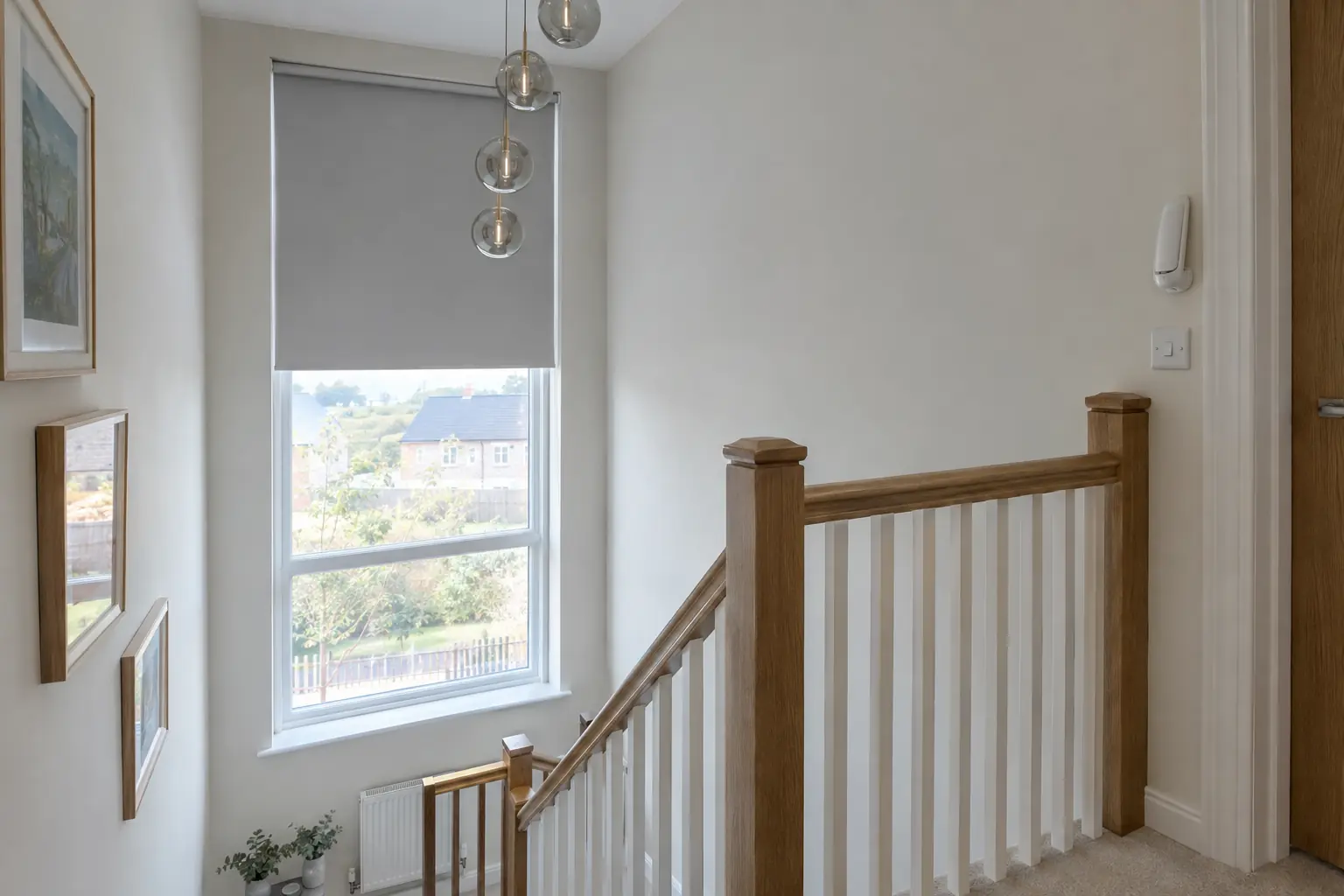
The strongest case for a motor is a window you cannot comfortably reach. Roof windows in a loft conversion, tall glass over a stairwell, gable-end windows and anything behind a sofa, a bed or a kitchen island all fall into this group. A chain on those windows is either out of reach, hanging somewhere awkward, or dangling where a child can get to it.
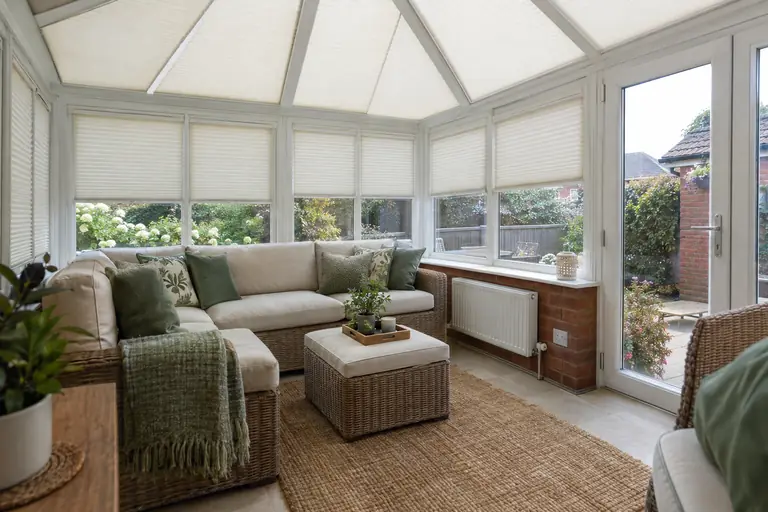
Conservatory roofs are the clearest example. The panes are overhead and out of reach, and a roof blind is only useful if it is actually closed when the sun is on the glass. Nobody fetches a stepladder twice a day to open and close them, so without a motor they tend to be left in one position all season. That is why we almost always suggest motorising roof blinds.
Skylight blinds in a loft are similar. The blind will be out of reach for the rest of its life, so a handset is usually worth the difference. The alternative is a pole, which works but means fetching it every time.
At the other end of the scale, a small window in a cloakroom or a utility room that you open once in the morning and close once at night rarely needs a motor. A cordless manual blind does that job neatly. Your advisor will suggest motors only where they make sense.

Battery or mains
Battery is the usual choice. The motor sits in the headrail with a rechargeable battery that is topped up with a charging lead every few months, so nothing needs wiring in and no electrician is involved. How often you charge depends on how much the blind moves; one that goes up and down twice a day will need charging more often than one used occasionally. The battery also means the blind carries on working in a power cut.
Mains power is worth it where a blind runs constantly, or where it sits somewhere so awkward that reaching it with a charging lead would be a job in itself. The trade-off is the supply. We do not do electrical work, and if a motor needs a new mains supply, that is a job for a registered electrician.
It is worth knowing that in England, Building Regulations treat some electrical work as notifiable, including installing a new circuit and additions or alterations to existing circuits in a special location, such as the space around a bath or shower. Your electrician will know whether your job falls into that category, and the rules differ in the other nations of the UK.
Your advisor can tell you which of the ranges you like come motorised and whether battery power will suit each window, which is usually the answer.
What changes the quote and the upkeep
Every quote is worked out window by window, from the size of the opening, the product and fabric, the heading or mechanism, and any motorisation. A motor adds to the price of a blind, so there is no single figure for the difference; ask your advisor to price the same blind both ways if you want to compare. Fitting is included in the price either way, and the written quote covers the product, the fitting and the guarantee.
Upkeep differs more than the price. A manual blind has fewer parts, and the ones that wear, such as chains, connectors and brackets, are small and can usually be replaced without remaking the blind. A motorised blind adds a motor, a battery and a handset. The motor is covered by our 1-year guarantee just as the blind is, and since it is our motor on our blind, a fault is ours to sort out. Outside the guarantee, motors can usually be replaced without remaking the blind too.
The practical upkeep of a battery motor is charging it every few months and keeping the handset somewhere safe. If a motorised blind slows or stops, a flat battery is the first thing to check. Our guide to repairs and spare parts covers what to do next.
Side by side
How you move it
- Chain or cord
- Pull a chain or cord at the side
- Cordless manual
- Lift or lower the bottom rail, or turn a wand
- Motorised, battery
- Handset or app
- Motorised, mains
- Handset or app
Moving several blinds
- Chain or cord
- One at a time
- Cordless manual
- One at a time
- Motorised, battery
- Grouped to move together
- Motorised, mains
- Grouped to move together
Child safety
- Chain or cord
- Loop held by a safety device our fitter installs
- Cordless manual
- No loop: safe by design
- Motorised, battery
- No cord; keep the handset out of reach
- Motorised, mains
- No cord; keep the handset out of reach
Reach
- Chain or cord
- Windows within easy reach
- Cordless manual
- You need to reach the bottom rail
- Motorised, battery
- Any height, including roof windows
- Motorised, mains
- Any height, including roof windows
Power
- Chain or cord
- None
- Cordless manual
- None
- Motorised, battery
- Rechargeable battery, charged with a lead every few months
- Motorised, mains
- Mains supply; any new supply is a job for a registered electrician
In a power cut
- Chain or cord
- Works as normal
- Cordless manual
- Works as normal
- Motorised, battery
- Works as normal while charged
- Motorised, mains
- Waits until the power returns
Parts that can wear
- Chain or cord
- Chain or cord, connectors, brackets
- Cordless manual
- The operating mechanism, brackets
- Motorised, battery
- Motor, battery, handset, brackets
- Motorised, mains
- Motor, handset, brackets
Best for
- Chain or cord
- Everyday windows you can reach
- Cordless manual
- Children's rooms and small windows
- Motorised, battery
- High, awkward or grouped windows
- Motorised, mains
- Blinds used constantly or hard to reach for charging
Guarantee
- Chain or cord
- 1-year guarantee
- Cordless manual
- 1-year guarantee
- Motorised, battery
- 1-year guarantee, motor included
- Motorised, mains
- 1-year guarantee, motor included