The short answer
Choose a blind made for roof windows: it is tensioned inside the frame so it stays flat against the glass at any angle and holds any position. Pick blackout fabric for a loft bedroom, think about summer heat as well as light, and motorise anything you cannot reach comfortably. The fixing depends on the make and model of the roof window, so an advisor surveys the frame itself before quoting.
- Skylight blinds are tensioned inside the frame, so they stay flat to sloping glass and hold any position.
- Blackout fabric makes a loft bedroom sleepable on a June morning.
- An internal blind takes the edge off summer heat; it will not make a loft room cool.
- Motorise anything you cannot reach without a pole.
- The frame is surveyed on site, because the fixing depends on the roof window's make and model.
A blind on a roof window
Swipe to see the whole diagram
Roof window blinds run in side guides so they stay put on a slope, which is also what stops light creeping round the edges.
Why a roof window needs its own kind of blind
An ordinary blind relies on gravity. A roller hangs down under the weight of its bottom bar; a roman or a venetian drops straight from its headrail. Put any of them on a window that slopes with the roof and gravity pulls the fabric away from the glass, so the blind sags into the room and will not stay where you leave it.
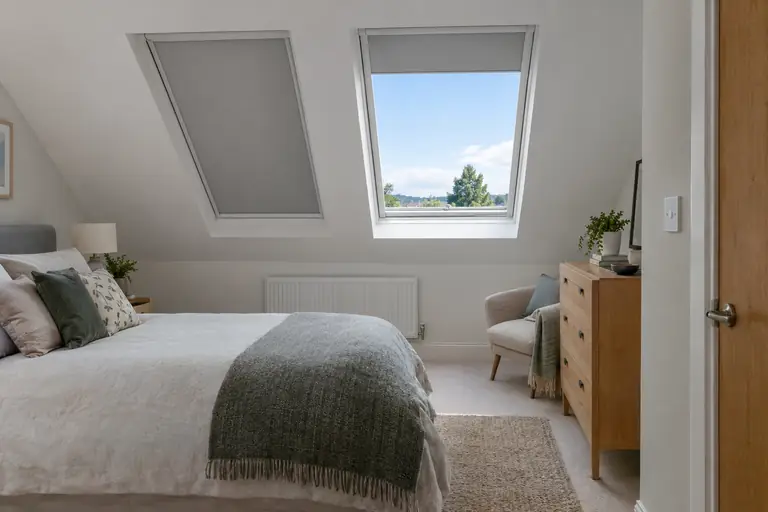
A skylight blind works the other way round. It fits inside the frame of the roof window and is held under tension along its length, so the fabric stays flat against the glass whatever the angle of the roof, and stops at whatever position you leave it: fully open, fully closed or anywhere in between. Because it is fixed to the window's frame rather than the plaster around it, it sits square to the glass even where the reveal of a loft ceiling is anything but square.
That is also why a skylight blind is sized to the frame rather than just the glass, and why it is one of the few blinds that cannot be quoted from a tape measure and a photograph. The next sections cover what that means for darkness, heat, reach and measuring.
Blackout for loft bedrooms
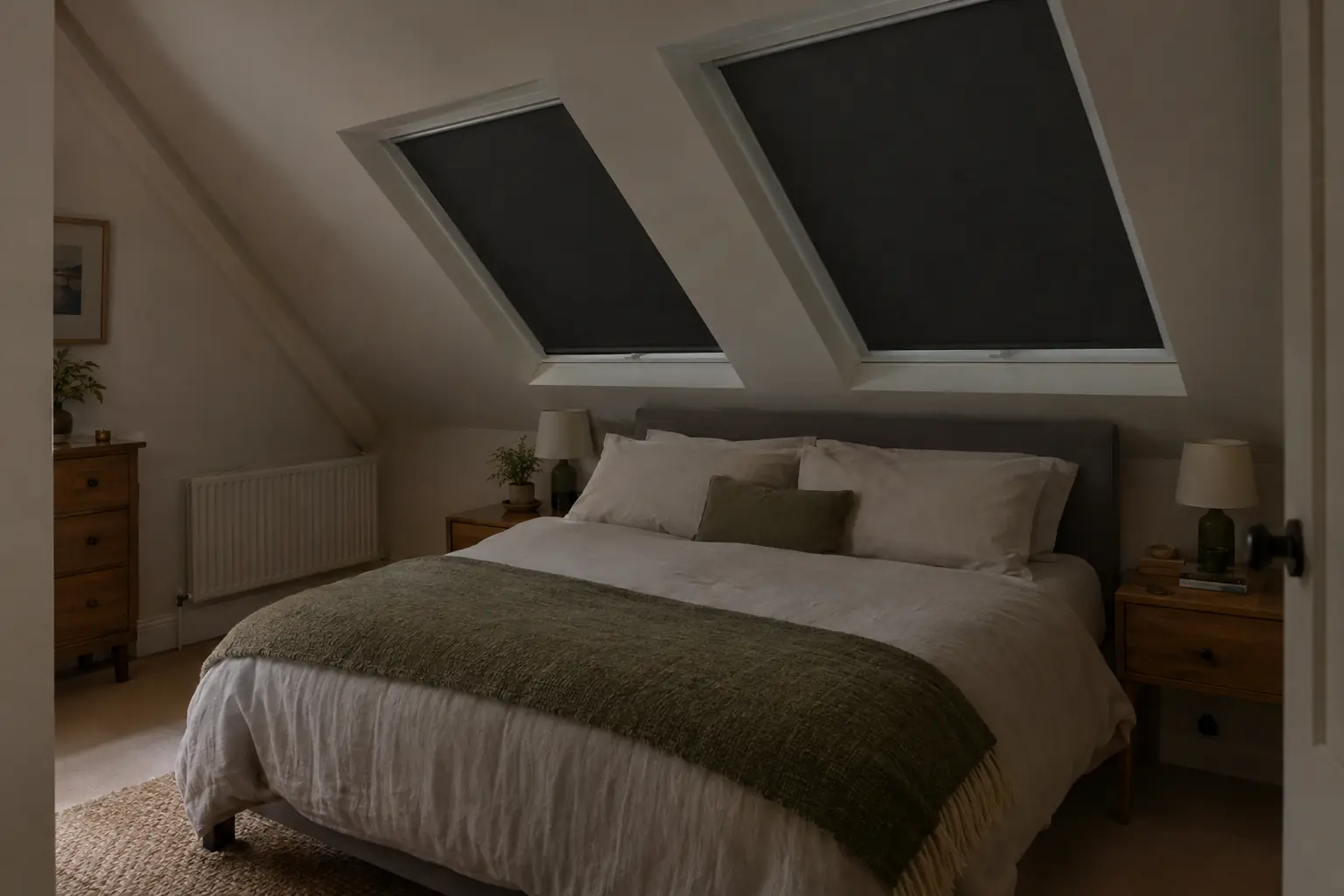
Loft bedrooms get the earliest light in the house. A roof window looks straight up at the sky, so on a summer morning it catches the dawn well before a vertical window on the floor below. In June that can mean a bright room long before the alarm.
Blackout fabric is the usual answer. The coating stops light passing through the cloth, and because a skylight blind sits tight inside the frame under tension, it does not leave the wide bright gaps at the sides that a blind hanging off a sloped reveal would. That fit is as important as the fabric: blackout cloth that does not sit snugly in the frame still lets the dawn in round its edges.
NHS advice notes that sleep may come more easily in a room that is quiet, dark and cool. A loft room with bare roof glass struggles on two of those three in summer, which is why a blackout skylight blind is often the first thing people fit after a loft conversion.
If the room is a nursery or belongs to a shift worker, say so at the appointment. Your advisor will show you the blackout options for your particular roof window and be straight with you about how dark the result will be.
Heat: what a blind can and cannot do overhead
Roof glass is a heat problem as much as a light one. In summer the sun is high, and a sloping window takes it almost head-on through the middle of the day, which is why loft rooms are so often the warmest in the house.
A blind closed across the glass helps. One of the UK Health Security Agency's hot-weather tips is to close the blinds and curtains on windows exposed to direct sunlight during the day, and a skylight blind is the easiest way to do that on a window you cannot drape anything over. Blackout fabrics reflect some of the heat as well as the light, and some skylight fabrics are made specifically for heat control; your advisor will show you which suit your window.
Be realistic about the result. An internal blind stops sun reaching the room directly, but the glass itself still warms up, and some of that heat still finds its way in. A loft room with blinds will be more comfortable on a hot afternoon than one without; it will not be the coolest room in the house.
The habit matters as much as the blind. Close it before the sun reaches the glass rather than once the room is already hot. That is one of the strongest arguments for a motor with a timer.
Reaching a blind you cannot reach
Plenty of roof windows are within arm's reach, especially low on a sloping loft ceiling, and for those a blind moved by hand is perfectly practical. The ones that cause trouble are the high ones: at the apex of a vaulted ceiling, above a stairwell, or over a bath or a bed that you cannot stand beside.
There are two answers. A long pole lets you catch the blind's handle and move it from the floor, which is fine for a window you adjust once a day. A motor removes the problem altogether. Most motorised blinds have a rechargeable battery in the headrail, recharged by plugging in a lead every few months, which avoids any wiring. Mains power suits a blind that moves many times a day or is awkward to reach for charging. Where there is no supply close by, a registered electrician has to put one in first, because we do not carry out electrical work ourselves.
You control them from a handset or an app. Put every roof window in the room on one group and they open and close together, or set a timer so they shut before the afternoon sun arrives. The motor carries the same 1-year guarantee as the blind. For a window above a stairwell, motorised is what almost everyone ends up choosing.
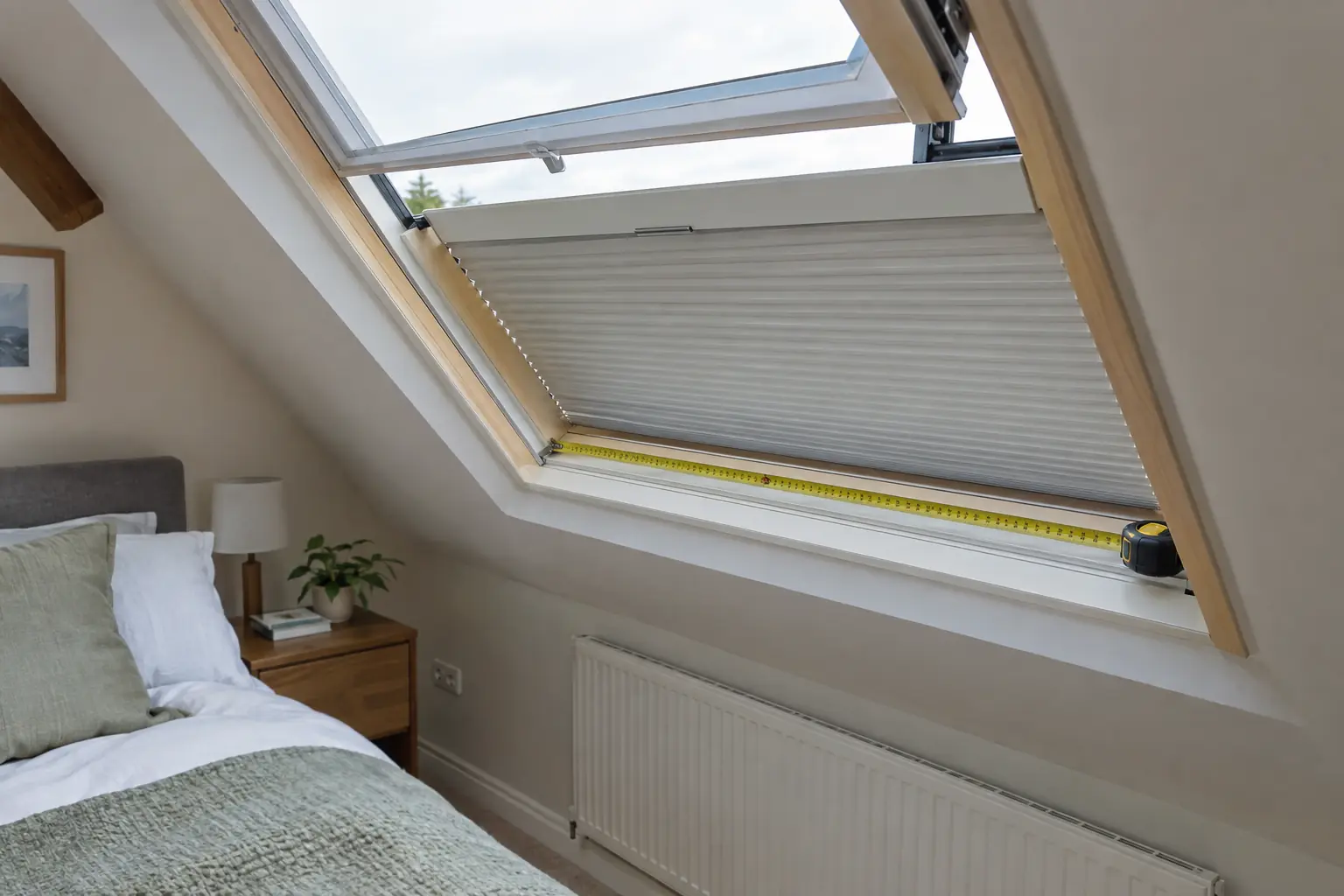
Measuring overhead glass
A skylight blind fits the frame of the roof window, and roof window frames differ from one make and model to the next. The fixing points, the depth of the frame and the size of the opening all have to match, and a few millimetres the wrong way leaves either a blind that will not fit or a bright line of light down the side.
That is why a roof window is always measured on site. Your advisor looks at the frame itself, not just the glass, and measures it there and then. It is also why a skylight blind is quoted after the visit rather than from a photograph.
You can help before the appointment. Many roof windows carry a small plate on the frame, visible when the sash is opened, giving the manufacturer's type and size. If you can find it safely, take a photo of it for your advisor. Do not climb onto furniture to reach a high window; the advisor will bring what they need.
If there are several roof windows in the room, each one is measured on its own. Windows that look identical from below are not always the same size or model, particularly where a loft has been extended in stages.
Dressing a whole loft room
Most loft rooms have more than one kind of window: roof windows in the slope, and often a dormer or a gable window as well. It is worth planning them together rather than one at a time.
Keep the fabric consistent. A blackout skylight blind in charcoal next to a cream roller on the dormer can look disjointed, so either match the colour or pick tones that clearly belong together. Your advisor brings the skylight fabrics and the ranges for vertical windows to the same appointment, so you can see them side by side against the slope of the ceiling.
Match the job, too. If the roof windows are blackout for sleeping, the dormer needs to be just as dark, or the room will still wake you. A blackout roller on the dormer, fitted outside the recess, pairs well with blackout skylight blinds.
Finally, think about control. Blinds grouped on one handset or timer make a loft room far easier to live with, particularly when some windows are high and some are low. A room where every blind moves together is one where the blinds actually get used.
Pros and cons
In its favour
- Held flat against sloping glass at any angle, and stays where you leave it
- Blackout fabrics for loft bedrooms and nurseries
- Fits inside the roof window's frame, so it sits tight to the glass
- Can be motorised, grouped and put on a timer for windows out of reach
- Cuts direct sun through roof glass on hot days
Worth knowing
- Needs the actual frame surveyed; it cannot be quoted from a photo
- An internal blind reduces heat from roof glass but does not stop it
- A high window without a motor means a pole every time
Room by room
- Loft bedroomA great fitBlackout fabric held tight inside the frame keeps the early summer dawn out of a room that faces the sky.
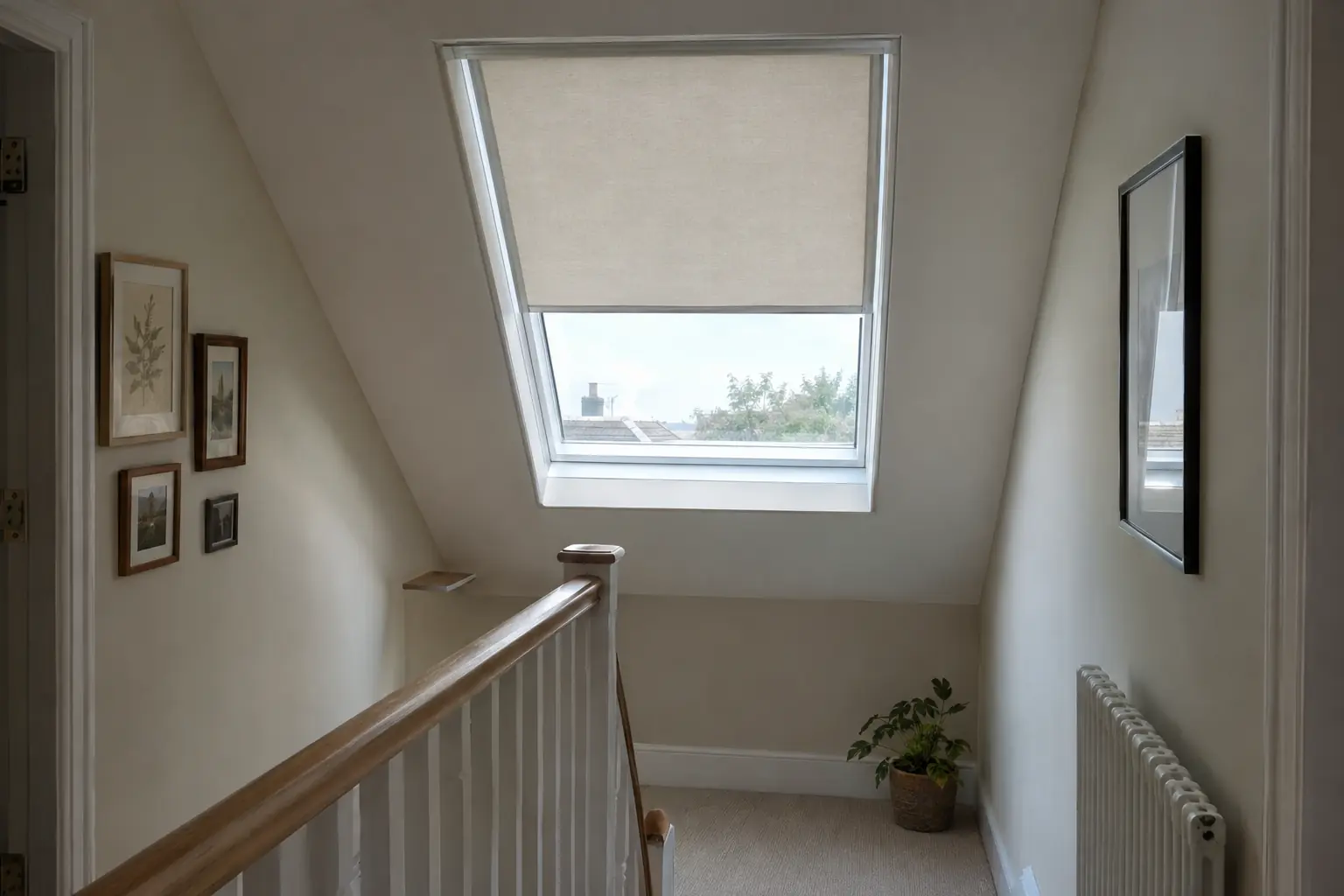
- Stairwell or landingA great fitMotorised, a roof window blind over a stairwell can be closed against the afternoon sun without a ladder or a pole.
- Loft home officeWorks wellTakes the glare off a screen when the sun is overhead; a lighter fabric keeps the room bright.
- Kitchen extension with roof windowsWorks wellShades the table and worktops from high midday sun; grouped motors make several roof windows easy to manage.
- Bathroom roof windowThink twiceSteam and fabric need thought. Ask your advisor which skylight fabric suits a humid room before you choose.