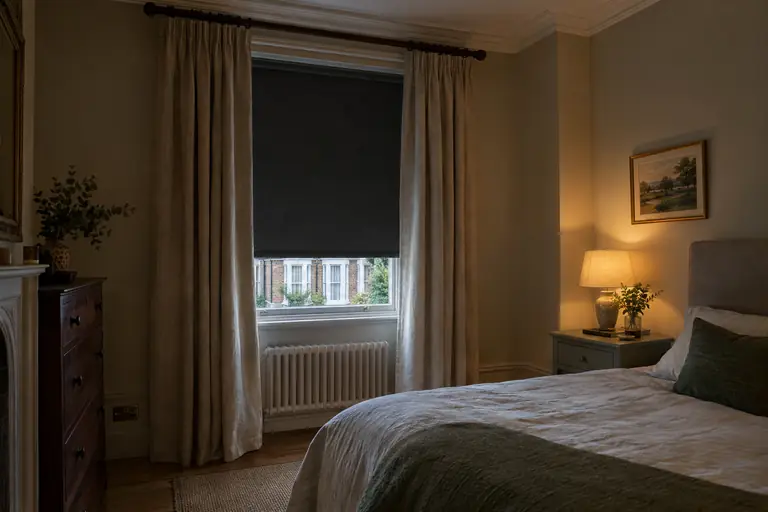
The short answer
A blackout blind uses fabric coated or backed so that no light passes through it, but no blind inside a recess is completely dark, because it needs a small gap at each side to move. For the darkest room, choose a blackout roller or roman fitted outside the recess so it overlaps the opening, or add blackout-lined curtains over it. Slatted blinds cannot be blackout. For a nursery or a shift worker, your advisor will say what your window allows.
- Blackout describes the fabric: no light passes through the weave, whatever colour is on the front.
- Inside a recess, light still gets in down the sides, over the top and under the bottom.
- An exact fit that overlaps the opening, or lined curtains over the blind, gives the darkest room.
- Rollers and romans take blackout fabric; slatted blinds and day and night blinds cannot be blackout.
- For nurseries, choose cordless or motorised: RoSPA advises no looped cords or chains in a child's bedroom.
How much light gets through
Swipe to see the whole diagram
The fabric decides how much light comes through the blind itself; the fit decides how much comes round the edges.
What blackout fabric does, and what it can't
Blackout describes a fabric, not a room. A blackout fabric is coated or backed so that no daylight passes through the weave: hold a sample up to a bright window and nothing glows through it. That is the part you can judge from a swatch.
What the label cannot promise is a dark room, because a blind is a piece of fabric hanging in a hole in the wall, and light comes round it. How much depends on where the blind hangs, how closely it covers the opening and what sort of blind it is, and none of that is printed on the sample.
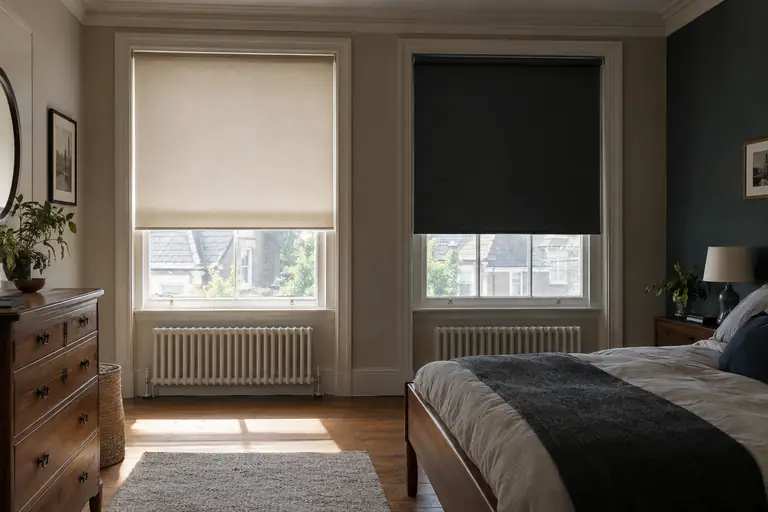
The darkness comes from the coating or backing rather than the colour on the face, so a pale blackout fabric keeps out as much light as a navy one. That frees you to choose the colour for the room: a soft cream in a small bedroom does not have to mean a lighter room at night.
It also helps to know what you are comparing it with. A dimout fabric takes a room well down but lets a little light through, which some people prefer, because you can tell it is morning. Blackout is for the rooms where you would rather not be told.
Where the light gets in
Stand in a bedroom with a blackout roller fitted inside the recess at dawn in midsummer, and you will see exactly where a blind leaks.
Down the sides. A blind inside the reveal needs a small clearance at each end so it can move without scraping, and the brackets and control take up a little of the width, so the fabric stops short of the plaster. The result is a pale stripe of daylight down each edge of the blind, bright against the dark fabric.
Over the top. On a recess-fitted roller the fabric drops from the roll, leaving a gap between the roll and the top of the reveal. Low morning sun comes through it and lights the ceiling.
Under the bottom. If the blind stops just short of the sill, or the sill is not quite level, a strip of light shows along the bottom.
Your eyes make all of this look worse than it sounds. In a dark room they adapt, and a line of light you would not notice at midday becomes the brightest thing in the room. That is why a blind can be blackout and still not be dark enough for a baby's nap or a night worker's sleep, and why the fit deserves as much thought as the fabric.
Closing the gaps: fit and overlap
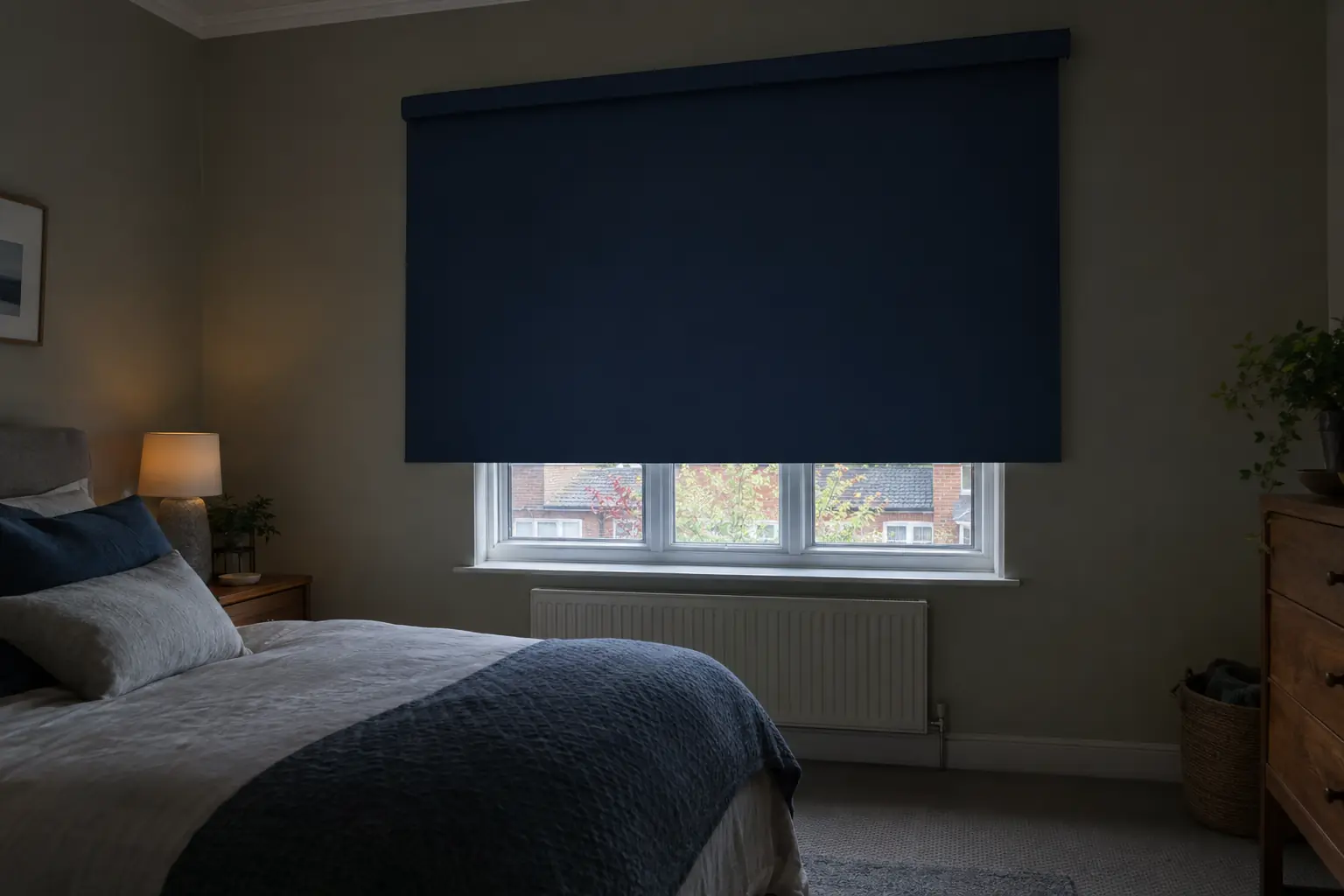
The most reliable way to cut the edge leak is to take the blind out of the recess. An exact fit, also called a face fit, is fixed to the wall above the window and made wider and longer than the opening, so it overlaps on every side. Light that gets past the edge of the fabric lands on the wall rather than in the room, and the more generous the overlap, the less of it reaches you.
Height helps too. A blind fixed a little above the reveal covers the gap over the top, and one that drops past the sill covers the bottom, though that depends on the window board and anything underneath it, such as a radiator you do not want to cover.
Some windows can take a system in which the fabric runs in channels down each side, closing the side gaps. Whether yours can depends on the window, the reveal and the blind, so ask your advisor, who will tell you on the day what the window allows.
If you love the look of a blind inside the recess, you do not have to give it up. A blind in the reveal with lined curtains outside it is the classic way to have both, and it is covered further down.
Which blinds can be blackout
Not every blind can be made dark, and it is worth knowing which before you fall for a style.
Rollers are the most common blackout blind: a single sheet of coated fabric, and the simplest to fit over the recess for the darkest result. Romans take a blackout lining behind the face fabric, which gives a softer, curtain-like look in a bedroom with the same effect through the fabric. Because a roman's folds stack at the top, it is often fitted above the window anyway, which helps with the gap over the top.
Honeycomb blinds come in blackout cell fabrics and dim a room well, but the cords pass through small holes in the fabric and those pinholes let points of light through, so they are not as dark as a blackout roller fitted over the reveal. There are blackout pleated blinds in the perfect fit style too, which sit in a slim frame on the glass of a uPVC window; ask your advisor how dark they get on yours.
Day and night blinds are not blackout: light passes where the bands meet. Slatted blinds, whether venetian, wooden or vertical, cannot be made blackout at all, because light passes at every slat edge however tightly they close.
Roof windows are a special case. Gravity pulls an ordinary blind away from sloping glass, so skylight blinds run in side channels, which is also what stops light creeping round them.
Blackout with curtains: the belt-and-braces answer
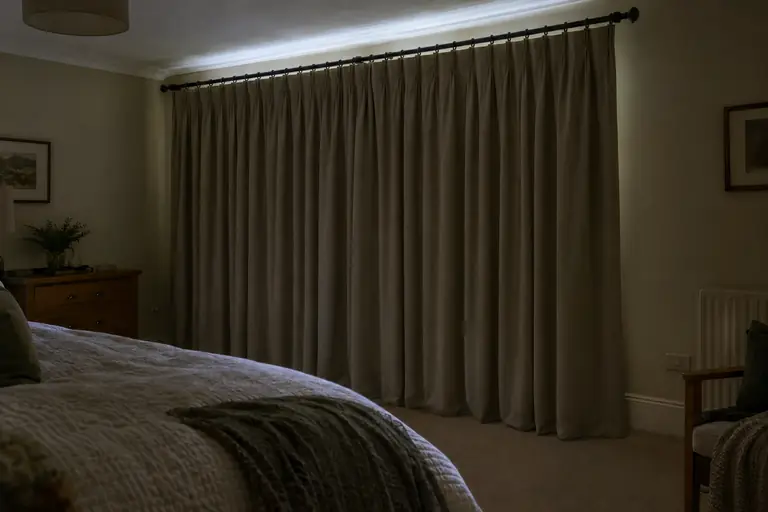
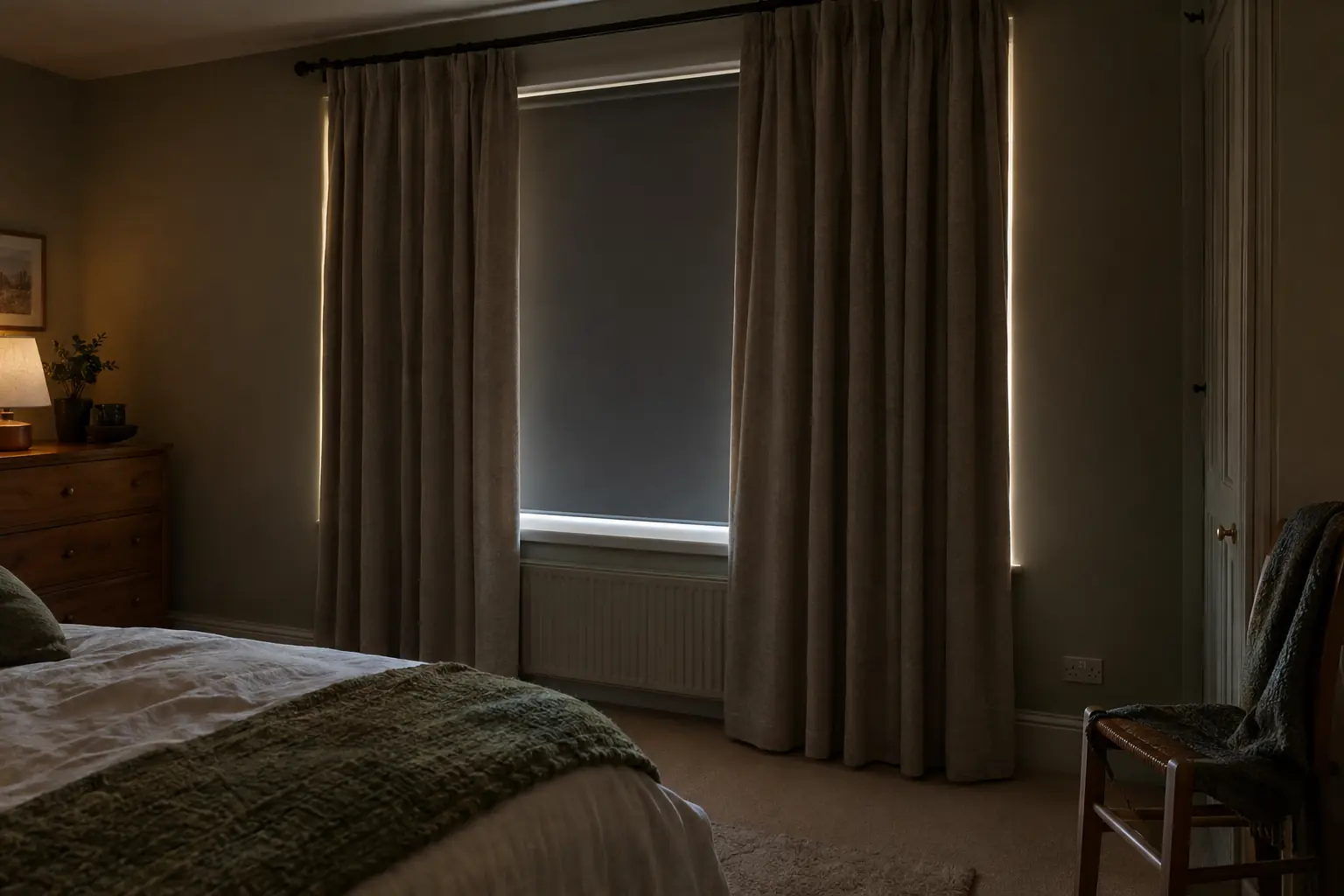
The darkest bedrooms we dress usually have two layers: a blackout blind inside the reveal and blackout-lined curtains on a pole or track outside it.
Each covers the other's weakness. The blind stops light through the glass and gives you privacy with the curtains open. The curtains, hung wider than the window and dropping past the sill, lie over the gaps at the sides and bottom of the blind, and a pole set above the reveal deals with the top. On a winter night the curtains add warmth as well.
For it to work, the curtains need to be wide enough to overlap the opening on both sides when drawn, and the reveal needs to be deep enough for the blind to hang clear of the handles. Your advisor checks both at the appointment, and the poles and tracks are supplied and fitted with everything else.
It solves a design problem too. A slim roller in the recess keeps the window neat by day, and the curtains bring colour, pattern and softness to the room. If you would rather have a single layer, choose a blackout roller or roman fitted over the recess and generous enough to overlap it.
Nurseries and children's rooms
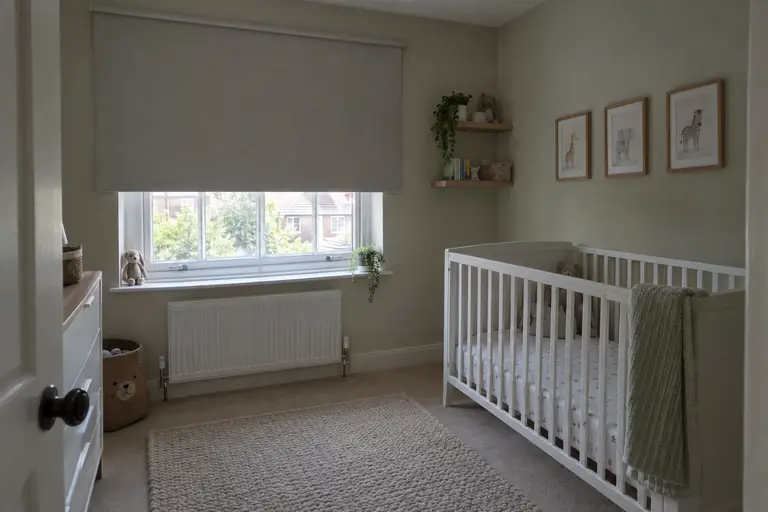
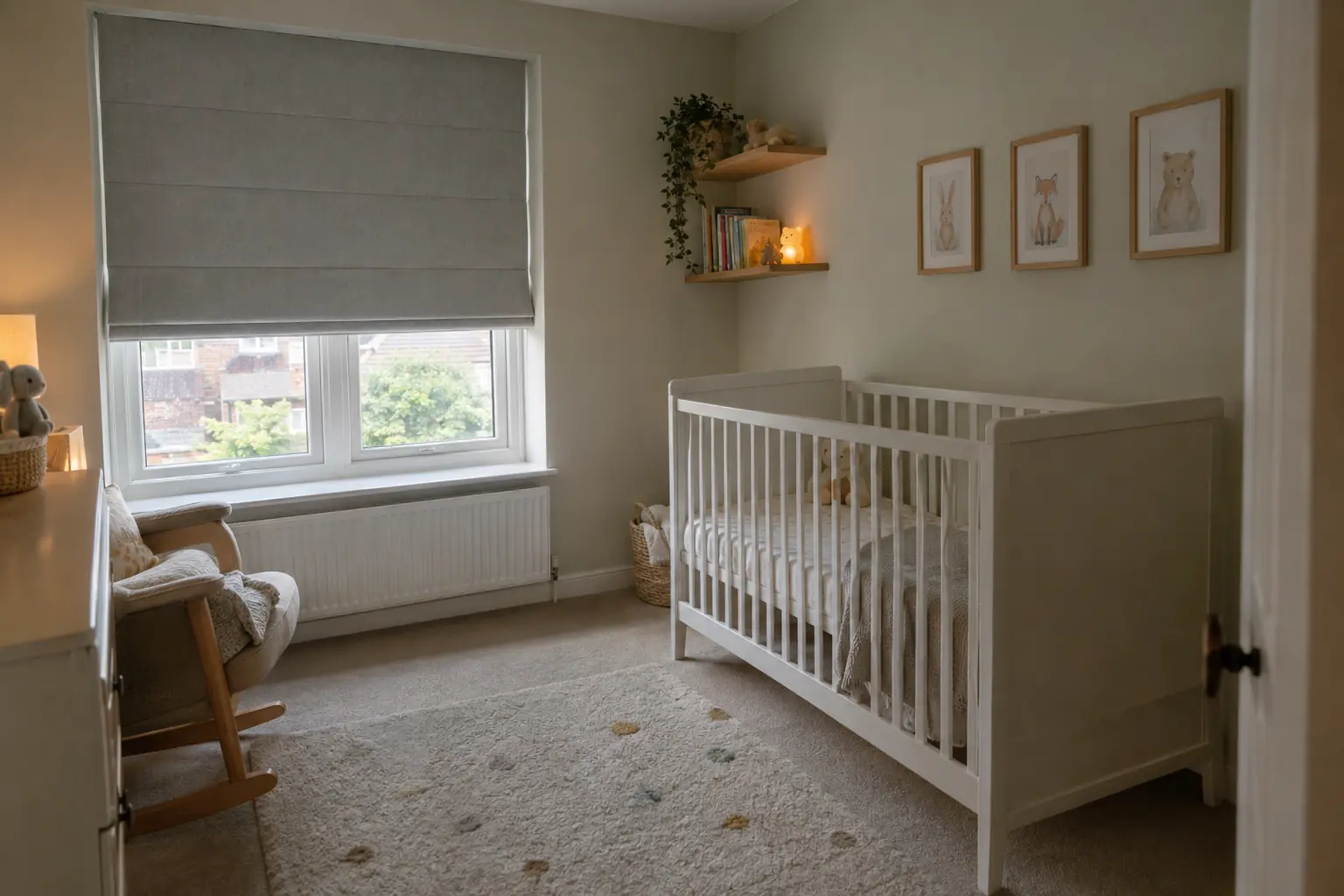
Babies and young children often need to sleep while it is still light outside, whether that is a lunchtime nap or a summer bedtime. NHS advice for children's sleep, from Somerset NHS Foundation Trust, is to make the bedroom dark for sleep and says you can use blackout blinds. It adds that a night light is fine for children who are afraid of the dark, and suggests a red or orange one.
How the blind is worked matters as much as how dark it is. RoSPA advises never fitting a blind with a looped cord or chain in a child's bedroom, and the Child Accident Prevention Trust advises moving cots, beds, highchairs and playpens away from looped blind cords, because young children climb. For a nursery we usually recommend a cordless or motorised blackout blind, so there is no loop at the window at all.
Every corded blind we supply comes with the child-safety devices UK regulations require, and our fitter installs them and shows you how they work. In a child's bedroom, though, no cord at all is the better answer. Put the cot on a wall away from the window too: it keeps a curious toddler away from the glass and out of the chill that comes off it on a winter night.
Shift workers and light sleepers
For anyone sleeping by day, a bedroom has to do something it was never designed for. The NHS advice for sleeping better is to make sure the bedroom is dark and quiet, using curtains, blinds, an eye mask or ear plugs if needed, and its Every Mind Matters advice notes that you may find it easier to sleep in a room that is quiet, dark and cool.
Daytime is when the edge leak is at its worst: the sun is high, the light is strong and it is on the window for hours. So for a shift worker the fit is not a detail. An exact fit with a generous overlap, or a blind and blackout-lined curtains together, is what we would expect to suggest, and your advisor will say which your window suits.
Cool is the other half. A blackout coating reflects some of the sun rather than absorbing it, which helps a bedroom on the sunny side of the house, but heat is a different problem to light, and if the room overheats it is worth looking at thermal fabrics as well. And if you sleep at odd hours, a motorised blind lets you close it from bed without letting the light in by fiddling with a chain.
Pros and cons
In its favour
- Stops light through the fabric itself, whatever colour you choose
- Available on rollers and romans, and as a lining on curtains
- An exact fit or curtains over the blind close most of the edge leak
- Makes daytime naps and day sleep after a night shift far easier
- The coating reflects some sun, which helps a bright bedroom stay cooler
Worth knowing
- Fitted inside a recess, there will always be a thin line of light at the sides
- Slatted blinds and day and night blinds cannot be made blackout
- A properly dark room by day means lamps on if you want to use it
- A looped chain is not suitable in a child's bedroom, so nursery blinds need cordless or motorised control
Room by room
- Main bedroomA great fitA blackout roller or roman, fitted over the recess or layered with curtains, handles early summer mornings.
- NurseryA great fitA dark room helps daytime naps; choose cordless or motorised so there is no looped chain near the cot.
- Loft bedroom with roof windowsWorks wellRoof windows need blackout blinds held in side channels; your advisor checks the frame before quoting.
- TV room or snugWorks wellBlackout stops daytime glare on the screen, though dimout is often enough if you mostly watch in the evening.
- Living roomThink twiceA fully dark living room is rarely what you want by day; dimout or a day and night blind usually suits better.
- KitchenThink twiceA kitchen rarely needs darkness; a wipeable roller or a venetian does the useful job there.