The short answer
Blackout fabric is coated so that no light passes through the weave. Dimout lets some light through and takes a room down several stops without making it dark. Thermal fabric is woven or backed to slow heat moving through the window. Some fabrics are both blackout and thermal. How dark or warm the room ends up also depends on the fit, because light and cold air both find their way round the edges of a blind in a recess.
- Blackout stops light passing through the fabric, but light can still get round the edges of a blind in a recess.
- Dimout softens light and gives privacy while the room stays usable; it will not make a room dark.
- Thermal is about heat, not light: it slows warmth escaping in winter and keeps sun-facing rooms cooler in summer.
- Some fabrics are blackout and thermal at once; others do only one job, so check the label for each.
- On curtains, the lining decides: standard, thermal, blackout or interlining.
How much light gets through
Swipe to see the whole diagram
The fabric decides how much light comes through the blind itself; the fit decides how much comes round the edges.
Three labels, three different jobs
The labels on blind and curtain fabrics describe performance, and it helps to read them as answers to three separate questions. How much light gets through the fabric? That is blackout or dimout. How much heat gets through it? That is thermal.
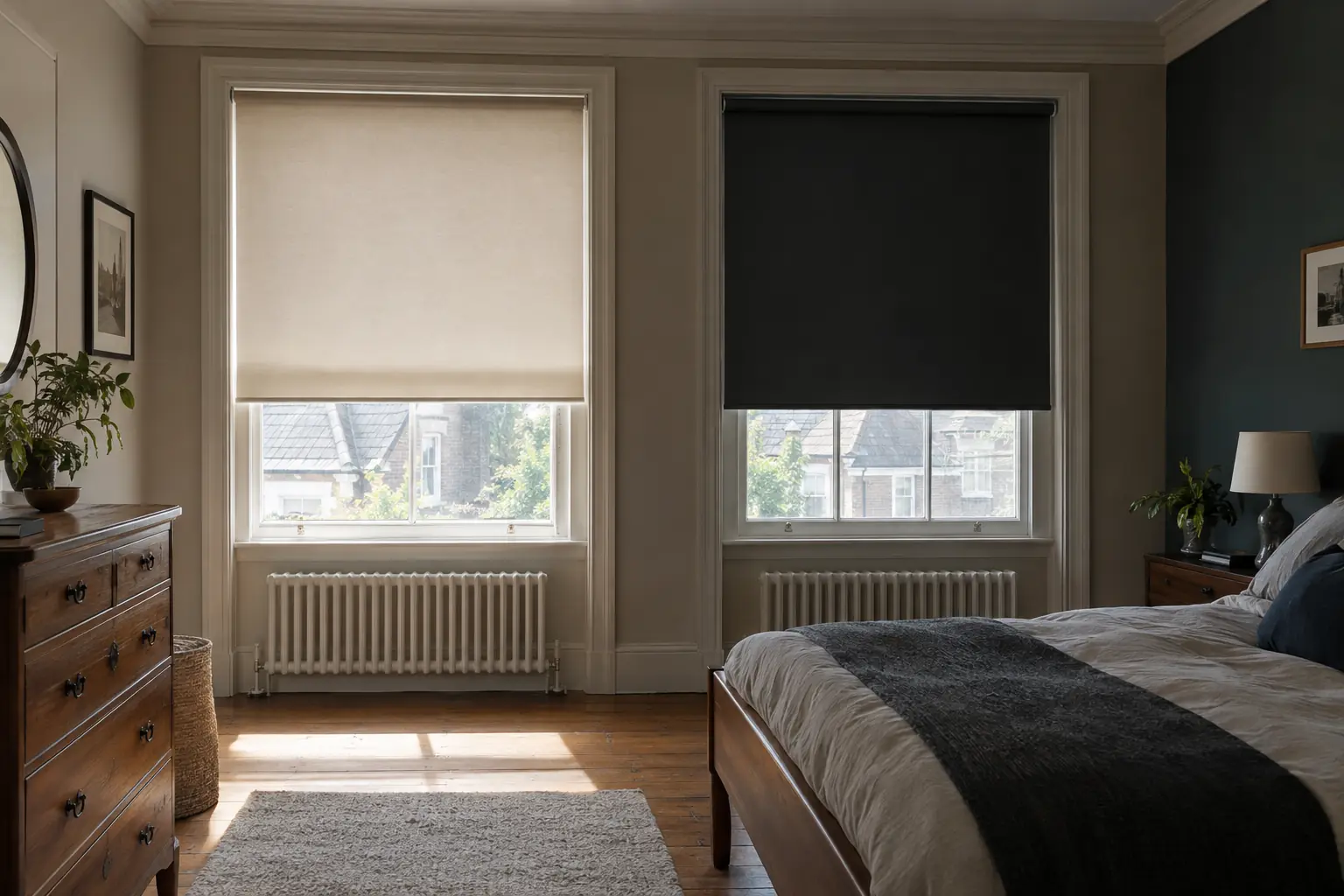
Blackout means the fabric stops light passing through the weave completely. Dimout means it lets some light through and takes the room down several stops, so it feels shaded and private but you can still see to move about. Thermal means the fabric is woven or backed to slow heat moving through the window, in either direction.
The mistake people make is to assume that one label covers the others. A blackout blind is not automatically the warmest option, a thermal blind is not automatically dark, and a dimout will not get a bedroom dark on a June morning, however well it is fitted.
The other thing all three have in common is that the fit matters as much as the fabric. Light and cold air both find their way round the edges. A perfect blackout fabric with a gap at each side is not a dark room, and a thermal fabric hanging loose in front of a window is not a warm one. The sections below take each label in turn, then the places where they overlap.
Blackout: dark, but mind the edges
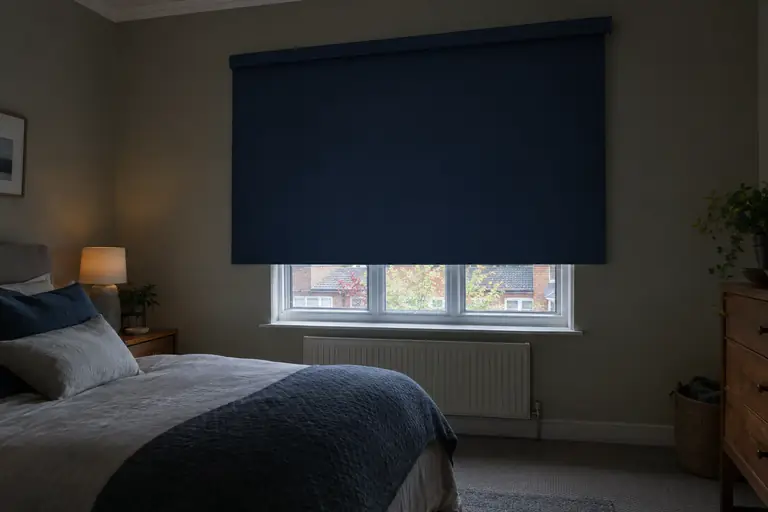
Blackout fabric has a coating on the back that light cannot pass through, so the fabric itself stops the light completely. Rollers and Roman blinds both take blackout fabric, and blackout lining is standard on curtains. Slatted blinds cannot be blackout in the same way, because light passes at every slat edge however tightly they close, and day and night blinds are not blackout either, because light always passes through their sheer stripes.
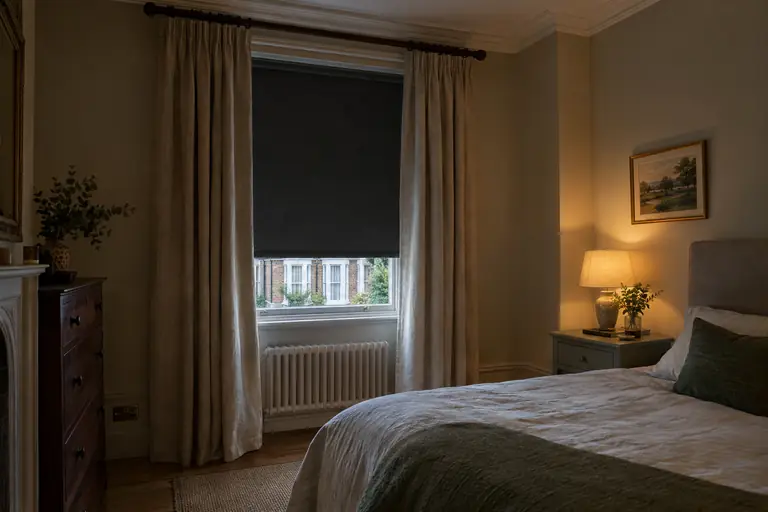
The catch is the edges. A blind inside a recess cannot touch the side walls or it would scrape, so there is always a slim gap, and daylight finds it: a pale stripe down both sides and a glow over the top of the roll. For most bedrooms that is fine. For a nursery, a shift worker or anyone woken by the dawn, fitting the blind outside the recess so it overlaps the opening, or adding lined curtains over a blackout blind, is what closes the gap. Your advisor will say on the day which the window allows.
Darkness is worth taking seriously. NHS advice for sleeping problems includes making sure the bedroom is dark and quiet, using curtains or blinds if needed, and an NHS trust's advice for children's sleep suggests blackout blinds to make the bedroom dark.
Dimout: the everyday middle ground
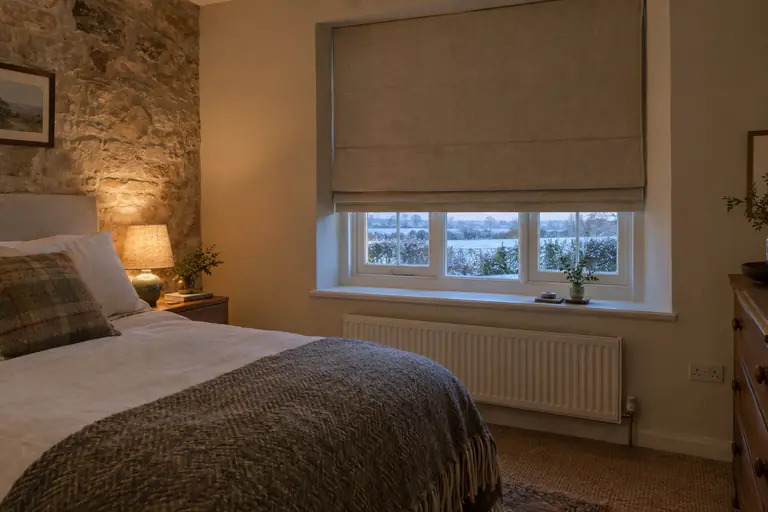
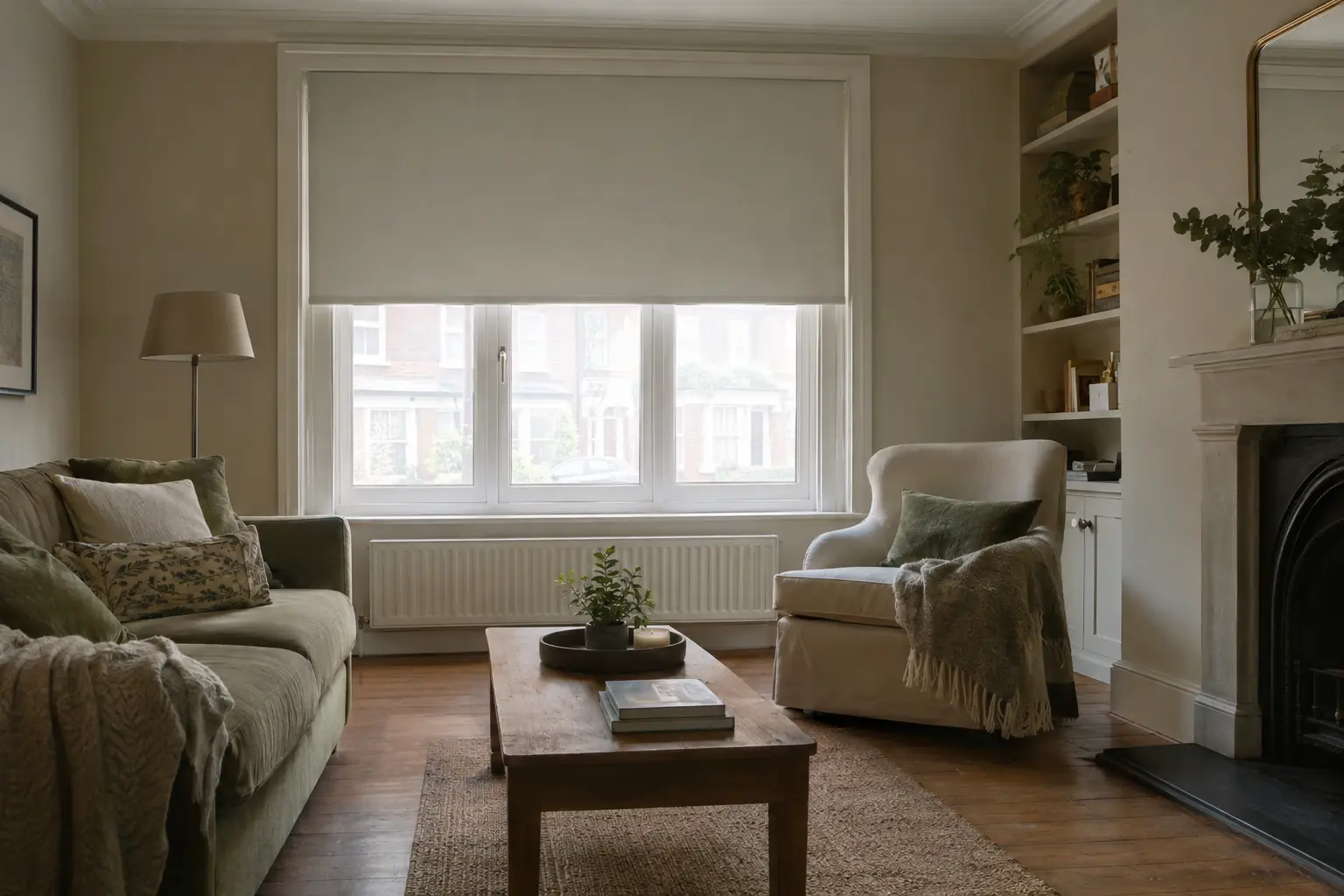
Dimout sits between a sheer fabric and blackout. It filters daylight rather than stopping it, so the room goes down several stops, glare off a screen disappears, and people outside cannot see in during the day, while you can still read, work or cook without switching the lights on.
That makes dimout the usual choice for rooms you use in daylight: living rooms that catch the afternoon sun, kitchens, home offices and street-facing rooms where privacy matters more than darkness. It is also a sensible choice for bedrooms where a little morning light is welcome, particularly for people who find a completely dark room hard to wake up in.
What dimout will not do is black a room out. On a bright summer morning, a dimout blind glows. If a bedroom needs to be properly dark, choose blackout, or put a dimout blind in the recess for daytime and blackout-lined curtains outside it for the night.
Because dimout fabrics vary in how much they let through, they are the hardest of the three to judge from a picture. Look at samples against your own window in daylight. Free samples are posted first class, up to five per order, and your advisor brings the full range to the appointment so you can hold each one up to the glass.
Thermal: about heat, not light
A thermal fabric has a woven or backed layer that reflects heat rather than absorbing it. In winter, it helps keep warmth in the room instead of letting it escape through the glass. In summer, the same layer helps keep a south-facing room cooler by turning some of the sun's heat away at the window.
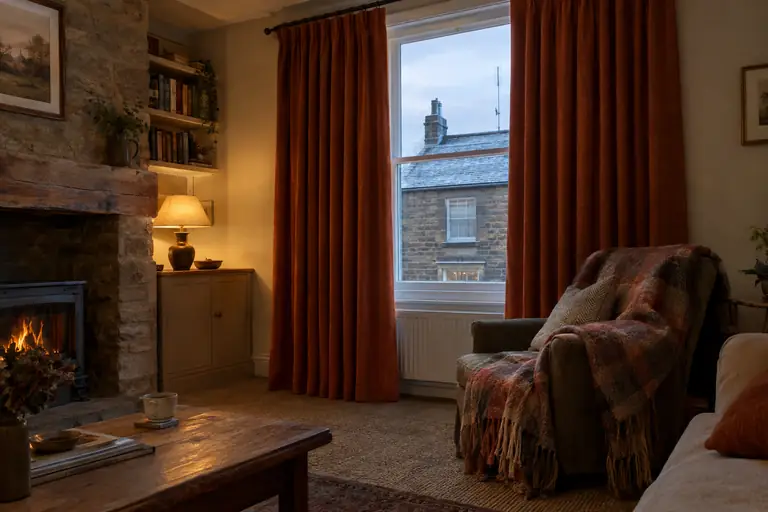
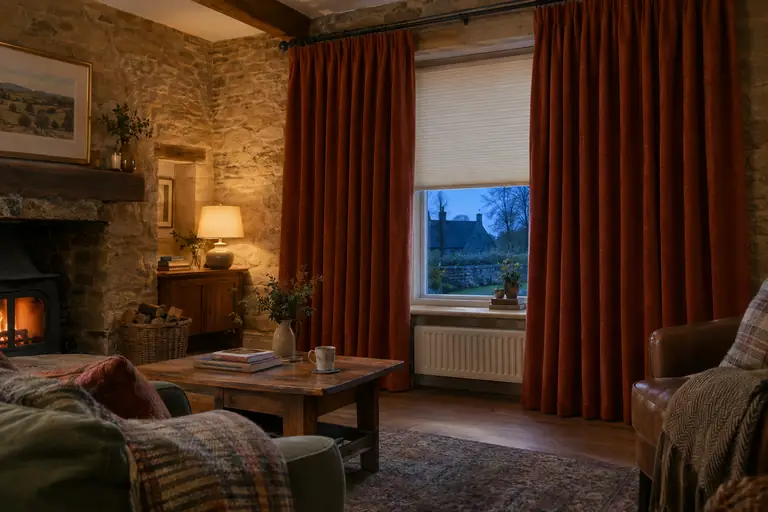
A honeycomb blind is warmer still, because each pleat forms a sealed cell of trapped air. A thermal roller or Roman is the sensible middle ground, and works well on a room you heat but do not spend all day in. On curtains, the warmth comes mainly from the lining, a thermal lining in particular, rather than the face fabric, and weight helps: government advice on draught-proofing says heavy curtains can cut the heat a window loses overnight.
Thermal fabric does most in the rooms that need it most: single-glazed windows, north-facing bedrooms and rooms with a lot of glass. On modern double or triple glazing, where the window itself already slows heat, you will notice less. Fit matters here as well: a gap round the edges lets cold air spill into the room, whatever the fabric. Our guide to keeping your home warm goes into fit, timing and radiators in detail.
Where the labels overlap
The labels are not exclusive, and some fabrics carry two of them. A blackout fabric with a reflective coating can also slow heat. A thermal fabric may also be blackout, or it may let some light through. When you browse, the same range can appear under more than one heading, and that is why.
A blackout coating does turn back some of the sun's heat, but stopping light and stopping heat are separate jobs. If the real trouble is a room that overheats in the afternoon, a thermal fabric is made for that job, and a blackout fabric only does part of it. Equally, if the trouble is a cold bedroom that also needs to be dark, a fabric that is both, or a blackout blind with thermal-lined curtains outside it, covers both at once.
Honeycomb blinds show how the labels can pull against each other. Blackout honeycomb fabrics are available and dim a room well, but the small holes where the cords pass through the cells mean they are not as dark as a blackout roller fitted over the reveal.
The simplest way through is to tell your advisor what each room needs to do, in order of importance: dark first, warm first, or light and private first. The right fabric follows from the answer.
On curtains, the lining decides
With curtains, you choose the face fabric for how it looks, and the lining for what it does. That separation makes curtains easier to specify than blinds: almost any fabric can be made up with the lining the room needs.
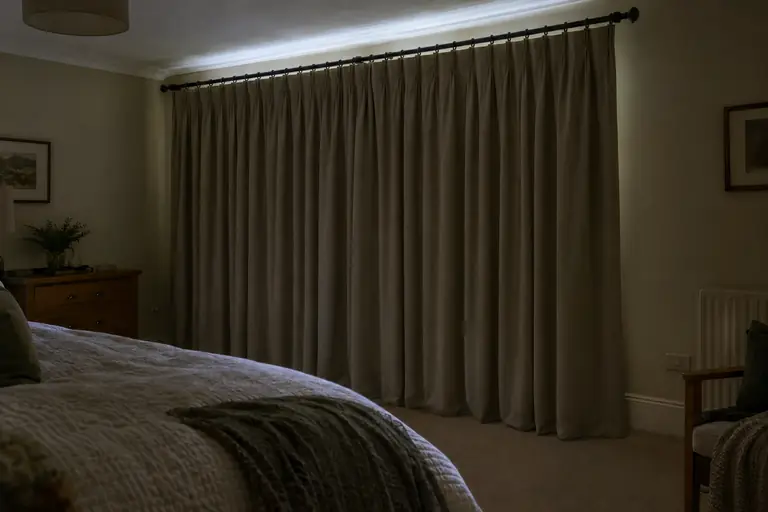
A standard lining protects the fabric from the sun and improves how it hangs, and on a mid-weight fabric it gives a softened, shaded room rather than a dark one. A thermal lining is the choice for a cold north wall or a single-glazed bay. A blackout lining is what you want in a bedroom. Interlining sits between the face fabric and the lining, adding weight and body for a fuller, heavier drape.
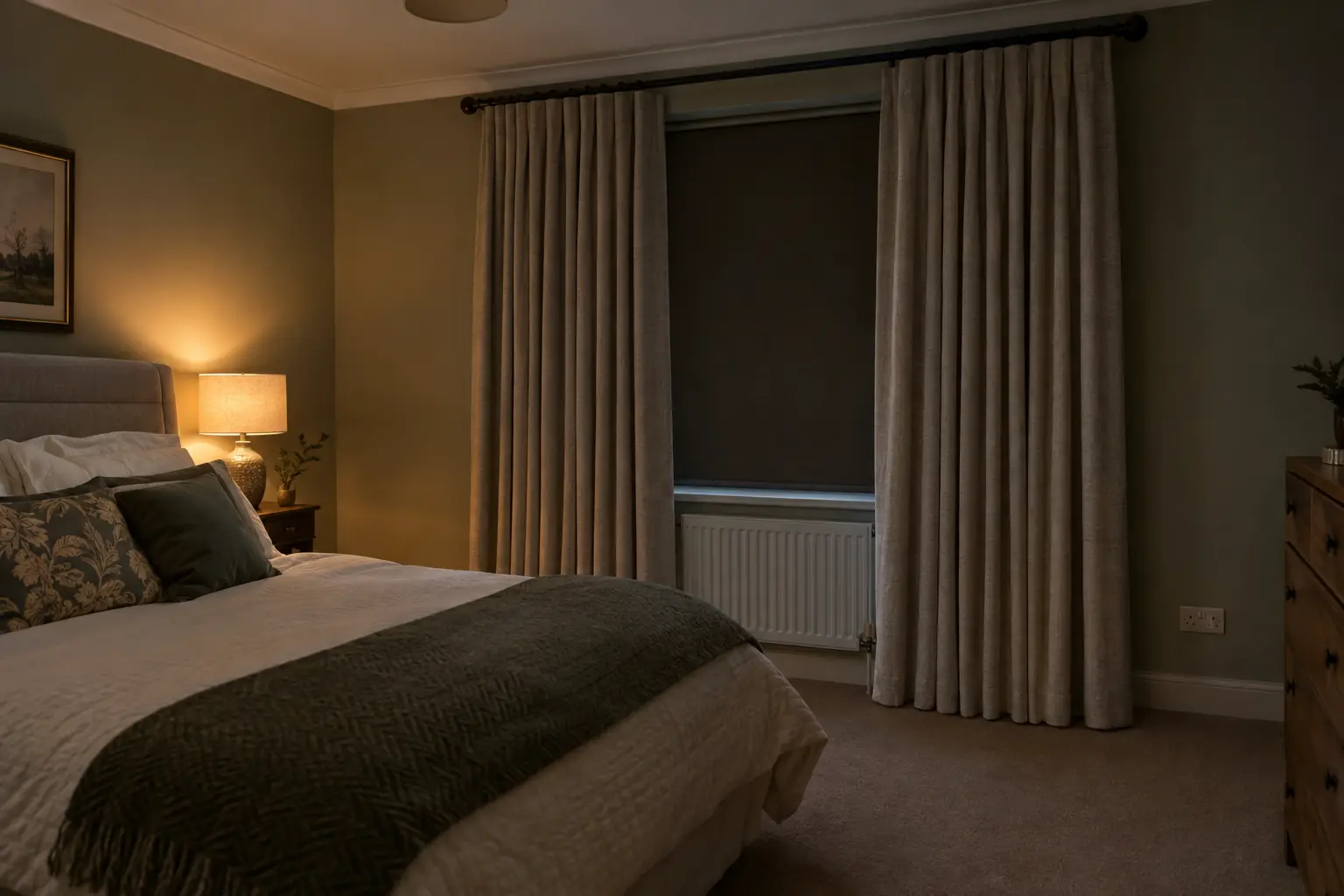
Curtains also solve the edge problem that a blind in a recess has. Hung from a pole or track that runs beyond the opening, they close over the edges of the window rather than inside them, which is why a blind in the recess and curtains outside it is such a common pairing. The blind gives you daytime privacy or blackout close to the glass, and the curtains add the final layer of darkness and warmth.
If you are torn between labels, that combination is usually the answer, and your advisor will check that the reveal is deep enough for both.
Side by side
What it is for
- Blackout
- Darkness: stopping light passing through the fabric
- Dimout
- Softer light and privacy without a dark room
- Thermal
- Warmth in winter, less heat from the sun in summer
How it works
- Blackout
- A coating on the back that light cannot pass through
- Dimout
- A closely woven fabric that filters light rather than stopping it
- Thermal
- A woven or backed layer that reflects heat rather than absorbing it
In the daytime
- Blackout
- The room goes dark apart from light at the edges
- Dimout
- The room dims but stays usable
- Thermal
- Depends on the fabric: some thermals are also blackout
Effect on heat
- Blackout
- Helps a little, because the coating reflects
- Dimout
- Not designed for it
- Thermal
- Designed for it
At the edges
- Blackout
- Light gets round a recess fit; an exact fit or curtains close the gap
- Dimout
- Edge light rarely matters
- Thermal
- Cold air moves round the edges; a close fit matters as much as the fabric
On blinds
- Blackout
- Rollers and Romans; not slatted blinds
- Dimout
- Roller fabrics, and some day and night blinds
- Thermal
- Rollers, Romans and honeycomb blinds
On curtains
- Blackout
- Blackout lining
- Dimout
- Chosen through the fabric and a standard lining
- Thermal
- Thermal lining, or interlining for more body
Best rooms
- Blackout
- Bedrooms, nurseries, shift workers' rooms
- Dimout
- Living rooms, kitchens, street-facing rooms
- Thermal
- North-facing rooms, single-glazed bays, sun-facing rooms
Watch for
- Blackout
- A thin line of light at each side in a recess
- Dimout
- Not dark enough for early summer mornings
- Thermal
- A smaller difference on modern double or triple glazing