The short answer
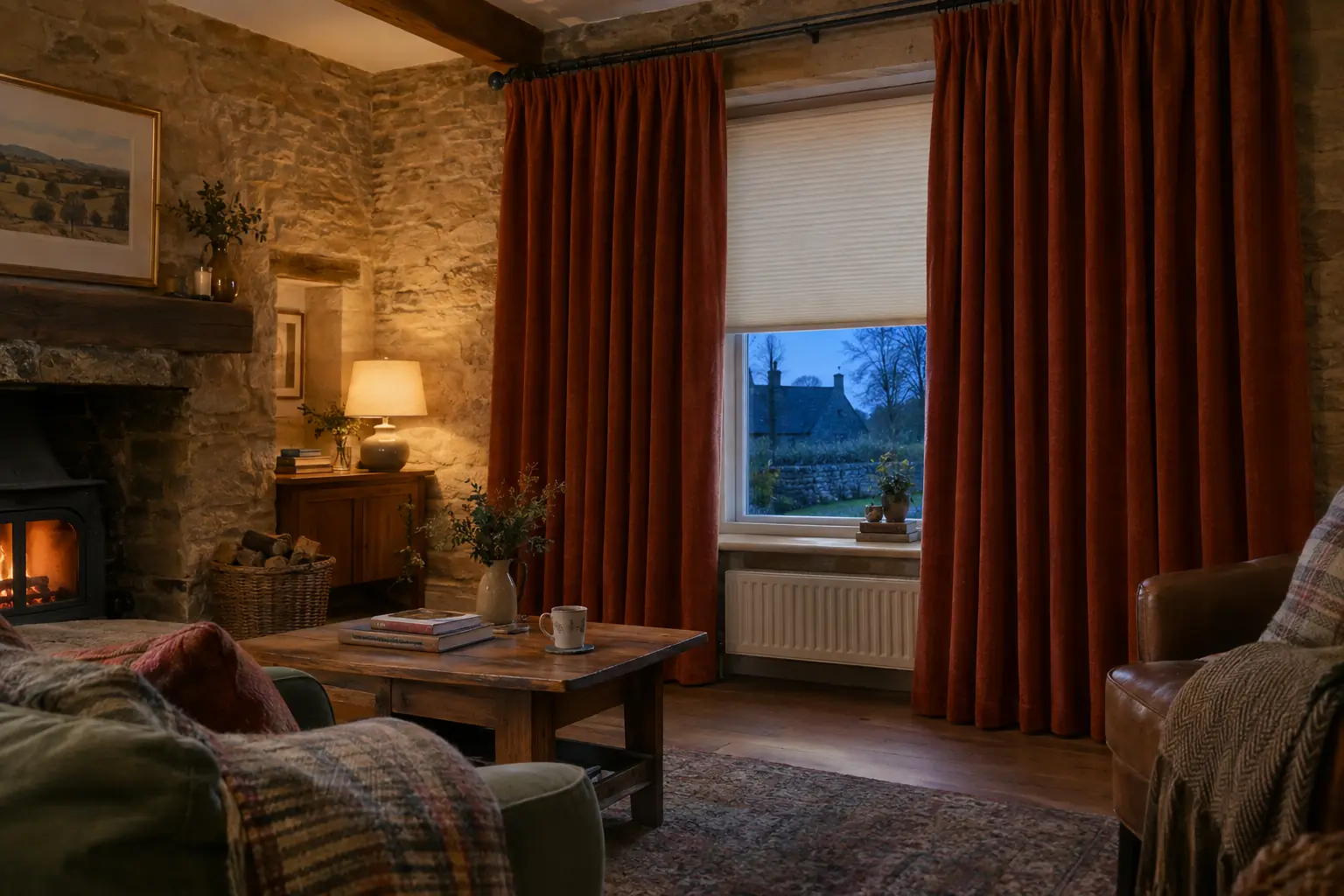
Close blinds, curtains and shutters at dusk and open them to the sun during the day. Heavy or thermal-lined curtains reduce heat loss through a window at night, and honeycomb blinds trap air in their cells. Fit matters as much as fabric: a covering that sits close to the glass or overlaps the opening stops cold air tumbling into the room. Keep curtains off radiators, and do not expect a blind to fix a draughty frame.
- Heavy and thermal-lined curtains reduce heat loss through a window at night; close them at dusk.
- Honeycomb blinds trap air in sealed cells, which makes them warmer than a thermal roller or Roman.
- A close fit and generous overlap matter as much as the fabric, because cold air escapes round the edges.
- Curtains hanging over a radiator send its heat up the cold glass instead of into the room.
- A blind slows cold air coming off the glass, but it cannot seal a gap in the window frame.
A blind and curtains on one window, from the side
Swipe to see the whole diagram
A slim blind inside the reveal gives privacy and blackout; curtains on a pole outside it add warmth and close the light gap round the edges.
Why windows lose heat, and what a covering does
On a cold evening the glass is the coldest thing in the room. Warm air that touches it cools, becomes heavier and slides down the pane, then spreads across the floor. That sinking current is what most people feel as a draught from a window, even when the frame is perfectly sound.
A blind, curtain or shutter puts a barrier between the room and the glass. The air trapped between the covering and the window stays still and cold, and the room air on the warm side stops circulating against the pane. The better the covering holds that pocket of air in place, the less heat is carried away. That is why the material matters, and why the fit matters just as much.
It is worth being clear about what a covering cannot do. A blind will slow the cold air coming off the glass, which is what most people actually notice, but it cannot seal a gap in the frame itself. If you can feel air moving round a closed window, or see a curtain stir when the wind blows, that is a job for the window and its seals, and we would rather say so than sell you a blind to fix it.
What the research says
Official advice agrees that window coverings help, though it is careful about numbers. Government draught-proofing advice says that fitting curtains made with heavy material can reduce heat loss through a window at night. The Energy Saving Trust lists heavy thermal curtains alongside measures up to double glazing as ways to reduce the heat lost through windows, depending on budget. Neither gives a percentage for curtains or blinds.
The most detailed figures come from traditional windows. Historic England's research into the thermal performance of traditional windows found that heat loss can be significantly reduced by curtains, interior shutters and blinds, and that an insulating liner on curtains or cellular blinds help even more.
In a laboratory test on a traditional single-glazed sash window, published by Historic Scotland, timber shutters reduced heat loss through the window by 51%, curtains by 14%, a Victorian roller blind by 28% and a modern roller blind by 22%. Those results are for one single-glazed window in a test chamber. They are not a saving on anyone's heating bill, and they do not describe modern double glazing, where the glass itself loses less heat and a covering makes a smaller difference. What they do show is that, on that window, closed timber shutters did far more than any of the fabric coverings tested.
Choosing the warmest option
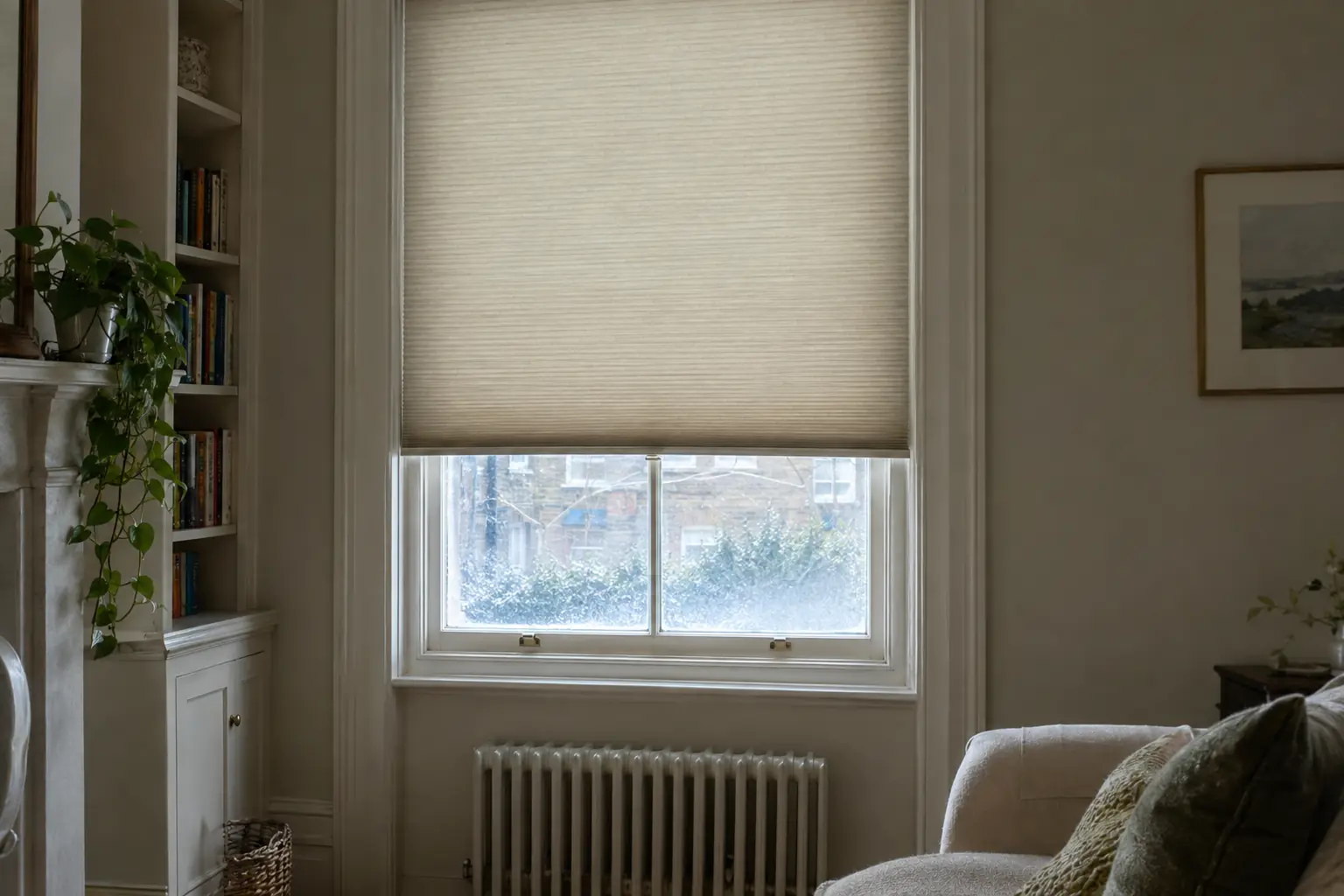
Not every covering is made for warmth, and the labels are worth reading. A honeycomb blind is folded so each pleat forms a sealed cell, and that trapped air is what makes it warmer than a thermal roller or Roman. It makes a noticeable difference in a single-glazed bay, a north-facing bedroom or a room with a lot of glass, and stacks into a slim headrail when it is up. On modern triple glazing you will feel much less.
Thermal blinds use a woven or backed fabric that reflects heat rather than absorbing it, and suit rooms you actually heat. A thermal roller or Roman is a sensible middle ground; a honeycomb is warmer.
With curtains, the lining does most of the work. A thermal lining measurably helps a cold or draughty room, and interlining adds weight and body between the face fabric and the lining, which makes for a heavier drape. Blackout lining is chosen for darkness rather than warmth, though a heavy lined curtain of any kind is better than an unlined one.
Shutters add insulation too, and they need no cords. For the difference between blackout, dimout and thermal fabrics, see our guide to what the labels mean.
Fit and edges: where the heat really escapes
A thermal fabric with a gap round it is a thermal fabric with a chimney round it. Cold air falls out of the gap at the bottom, warm air is drawn in at the top, and the pocket of still air that does the insulating never forms. So the fit deserves as much attention as the fabric.
For a blind, the closer it sits to the glass, the less air moves past it. A blind in the recess sits close to the window but needs a small clearance at each side to run freely. An exact fit, mounted outside the opening, overlaps the edges instead. Which suits your window depends on the depth of the reveal, the handles and the sill, and your advisor will measure and advise on the day.
For curtains, the pole or track should run beyond the opening on both sides so the curtains close over the edges of the window rather than stopping at them, and the two curtains should meet or overlap in the middle. Floor-length curtains that just clear the floor trap more cold air than short ones that stop in mid-air, provided there is no radiator in the way.
The warmest arrangement of all is a layered one: a blind in the reveal, close to the glass, and lined curtains outside it. Two still layers of air do more than one.
Radiators under windows
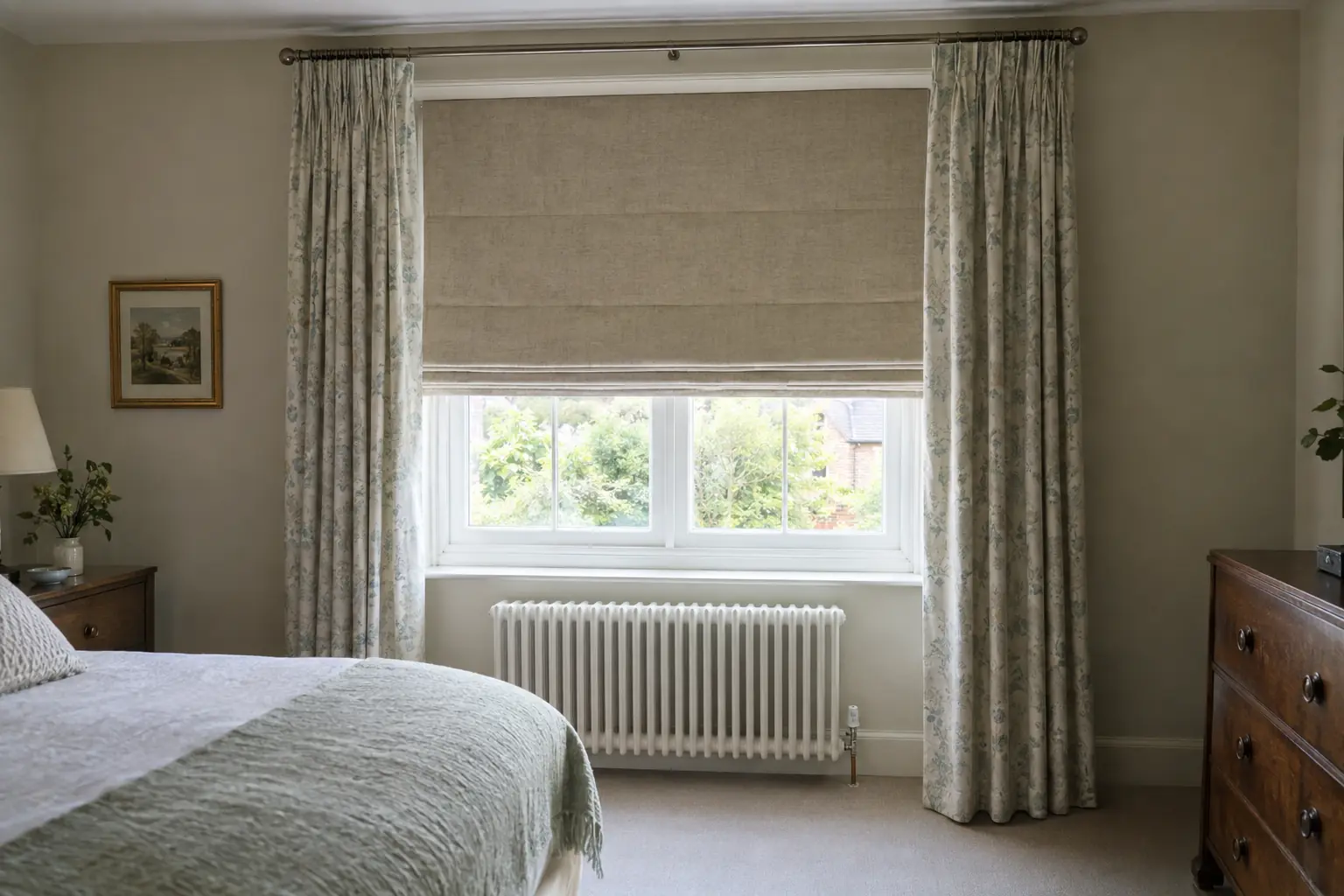
In British houses the radiator is very often under the window, which was a sensible choice for single glazing: the rising warm air met the cold air falling off the glass. It becomes a problem when a floor-length curtain is drawn in front of it. The radiator then heats the space between the curtain and the window, and the warm air rises straight up the cold glass instead of into the room.
There are three good answers. The first is a curtain that stops at the sill, so the radiator stays on the room side. The second is a blind in the recess, which closes the window off while leaving the radiator to heat the room. Roman blinds suit this well, because they bring curtain fabric to the window where a radiator or a window seat leaves no room for a full drop. The third is to keep the long curtains and add a blind behind them, then leave the curtains open in the evening and close only the blind.
Whatever you choose, keep fabric off a hot radiator. Curtains or a long blind resting on it will not warm the room any faster, and the heat is not kind to the fabric either. Your advisor will look at the radiator position when measuring and tell you how far a blind can drop.
When to open and close
Timing makes more difference than most people expect. Close blinds, curtains and shutters as the light goes, before the room has had a chance to cool, and keep them closed overnight. That is when the difference between the room and the outside air is greatest, and when the guidance on heavy curtains applies.
In the day, let the sun in. A south-facing window on a clear winter day brings in real warmth, and a closed thermal blind would keep it out. On grey days, rooms you are not using, particularly north-facing ones, can stay covered.
Motorised blinds can be grouped so a run of windows closes together, which makes the evening routine easy on a room with a lot of glass or windows that are awkward to reach.
One side effect is worth knowing. A well-insulating covering keeps the room air off the glass, so the glass runs colder overnight and you may see more condensation in the morning. Government guidance describes condensation onto cold surfaces such as window frames as the most common form of damp. Open the covering in the morning, wipe the glass and the frame, and let the room air for a while. A warm room with a dry window is the aim.
Checklist
- Close blinds, curtains and shutters at dusk, before the room cools.
- Open sun-facing coverings on bright winter days to let the warmth in.
- Keep curtains off radiators; stop them at the sill or use a blind in the recess instead.
- Check the covering overlaps the window edges or sits close to the glass.
- Wipe morning condensation from the glass and frame, and air the room.
- Deal with draughty frames separately: a blind slows cold air but cannot seal a gap.