The short answer
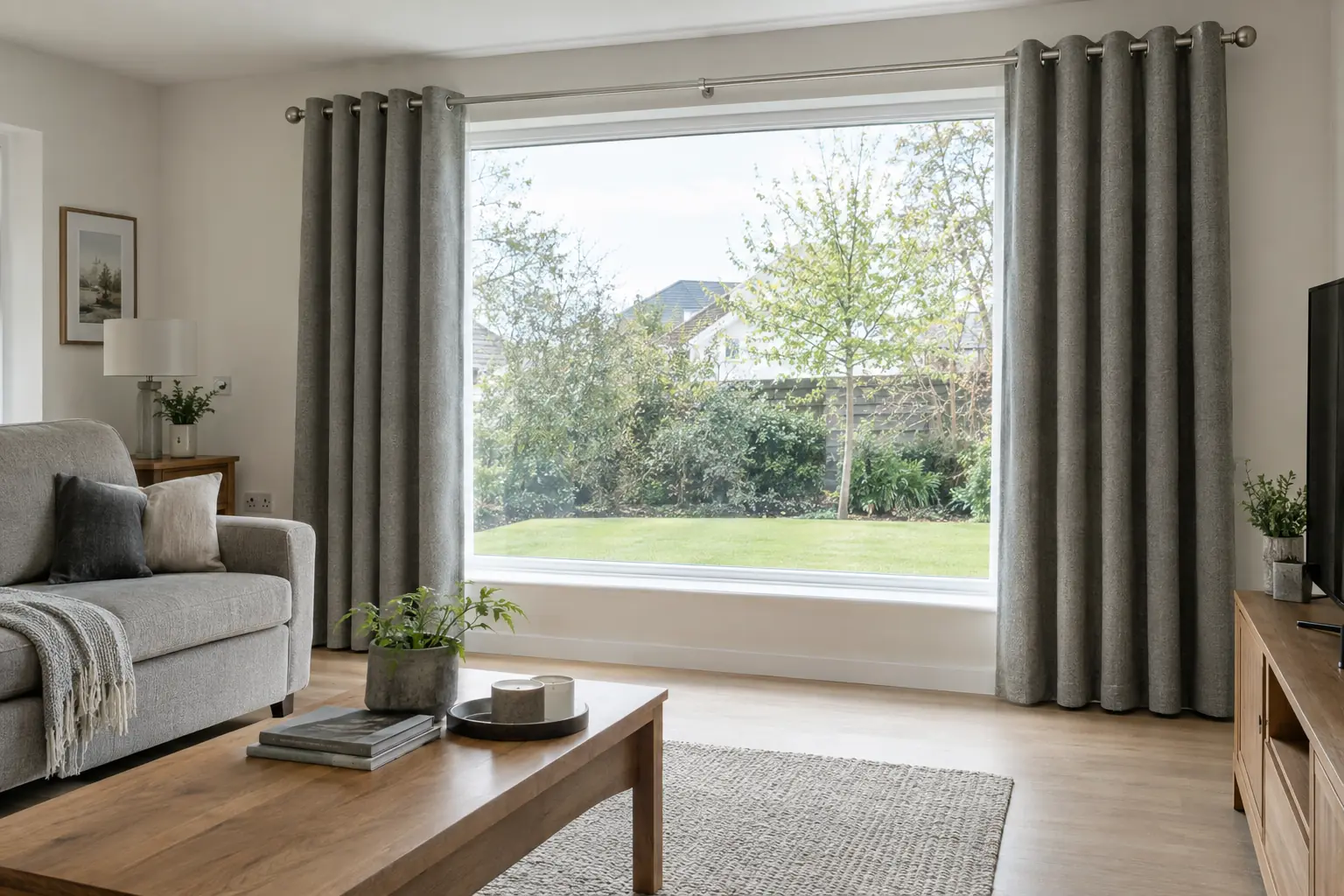
Eyelet curtains thread directly onto a pole through metal rings set into a stiffened heading. The fabric weaves in front of and behind the pole and falls in deep, regular waves, and the curtains draw with a single pull. They need a pole rather than a track, some clear wall above the window for the heading, and room either side for a fairly generous stack. They suit modern living rooms, bedrooms, children's rooms and doors that are opened every day.
- Eyelets only hang from a pole, so the pole and the rings are always on show.
- The heading stands up above the pole, so leave clear wall between the pole and the ceiling.
- Deep folds make a wide stack; run the pole well past the window to keep the glass clear.
- The rings cannot pass a bracket, which matters on long poles and in bays.
- No cords: an eyelet curtain is drawn by hand from its leading edge.
Curtain widths and drops
Swipe to see the whole diagram
The pole or track runs past the window each side so the curtains can stack off the glass. The drop is measured from the pole or track to where you want the curtain to finish.
How eyelet curtains hang
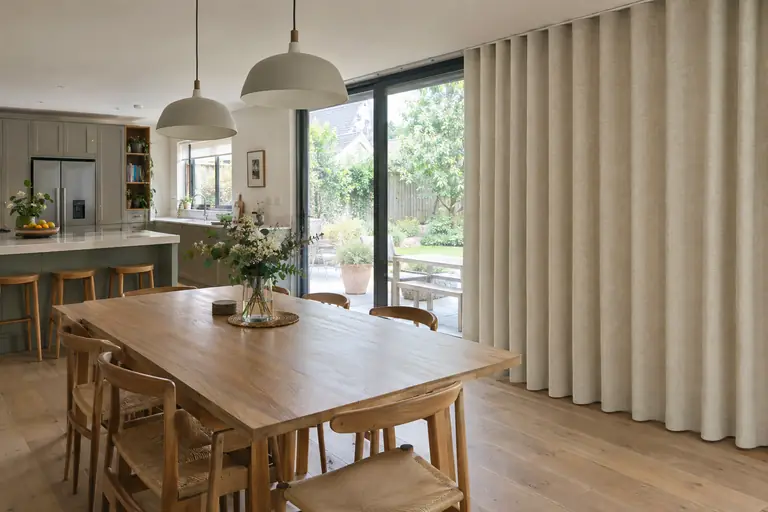
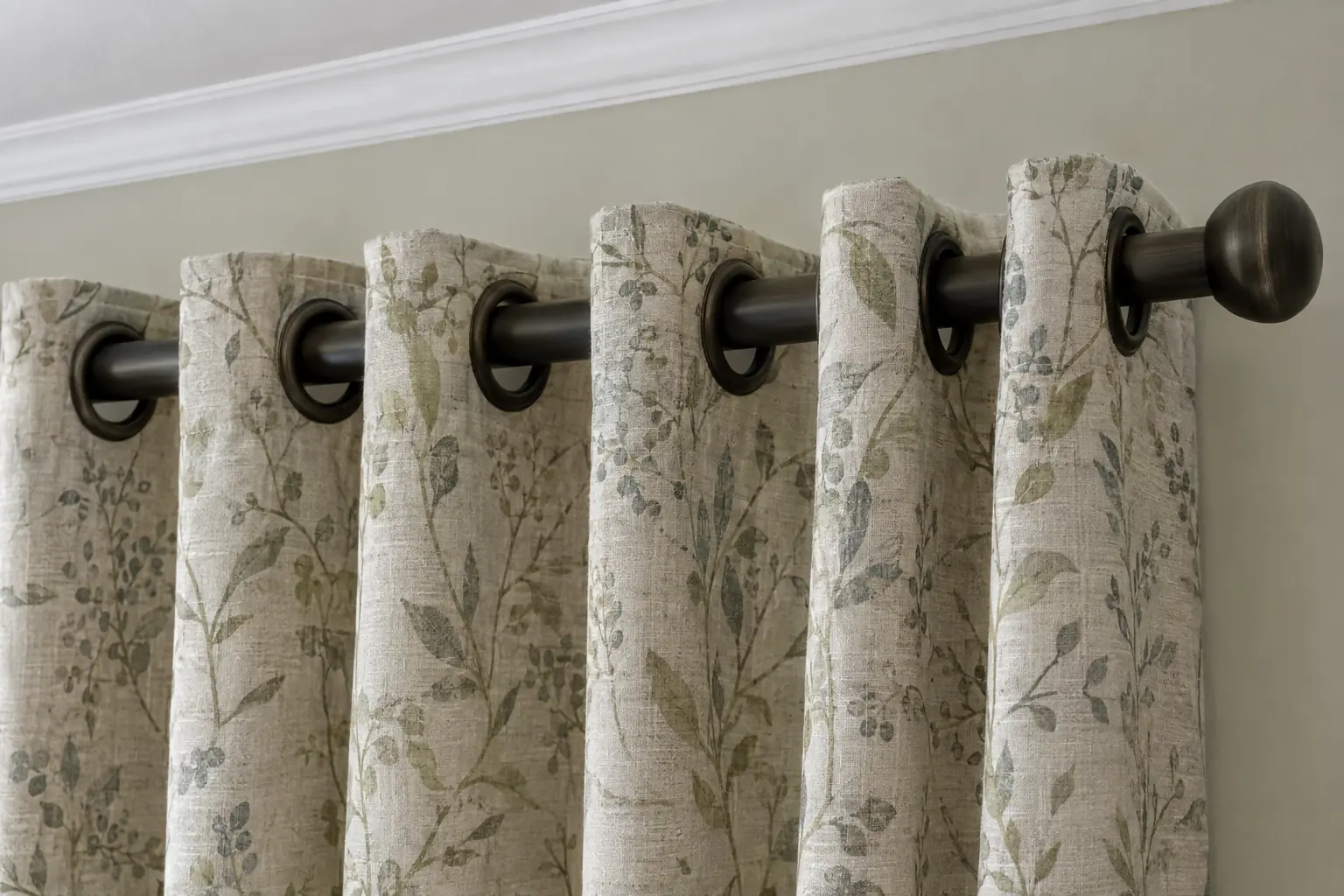
The top of an eyelet curtain is stiffened, and a row of metal rings is set through it at even intervals. The pole runs through the rings, and the fabric passes behind the pole at one ring and in front of it at the next. Below the heading, that in-and-out pattern becomes a series of deep, rounded waves running all the way down to the hem.
The rings are arranged so that both edges of each curtain turn back towards the wall rather than out into the room. That neat return at each end is part of why eyelet curtains look tidy when they are drawn, and why the leading edges meet cleanly in the middle of the window.
Because the rings sit directly on the pole, with no hooks or gliders in between, there is very little to catch or snag. Eyelet curtains slide open and closed easily, and a pair can be drawn with one pull on the leading edge. It is the reason so many people choose them for rooms where the curtains are opened every morning and closed every night.
A pole, not a track
Eyelets need a pole. The rings have to pass round something, and a track, which is fixed to the wall along its back edge, gives them nothing to go round. If a window needs a track, for a ceiling fixing or a curtain that travels round a bay, the heading has to be pencil pleat, pinch pleat or wave instead.
Because the pole runs through the heading and is visible along its whole length, it becomes part of the look. A dark metal pole reads as modern and graphic; a painted or natural wooden pole is softer and more traditional; the finials at each end frame the window. The eyelet rings are on show too, so it is worth thinking about the pole, the rings and the fabric together rather than one at a time.
The pole also has to be straight and firmly fixed, because the rings slide directly on it and any sag in the middle shows as a dip in the heading. Poles are supplied and fitted by our own team as part of the job, and your advisor will talk through the options for the room.
The space above the window
An eyelet heading stands up a little above the pole, because the fabric continues above the rings. Add the brackets, which fix to the wall above the window frame, and an eyelet curtain needs a band of clear wall above the window before it meets the ceiling or the coving.
In most rooms that is not a problem. It becomes one in cottages and older houses with low ceilings or beams, in rooms with deep coving or a picture rail just above the window, and on windows that run almost to the ceiling, as they often do in new builds and loft conversions. If the pole has to go too close to the ceiling, the heading ends up pressed against it, and the curtain drags along the coving when it is drawn.
Where the space is tight, a heading that hangs below its fixing, such as pencil pleat on a track set just under the ceiling, may look better. Your advisor measures the space above every window as well as the window itself, and will tell you on the day whether eyelets will sit comfortably.
The stack, and why the pole runs past the window
Eyelets give the deepest folds of any heading, and deep folds take up room when the curtains are open. A pair of eyelet curtains pulled right back forms two generous bundles, and where those bundles sit decides how much daylight the room gets.
If the pole stops at the edges of the window, the stack sits across the glass and blocks a strip of it all day. To keep the glass clear, the pole needs to run past the window on each side, far enough for the curtains to stack against the wall. Heavy fabrics and thick linings make the stack wider still.
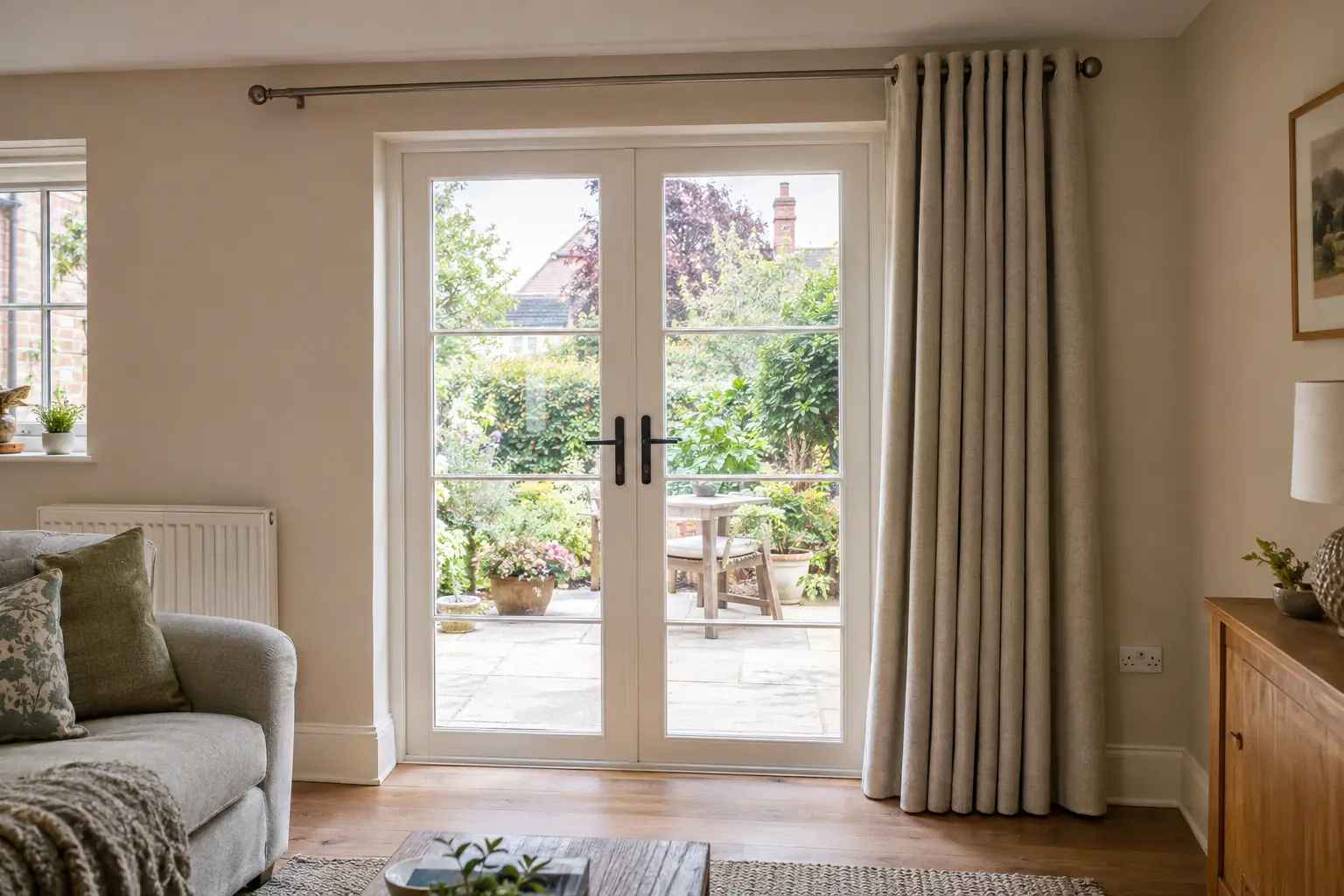
On a patio door or French doors, the stack matters twice over. It has to clear the glass, and it has to clear the opening, or you brush through a fold of curtain every time you step into the garden. Where there is wall on only one side, a single curtain drawing to that side often works better than a pair. Your advisor measures the wall beside the window as well as the opening, so the pole is long enough for the curtains you choose.
Brackets, bays and long spans
Eyelet rings slide along the pole until they meet something, and that something is usually a bracket. On a short pole, supported only near the ends, it makes no difference. On a long pole across a wide window or a pair of doors, the pole may need a support in the middle to stop it sagging, and an eyelet curtain cannot slide past it. The pair then has to be planned so that each curtain stays on its own side of the bracket.
Bay windows raise the same issue at every corner. An eyelet curtain on a bay pole cannot travel round the angle, so a bay is dressed with separate curtains for each section, drawn independently. That can look very good, with a curtain either side of each window in the bay, but it is a different effect from one curtain drawing right round.
If you want curtains that travel all the way round a bay, a pencil or pinch pleat on a track shaped to the bay is the usual answer. Your advisor measures every section and will tell you what works on your window.
Eyelets, linings and light
An eyelet curtain can be lined like any other. The lining does the practical work, whether that is body and drape, warmth or darkness, while the face fabric sets the look. A lining also stiffens the curtain slightly, which suits eyelets well: the waves hold their shape and fall more evenly.
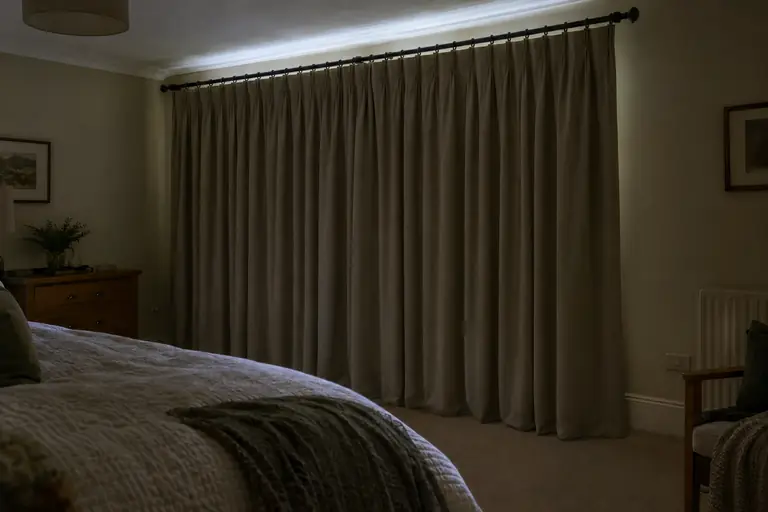
For a bedroom, there is one thing to know. Because an eyelet curtain hangs from a pole standing off the wall, with the heading weaving round it, some light can find its way over the top of the pole and round the ends, even with a blackout lining. Running the pole well past the window, and a little higher above it, reduces this.
For a properly dark room, the usual answer is a blackout blind inside the recess with eyelet curtains over it. The blind stops most of the light at the glass and the curtains close the gaps round it. Our blackout curtains guide goes into the options in detail.
Where eyelet curtains suit
Eyelets suit rooms where curtains are used, not just admired. Bedrooms, where they are drawn twice a day. Family living rooms, where they are pulled open by whoever gets up first. Patio and French doors, where one smooth pull clears the way into the garden. They suit children's rooms well, too: a curtain on a pole is drawn by hand, so there is no cord to think about.
The look is modern and relaxed. It works well with plain fabrics and textured weaves, and with bold patterns that benefit from being shown in big, even waves rather than broken into small gathers.
Eyelets are less suited to very formal rooms, where the regular waves can feel casual beside a tailored pinch pleat, to windows where the space above is tight, and to bays where you want one curtain to travel all the way round. For those, our curtain headings guide compares all four headings side by side.
Pros and cons
In its favour
- Draws with one pull, with nothing to catch or snag
- Deep, regular waves that suit plain, textured and patterned fabrics
- Hand-drawn on a pole, with no cord in a child's room
- Both edges turn back to the wall for a tidy finish
- A modern, relaxed look that suits most everyday rooms
Worth knowing
- Pole only; eyelets cannot hang from a track
- Needs clear wall above the pole for the heading
- Stacks wider than pleated headings when open
- The rings cannot pass a bracket, which limits bays and long spans
- Some light can creep over the top of the pole in a bedroom
Room by room
- Family living roomA great fitDeep, even folds and one-pull drawing suit a room where the curtains are opened and closed every day.
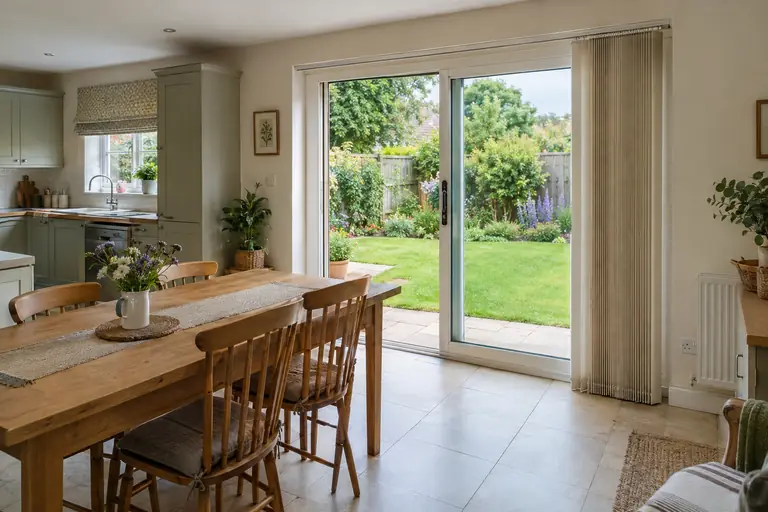
- Patio or French doorsA great fitSlide clear of the opening in one movement, as long as the pole runs well past the frame.
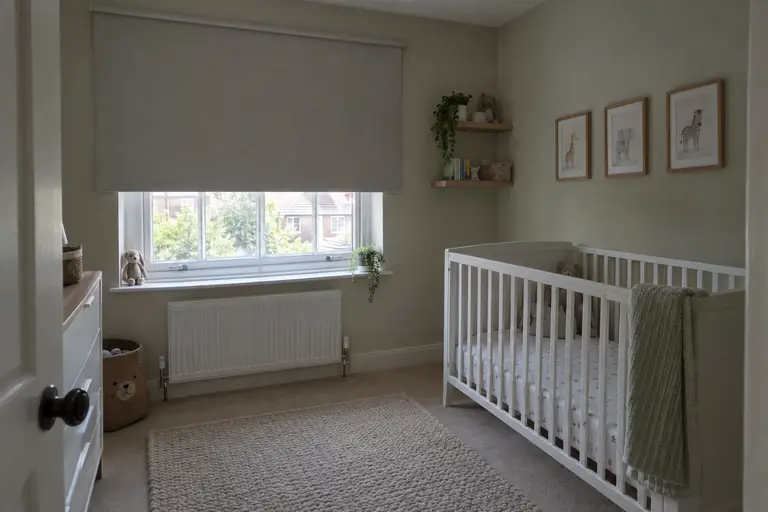
- Child's bedroomA great fitDrawn by hand on a pole, so there is no cord, and sturdy enough for daily use.
- BedroomWorks wellEasy to draw morning and night; add a blind in the recess if the room has to be truly dark.
- Bay windowThink twiceThe rings cannot pass the corner brackets, so each section of the bay needs its own curtains.
- Low-ceilinged cottage roomThink twiceThe heading stands above the pole and can press against a low ceiling, beam or coving.