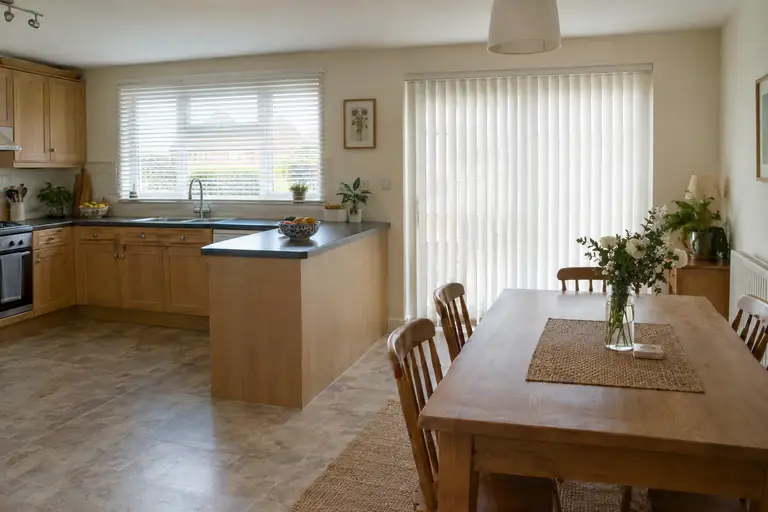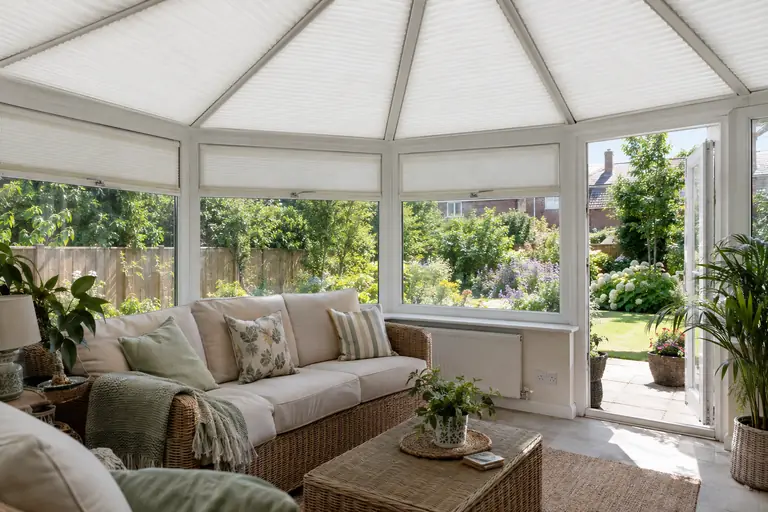
The short answer
Match the covering to how the door opens. Sliding patio doors suit vertical blinds that draw back to one side. French doors suit a blind fitted to each door that moves with it, or curtains on a pole wide enough to clear the doors. Bi-folds need blinds that fold with each panel, or a covering that clears the whole opening, such as tracked shutters. Your advisor checks handles and clearances on the day.
- Choose the covering by how the door opens: it slides, swings inwards or folds.
- Vertical blinds draw back to one end, leaving the half of the door you use clear.
- A blind fitted to each door pane moves with the door and sits behind the handle.
- Curtains on doors need a pole wide and high enough to clear the frame.
- Large glass means heat on summer afternoons and cold on winter nights; plan for both.
Blinds on doors with handles
Swipe to see the whole diagram
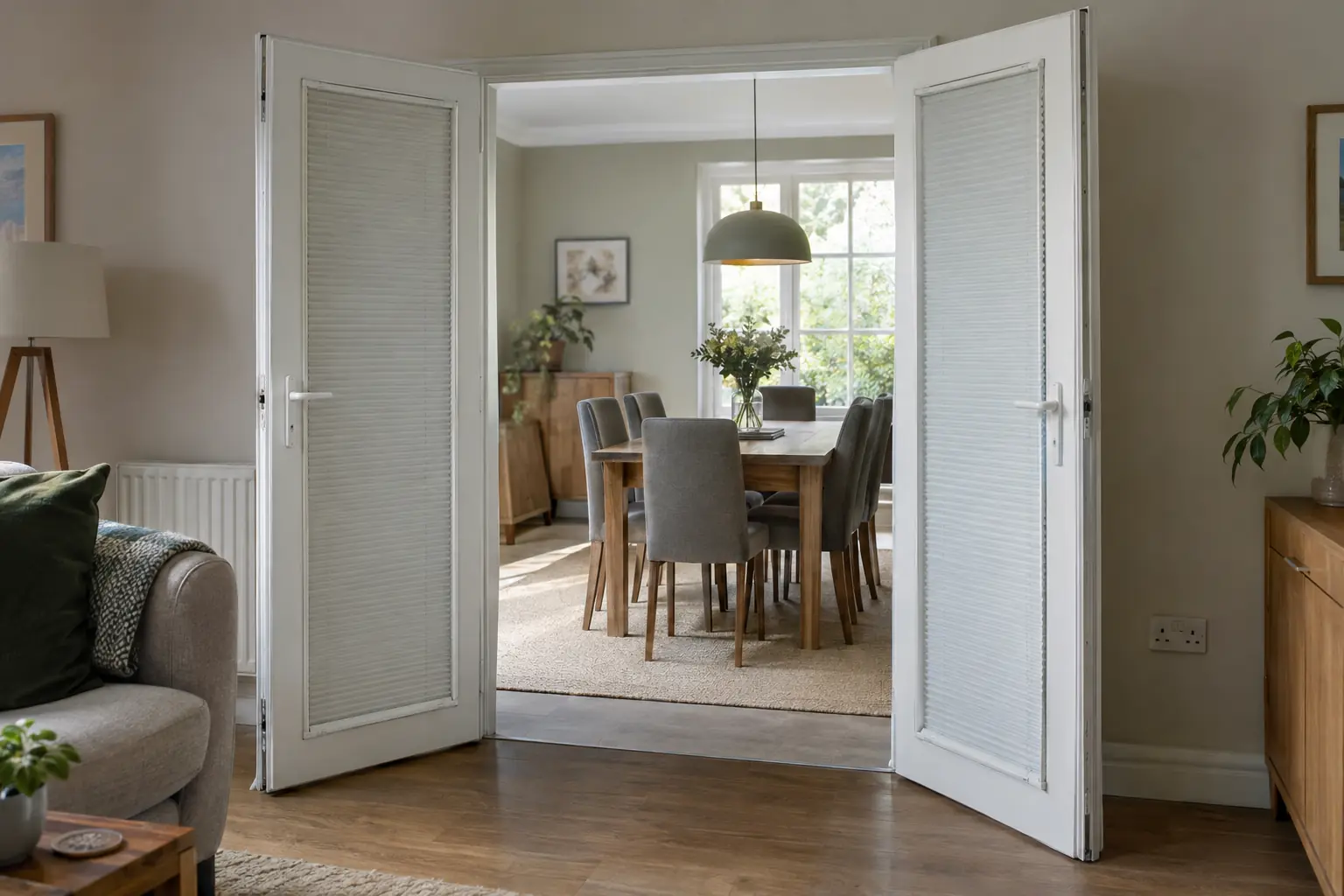
A blind hanging in front of a door has to clear the handle. Frame-fitted blinds sit on the glass side of the handle and move with the door.
Start with how the door opens
Doors to the garden come in three main kinds, and each needs a different answer.
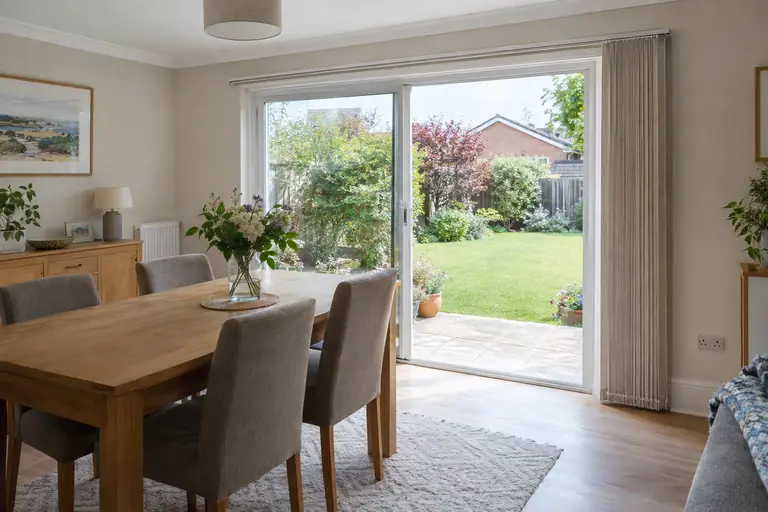
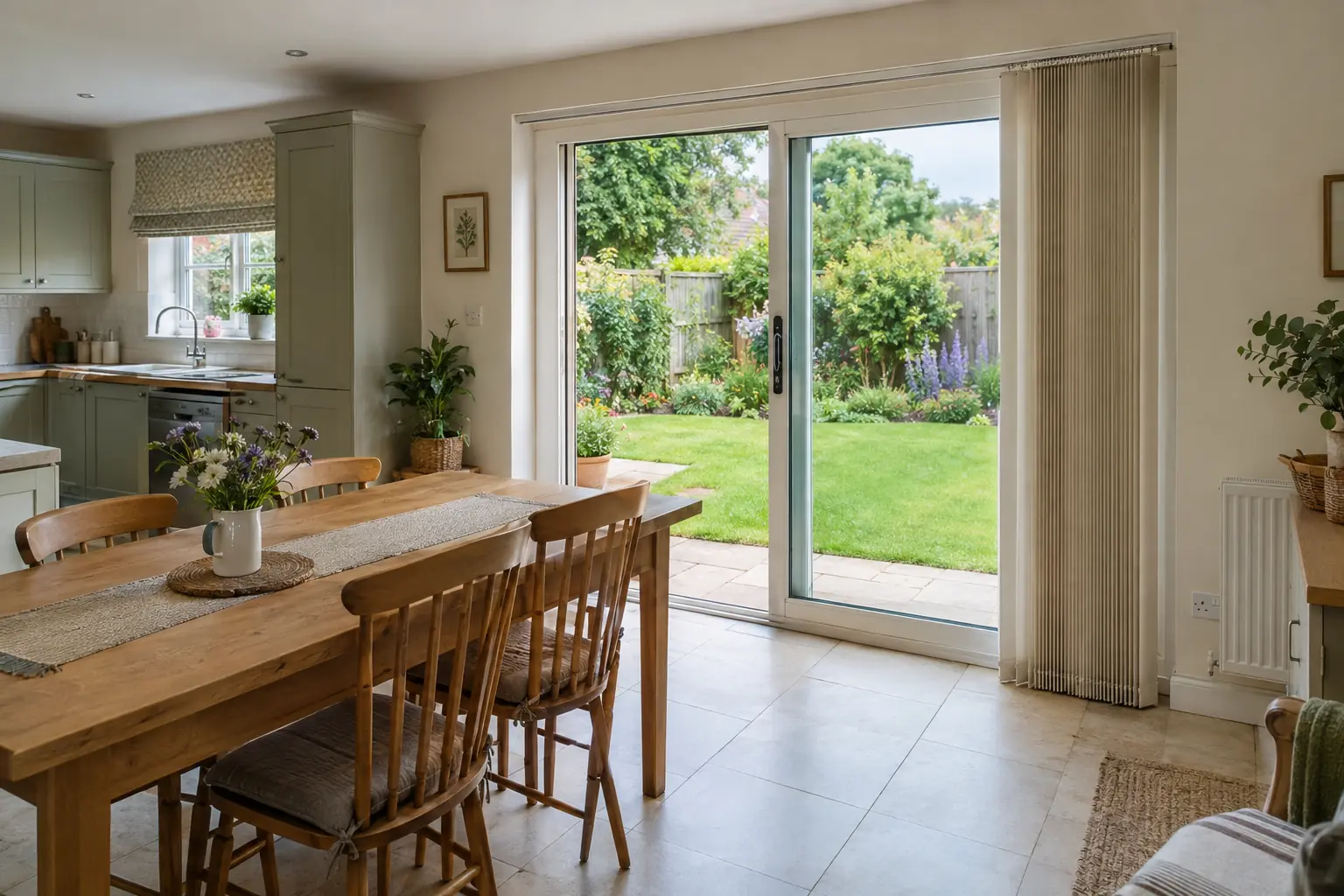
Sliding patio doors have one or two panels that slide past a fixed pane. Nothing swings into the room, so a covering can hang in front of the whole opening, as long as it can be drawn clear of the sliding half.
French doors are a pair of hinged doors, usually opening into the room. Anything hanging in front of them, below the top of the frame, gets in the way every time they open. The covering has to either move with each door or sit entirely above and beside the opening.
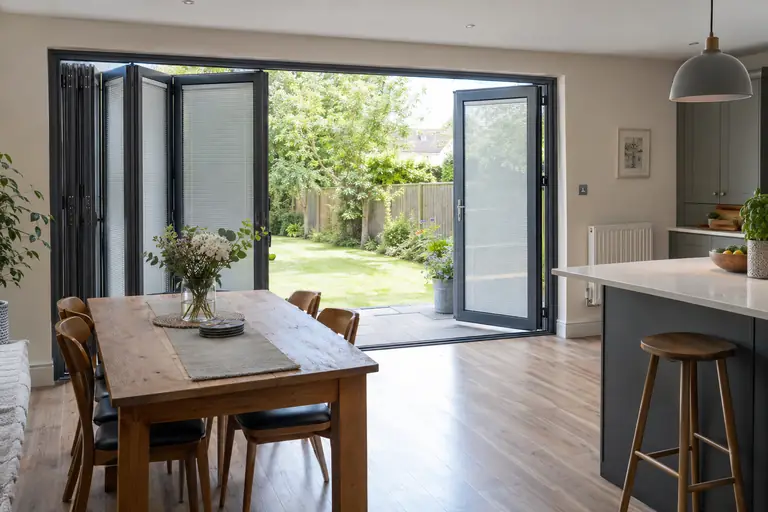
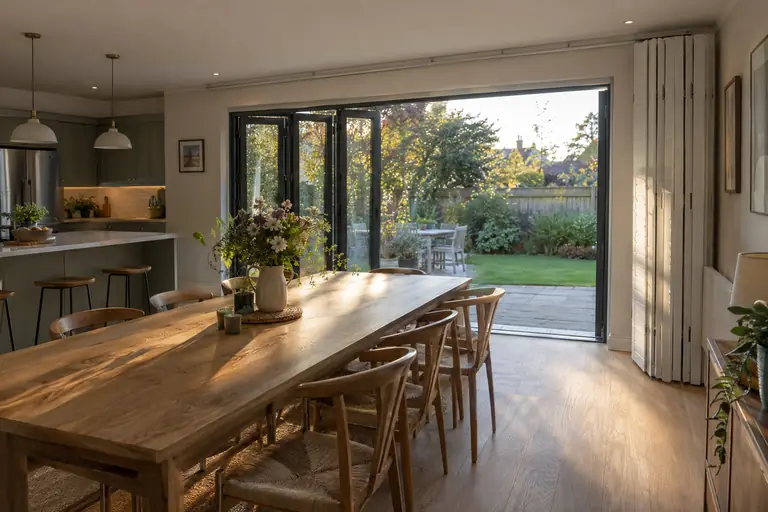
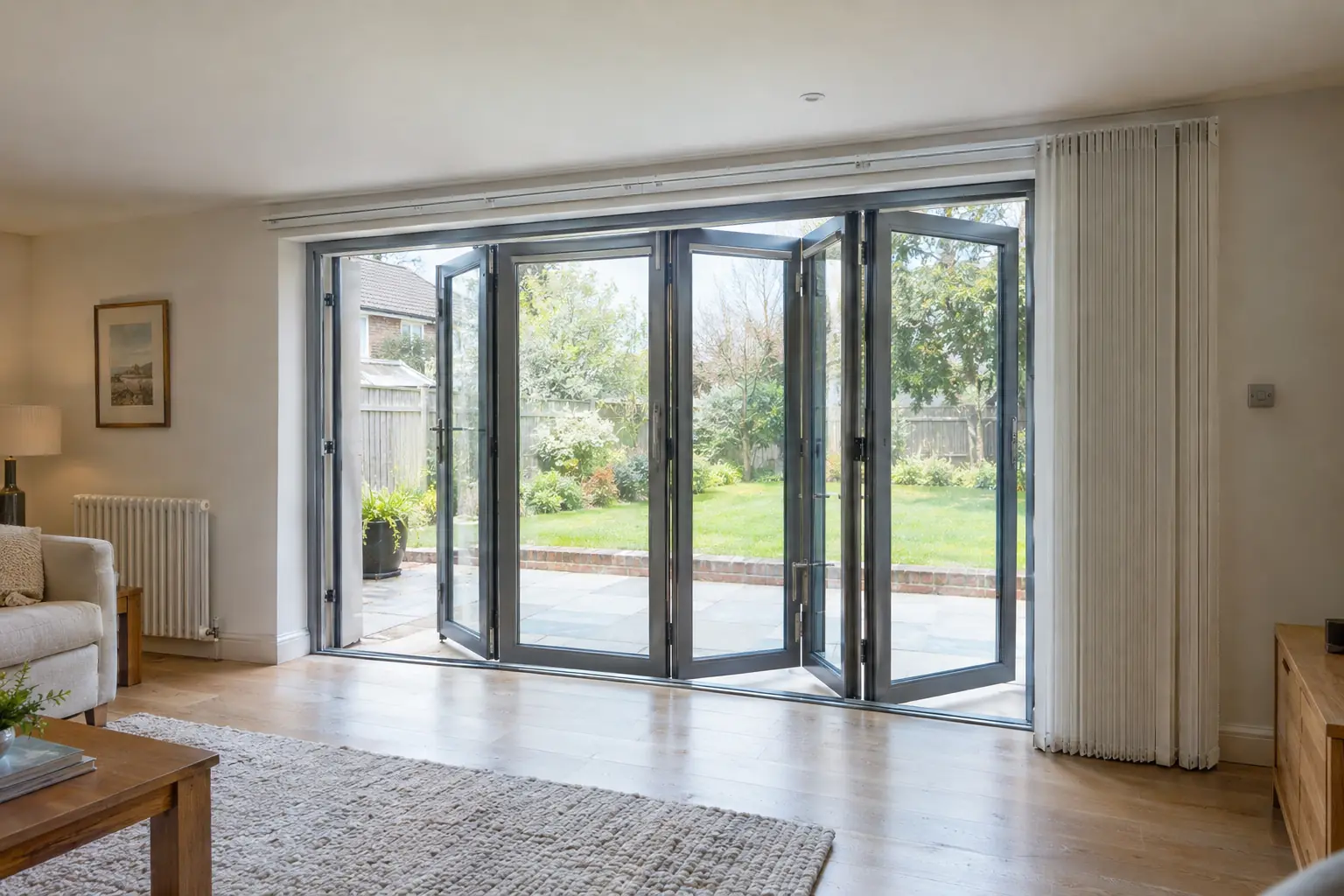
Bi-fold doors are several narrow panels that fold up against each other at one or both ends. They open the whole width, which is the point of them, and any covering has to allow for the panels stacking up.
Before your appointment, open the doors the way you normally do and notice where you walk, which side you open first and where the handles are. Those details decide more than the fabric does.
Vertical blinds on sliding doors
Vertical blinds are the long-standing answer for sliding patio doors, and for good reason. The louvres draw back into a stack at one end, so the half of the door you walk through is clear while the fixed half can stay covered. A single wide roller, by contrast, has to be raised completely before anyone can go out, and rolled up it leaves a fat cylinder of fabric across the top of the glass.
Two decisions matter. The first is which end the louvres stack to. Choose it by how you actually use the door, so the stack sits over the fixed pane rather than the one that slides. The second is the length of the headrail. Running it past the frame means the stack can sit clear of the glass and the handle instead of bunching in front of them.
Louvres also turn, so they can be angled against low evening sun on a west-facing door while you keep a view of the garden. Fabric louvres give a softer look; PVC louvres wipe clean, which helps on a door the dog uses. If one gets damaged, a single louvre can usually be replaced without remaking the blind.
French doors: move with the door or clear it completely
Because French doors open into the room, a covering has two choices: travel with the doors, or get completely out of their way.
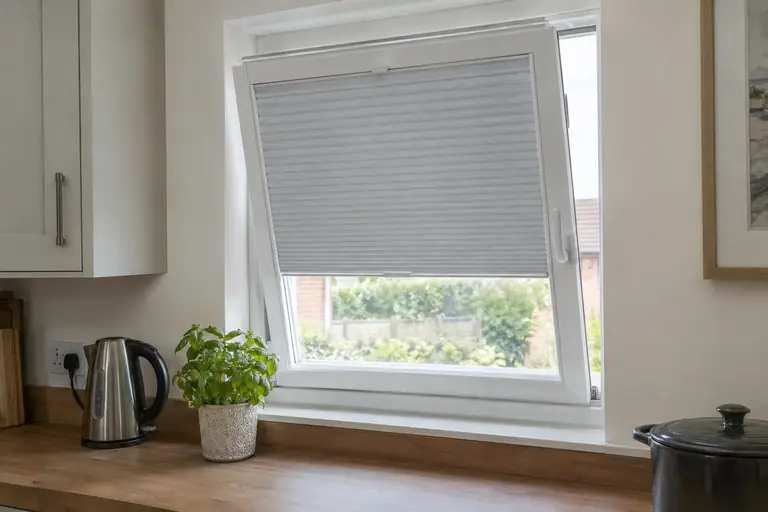
Perfect fit blinds travel with the doors. They clip into the frame of a uPVC door with no drilling and sit close to the glass, on the glass side of the handle, so each door opens and closes with its blind down. They need a frame with a gasket deep enough to take the clips, which your advisor checks on the day.
Curtains get out of the way. On a pole or track that runs well beyond the frame on each side, a pair of lined curtains can be drawn right back off the glass by day and across the whole doorway at night. The pole has to sit high enough for the doors to clear the curtains as they swing, and wide enough that the curtains stack against the wall rather than the door. Eyelet curtains draw with one pull, which suits a door used every day; pinch pleats stack tightest where the wall either side is narrow.
What rarely works is a single blind across both doors that has to be raised every time someone goes out. It gets left up, and then it is doing nothing.
Bi-fold doors
Bi-folds are the hardest doors to dress, because the whole point is that the glass disappears. A covering has to either fold with the panels or leave the opening entirely.
Blinds fitted to each panel fold with the doors. Perfect fit blinds need a uPVC or aluminium frame with a deep enough gasket, and each pane gets its own blind, made to line up across the run. Before recommending them, your advisor will look at the frames and at how tightly the panels fold together, because the doors still need to fold flat with the blinds in place.
Covering the whole opening is the other approach. Tracked shutters, with panels that slide and stack along a track, suit wide patio runs and bi-folds, and look like part of the room when closed. Vertical blinds or curtains on a long track can also cover a bi-fold, provided there is enough wall at one or both ends to draw them fully back. If there is not, they sit across the first folded panel, which defeats the purpose.
Our guide to tracked and shaped shutters covers shutters for doors in detail, and measuring French doors, patio doors and bi-folds explains what the advisor measures.
Large glass: heat, glare and cold nights
Garden doors are often the largest area of glass in the house, and they tend to face the garden and the sun. The UK Health Security Agency lists large east-, west- or south-facing windows without shading among the features of homes more likely to overheat, and its hot-weather advice is to draw blinds and curtains during the day wherever the sun falls directly on the glass. A covering you can close quickly, without wrestling it, is the one you will actually use on a hot afternoon.
In winter the same glass is a large cold surface, and you feel it most in the evening. Government draught-proofing advice notes that heavy curtains can cut the heat lost through a window at night, so lined curtains drawn across patio doors once they are locked for the night do a useful job. Thermal blind fabrics reflect heat back rather than soaking it up, which helps in both seasons.
Glare is the everyday problem. Vertical louvres angle against low sun, and blinds fitted to each pane can be lowered on just the panes the sun is hitting. Our guide to keeping rooms cool in summer goes further into shading.
Busy doors: children, pets and motors
A garden door is used more than any window, by more people, often in a hurry. That affects what lasts. A chain hanging beside a door gets caught on bags and pulled by children and dogs. Corded blinds come from us with the child-safety devices UK regulations require, installed by the fitter, and where there are small children we usually recommend cordless or motorised blinds. On vertical blinds, ask your advisor whether the louvres can hang without a linking chain along the bottom, which stays neater in a busy doorway.
Motorisation suits wide spans particularly well. A long run of verticals, or a blind on each pane of a set of bi-folds, can be grouped so the whole wall of glass opens or closes from a remote, an app or a timer. Battery motors need no wiring; where a motor needs a new mains supply, that part is a job for a registered electrician. As with every blind we fit, the motor is covered by our 1-year guarantee.
Checklist
- Work out how each door opens: it slides, swings inwards or folds.
- Note which side you open first and where the handles are.
- Look at the wall space either side for curtains or a stack of louvres.
- Check whether the frames are uPVC or aluminium, for blinds fitted to each pane.
- Plan for summer sun and winter nights on the glass.
- Choose cordless, chainless or motorised on a door that children and pets use.