The short answer
Choose a roller for a clean, simple look, for kitchens and bathrooms, for the widest choice of functional fabrics, and where you want the whole window clear when the blind is up. Choose a roman when you want the window to feel furnished, with pattern and softness like a curtain, in a living room, bedroom or dining room. Both can be blackout. Rollers are usually the better value; romans take more fabric and making-up.
- A roller rolls onto a slim tube; a roman folds into a stack that stays at the top of the window.
- Rollers use stiffened blind fabrics; romans use curtain fabrics with a lining behind.
- Rollers suit kitchens and bathrooms; romans belong in dry rooms.
- Both can be blackout: a coated fabric on a roller, a blackout lining on a roman.
- Rollers are usually the better value; a roman uses more fabric and more making-up.
The real difference: rolled or folded
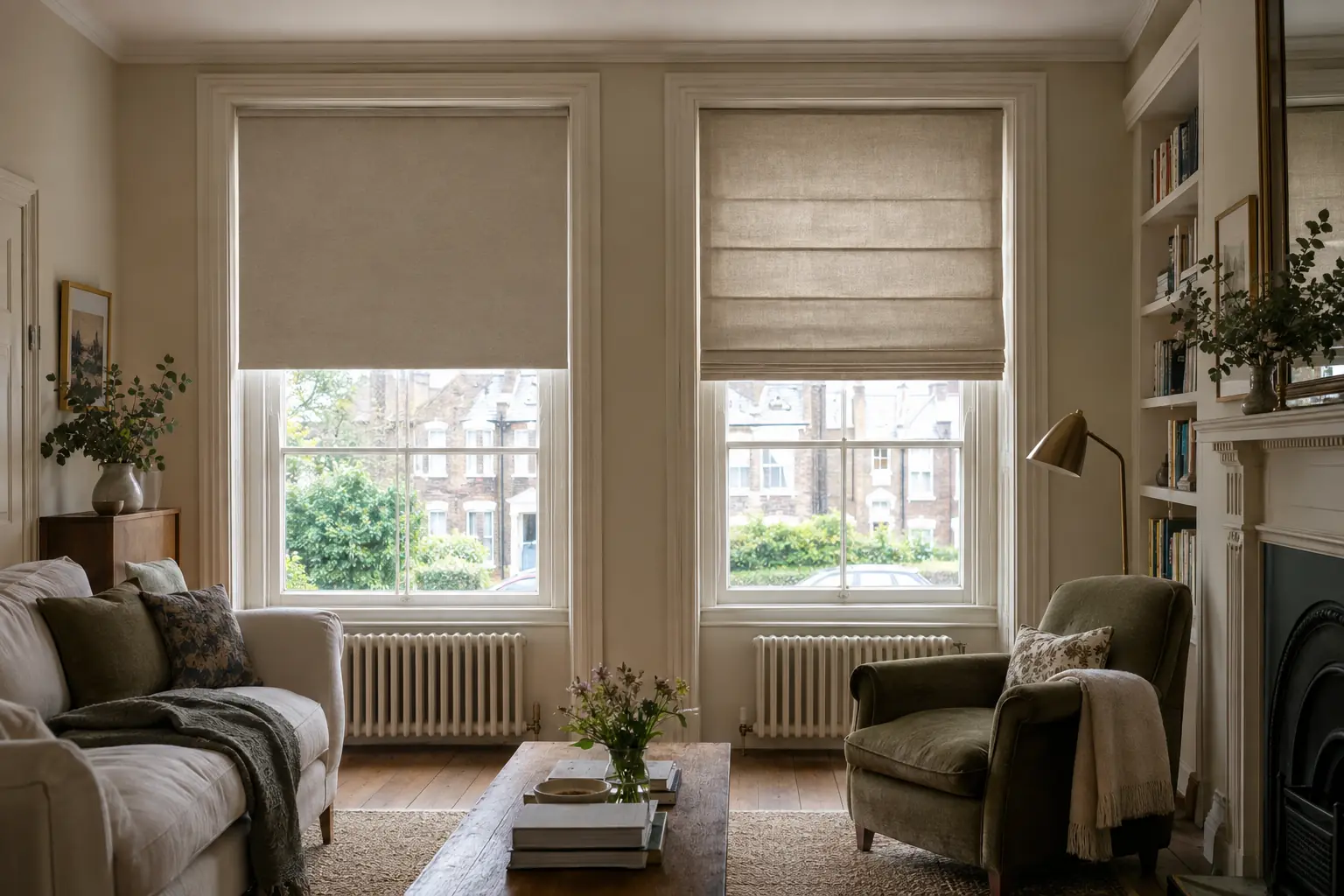
A roller blind is a single flat sheet of fabric on a tube at the top of the window. Pull the chain and the fabric winds onto the tube; let it down and it hangs as a smooth, flat panel, kept straight by a bar in the bottom hem. The fabric is stiffened so it rolls neatly and hangs without rippling.
A roman blind is curtain fabric with a lining sewn behind it and slim rods set in at intervals down the back. Raise it and the fabric lifts from the bottom, folding up between the rods into a stack of soft horizontal pleats under the headrail. Lowered, it is a flat panel with faint fold lines across it.
Everything else follows from that difference. The roller is built from a blind fabric, so it can be wipeable, blackout-coated or sheer, and it disappears when it is up. The roman is built from a furnishing fabric, so it brings the colour, texture and pattern of a curtain, and it always keeps some fabric at the top of the window.
Neither is better. They are good at different things, and plenty of homes use rollers in the kitchen and bathroom and romans in the living room and bedrooms, sometimes in the same colour so the house still hangs together.
How each one looks in the room
A roller is a quiet blind. Lowered, it reads as a clean panel inside the window, and raised, it is little more than a tube across the top of the reveal. That suits modern rooms, rooms where the window itself is the feature, and rooms where you want the blind to do its job without anyone noticing it. It also makes a roller the natural partner for curtains: a slim roller in the recess for privacy and darkness, and curtains outside it for warmth and dressing.
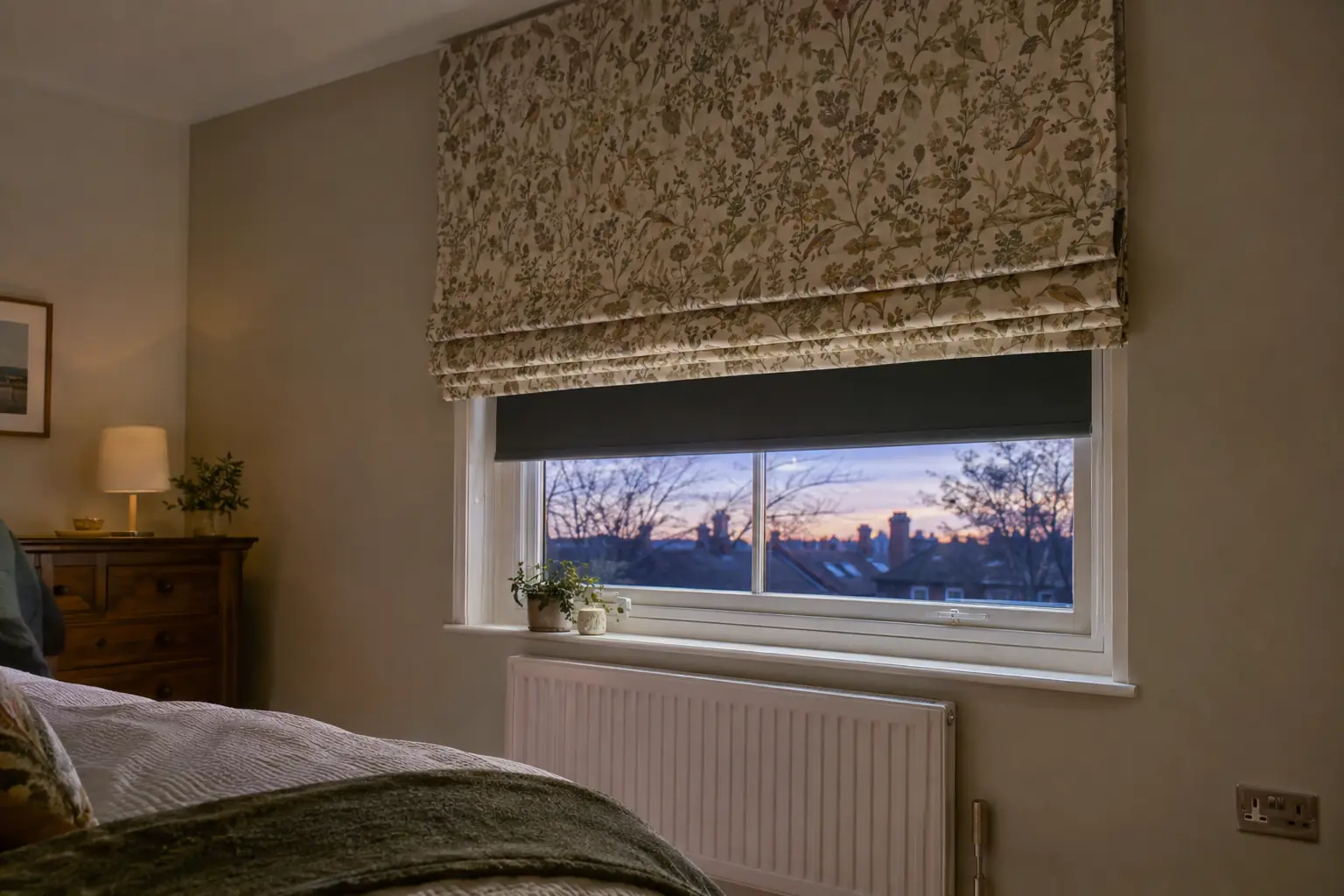
A roman is a furnishing. Even raised, its stack of folds gives the top of the window a soft, finished edge, a little like a pelmet. Lowered, it shows off a pattern or a textured weave almost as fully as a curtain. That is why romans suit living rooms, bedrooms, dining rooms and window seats, and period rooms where a flat roller can look a little utilitarian.
A useful test is to ask whether you would want curtains at this window if there were room for them. If the answer is yes but the wall space is not there, because of a radiator, furniture tight to the reveal or a window in a corner, a roman gives you most of what a curtain would, in the footprint of a blind.
What is left on the window when it is up
This is the practical difference most people only notice after the blind is fitted.
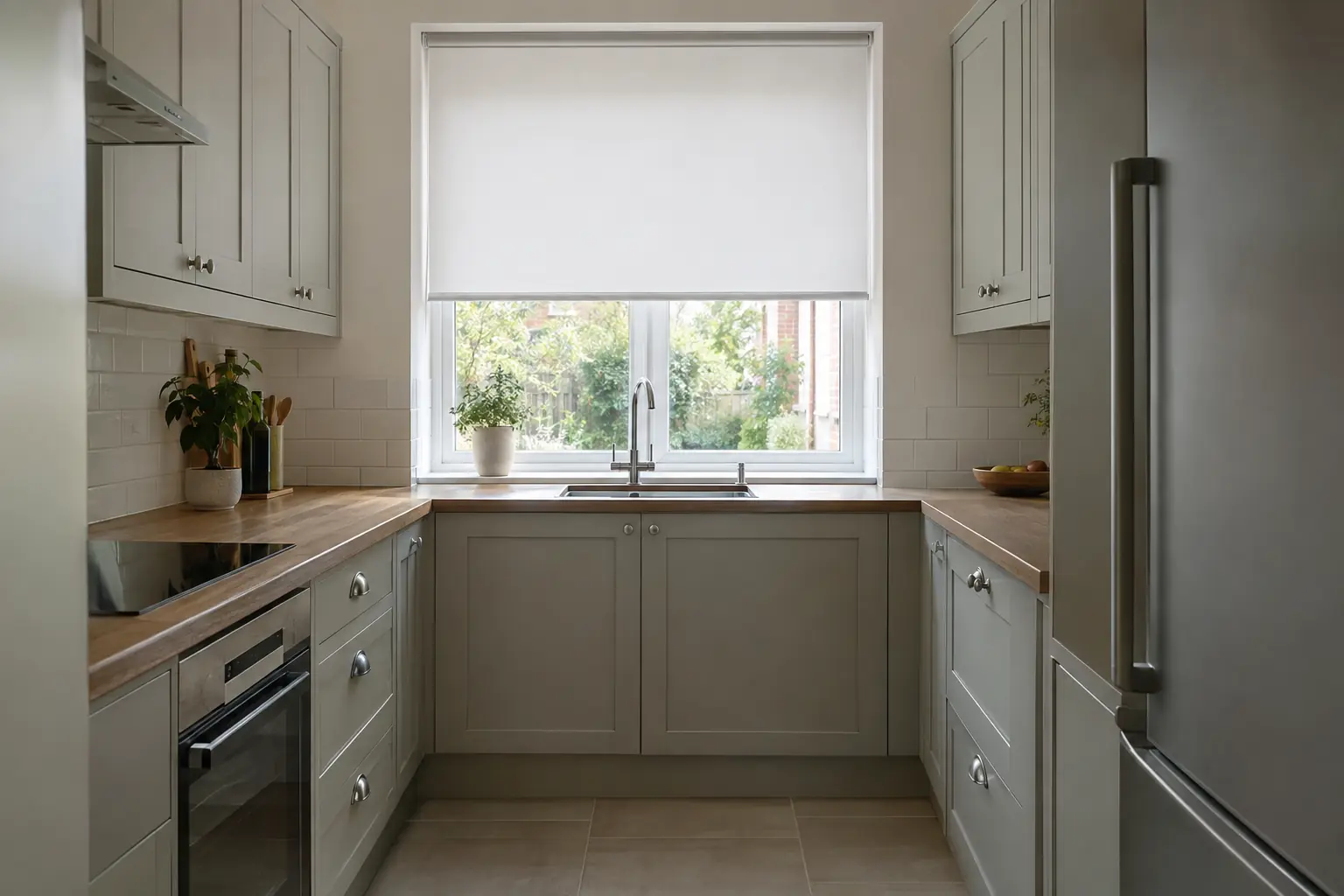
Raised, a roller is just the tube with the fabric wound round it. Fitted in the recess, that roll takes a thin strip at the very top of the glass; fitted on the wall above the window, it takes none at all. On a small window, a dark room or a window with a view, that matters.
A roman never disappears. Its folds, lining and rods gather into a stack, and because every extra fold adds to it, the longer the drop, the deeper the stack. On a tall window that is a small share of the glass. On a short or low window fitted inside the recess, it can take a band of daylight you will miss.
The answer is the same move for both: fix the blind on the wall above the opening, so whatever is left when it is raised sits over plaster rather than glass. For a roman on a short window it is often essential; for a roller it is a bonus. Where every bit of daylight counts and there is little wall above the window, the roller is the safer choice.
Depth of the reveal matters for both. A roller needs room for the tube and the rolled fabric; a roman needs room for its headrail and the stack. If handles, stays or a shallow reveal get in the way, both can be fitted outside the recess instead. Your advisor measures every opening and will tell you where each blind would sit.
Fabric choice and what each fabric can do
The fabric choice is where the two part company most clearly.
Roller fabrics are made for the job. There are sheers that soften the view, dimouts that take a room down without making it dark, blackout fabrics coated so no light passes through the weave, wipeable and PVC fabrics for kitchens and bathrooms, and thermal fabrics that help a room hold its warmth. Plains, textures and prints are all available, but the fabric is always stiffened, so it has a flatter, crisper look than a curtain.
Roman fabrics are furnishing fabrics: linens, cottons, textured weaves, bold patterns and stripes. They drape and fold, and they bring colour and texture into the room. The lining behind them does the practical work, with standard linings for body, thermal linings for warmth and blackout linings for bedrooms.
So if you need a blind to do a specific technical job, such as wipe clean over a sink, the roller range will usually have more options. If you want the blind to carry a pattern that picks up your cushions or your wallpaper, the roman range is where to look.
Either way, look at real fabric before deciding, as up to five free samples by post or the full ranges at a home appointment, because fabric never looks the same on a screen as it does against your window.
Kitchens, bathrooms and cleaning
In wet rooms the choice usually makes itself.
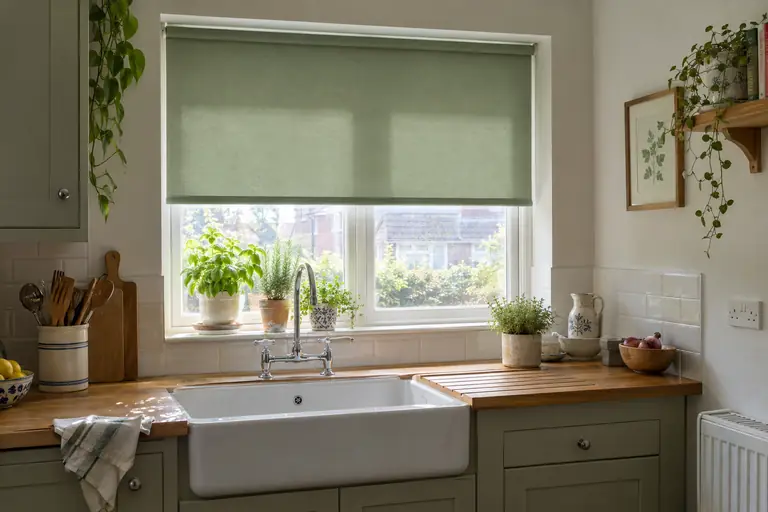
A roller in a wipeable or PVC fabric is one flat sheet with nothing to trap grease or steam. It copes over a sink, in a bathroom and in an en-suite, and a mark wipes off. Even standard roller fabrics are easy to care for: dust them with a soft brush while the blind is down, and sponge a mark lightly with a barely damp cloth. The one rule is never to soak it: roller fabric is stiffened to hang flat, and water softens that finish and leaves the blind rippled.
A roman is fabric and lining sewn together, and steam makes the two shrink at different rates, so romans are best kept out of bathrooms. In a kitchen, they are happiest at the window furthest from the cooker and the sink. Cleaning a roman is closer to caring for a curtain: brush or gently vacuum off the dust, spot clean a mark without soaking it, and never put it in a washing machine.
If your kitchen and living room are open plan, you can still use both: a wipeable roller at the sink window and romans in the same colour at the sitting end.
Blackout, warmth and light at the edges
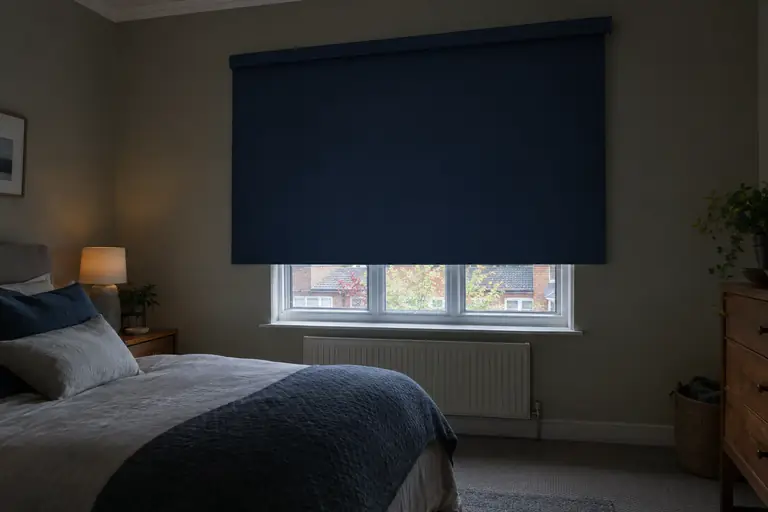
Both blinds can make a bedroom dark, in different ways. A blackout roller's fabric is coated on the reverse so daylight cannot get through the cloth. A blackout roman uses a blackout lining behind the face fabric. Either way, very little light comes through the blind itself.
What decides how dark the room gets is the light round the edges. Any blind inside a recess needs a small clearance at each side to move freely, and on a bright morning that shows as a thin line of light down each side. Fitting the blind on the wall outside the recess, and a little wider than the opening, cuts that leak for both types. Our guide to recess and exact fit explains the choice in detail.
For warmth, a roller can use a thermal fabric and a roman can have a thermal lining. A lined roman has more body than a single-layer roller, which makes it feel like the warmer choice in a cold room, but the difference depends on the fabric and lining you choose, and your advisor can show you the options for your window.
The darkest and warmest arrangement is often both: a blackout roller in the recess with lined curtains or a roman outside it.
What makes one cost more than the other
We do not publish list prices, because every blind is made to the size of your window and the quote depends on the product, the fabric, the mechanism and any motorisation. But the reasons one blind costs more than another are worth understanding.
A roller is the simplest blind we make: a tube, a single layer of fabric, a bottom bar and a control. That is why rollers are usually the best value, especially across several windows.
A roman uses more fabric, because the folds need extra length, plus a lining, rods and more hand-finishing to make the folds hang level. The same window will usually cost more in a roman than in a roller. Within the roman range, the face fabric you choose makes a real difference to the price.
For both, the size of the window, a blackout or thermal fabric or lining, and a motor all add to the price. What does not change is what is included: the quote your advisor leaves is written and itemised per window, and covers the blind, the fitting and our 1-year guarantee. The price promise covers both as well: find the identical blind, measured and fitted in the same way, for less elsewhere, and we will match the price.
Side by side
How it opens
- Roller blind
- Rolls onto a slim tube at the top
- Roman blind
- Folds up into a stack of soft pleats
Look
- Roller blind
- Clean, flat and understated
- Roman blind
- Soft and tailored, like a curtain
Glass clear when raised
- Roller blind
- Almost all of it
- Roman blind
- All but the stack, unless fitted above the reveal
Fabric
- Roller blind
- Stiffened blind fabrics: sheer, dimout, blackout, wipeable, thermal
- Roman blind
- Furnishing fabrics with a standard, thermal or blackout lining
Pattern
- Roller blind
- Prints and textures on a flat panel
- Roman blind
- Shows patterns and weaves almost as fully as a curtain
Kitchens and bathrooms
- Roller blind
- Wipeable and PVC fabrics suit both
- Roman blind
- Kitchens away from the hob and sink; not bathrooms
Blackout
- Roller blind
- Blackout-coated fabric
- Roman blind
- Blackout lining
Cleaning
- Roller blind
- Dust, sponge a mark, never soak
- Roman blind
- Dust gently, spot clean, never machine wash
Price drivers
- Roller blind
- Size, fabric, control and motor; usually the best value
- Roman blind
- Size, fabric, lining, making-up and motor