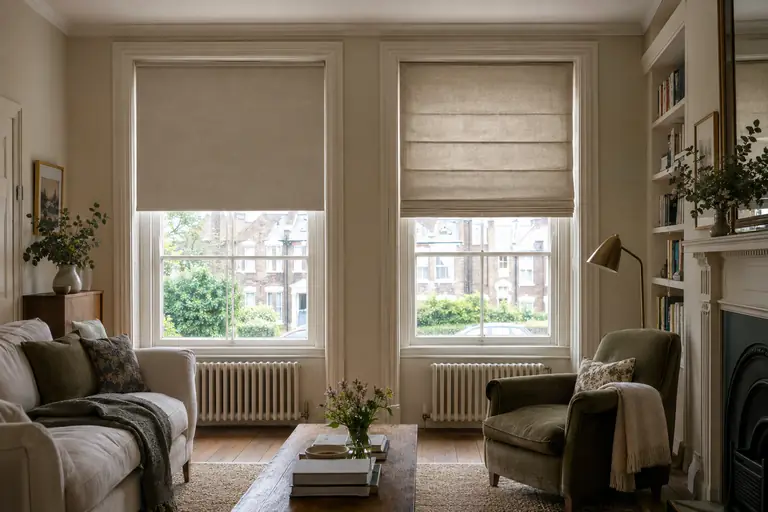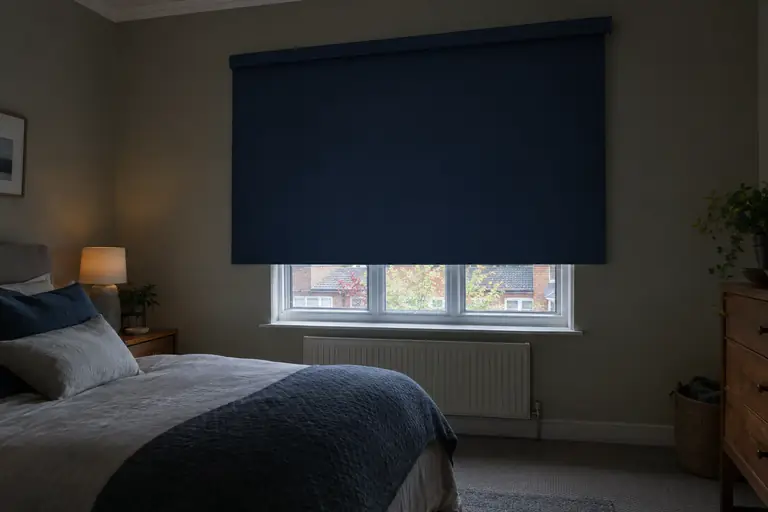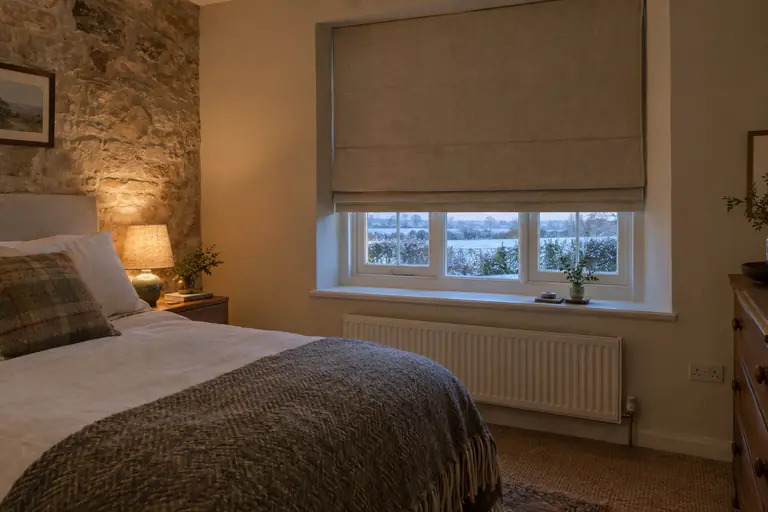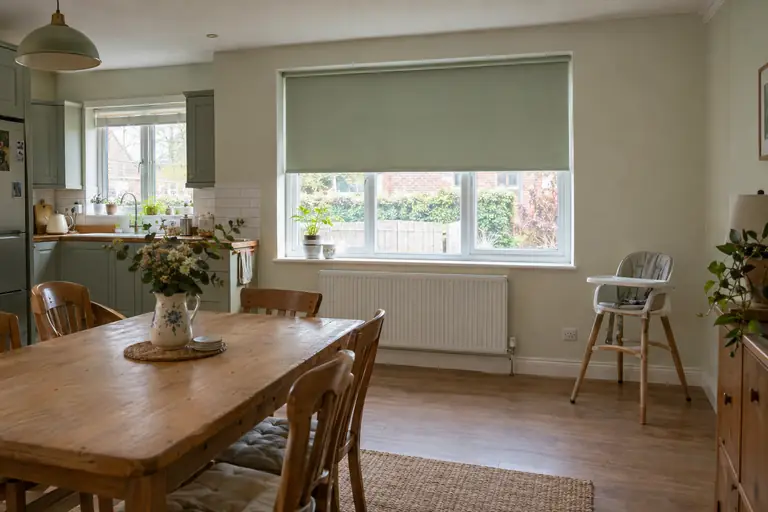

The short answer
Choose a roman when you want a window to feel furnished rather than fitted: living rooms, bedrooms, dining rooms and window seats. Pick the lining for the job: standard to protect the fabric and help the folds hang, thermal for a cold room, blackout for a bedroom. Allow for the stack of folds that stays at the top when the blind is up, and keep romans out of bathrooms.
- A roman is curtain fabric that folds up, so it dresses a window without taking the wall either side.
- When raised, the folds stack at the top; fitting above the reveal keeps them off the glass.
- Lining does the work: standard for body, thermal for warmth, blackout for sleep.
- Voile romans soften daylight but give little privacy once the lights are on.
- Not for bathrooms: steam shrinks face fabric and lining at different rates.
How much light gets through
Swipe to see the whole diagram
The fabric decides how much light comes through the blind itself; the fit decides how much comes round the edges.
How a roman blind folds
Behind the face fabric of a roman blind, a lining carries a set of slim rods sewn in at even spacings down the drop. Cords run up the back through small rings and over the headrail. Raise the blind and the bottom rises first, gathering the fabric into neat horizontal folds between the rods, one on top of the next, until the blind sits as a stack under the headrail.
Those rods are what give a roman its crisp, tailored lines. Lowered, the blind is a flat panel of fabric with faint stitched lines across it, which shows a pattern almost as well as a curtain does. Half-raised, the folds give a window a soft, layered edge that a roller cannot.
Because a roman is made from curtain-weight fabric rather than stiffened blind fabric, it sits comfortably alongside curtains, cushions and upholstery elsewhere in the room. Plains, textures, linens, stripes and large patterns all work. It is also why a roman is made up rather than simply cut: the fabric, lining and rods are assembled to your exact width and drop in our West Yorkshire workshop, so the folds fall level across the window.
The stack: how much window it keeps when it is up
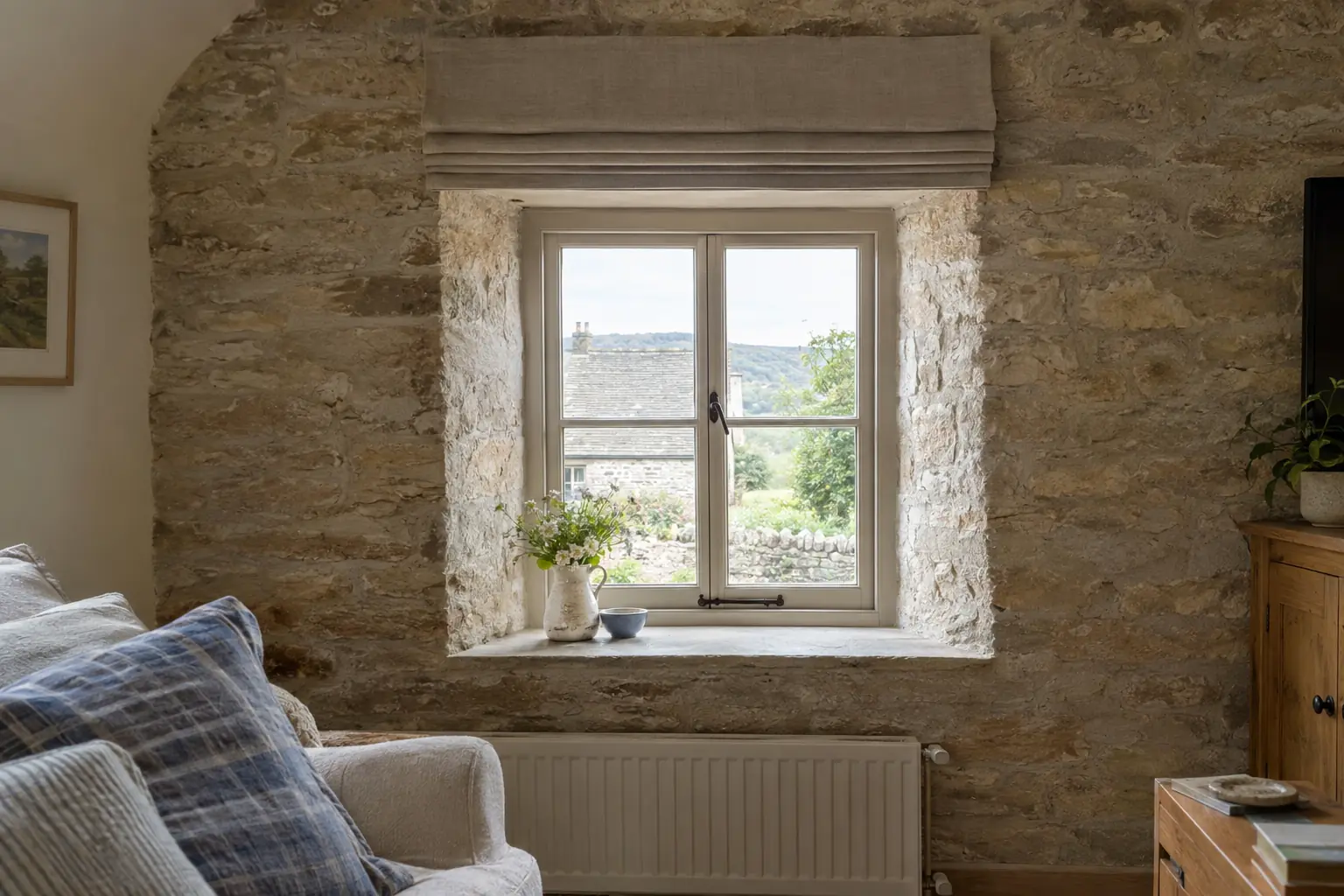
A roller disappears onto a slim tube when it is raised. A roman does not. The folds gather into a stack of fabric at the top of the window, and that stack has real depth. On a tall sash it hardly matters. On a short cottage window or a low dormer, a stack sitting inside the reveal can cover a noticeable band of glass and take some daylight with it.
The usual fix is to fit the blind above the opening rather than inside it. Mounted on the wall a little above the reveal, the stack sits on the wall when the blind is up, the full height of the glass is clear, and the window can look taller than it is. Made a little wider than the opening, the blind also covers the frame and cuts the light that leaks round the sides.
A recess fit still suits a roman on a deep, tall window where the frame and the reveal are worth showing, or where a curtain pole is going on the wall above. Either way, the reveal has to be clear of handles and stays that the folds could catch on. Your advisor measures every opening and will show you where the stack will sit before you decide.
Linings: what each one does
The lining is where a roman blind earns its keep, and it is worth choosing as carefully as the face fabric.
A standard lining gives the fabric body so the folds hang crisply, hides the rods and cords from outside, and takes the direct sun off the back of the face fabric. That last point matters more than it sounds. Conservators at the Institute of Conservation note that all textiles are easily damaged by light, with silk the most vulnerable, and that long exposure makes every kind of fibre fade, yellow and turn brittle. On a sunny window, the lining takes that exposure first.
A thermal lining adds an insulating layer, which helps in a cold room or on an older window, and turns the blind into something you close at dusk for comfort rather than just privacy.
A blackout lining stops light passing through the fabric and is what most bedroom romans end up with. The light that gets round the edges is a separate question, and the fit decides that: a roman mounted outside the reveal and made wider than the opening leaves much less of a bright outline than one inside the recess.
If a roman is going in a nursery or a shift worker's bedroom, say so at the appointment, and your advisor will show you the linings and fits that give the darkest result for that window.
Voile romans: softened light, not night-time cover
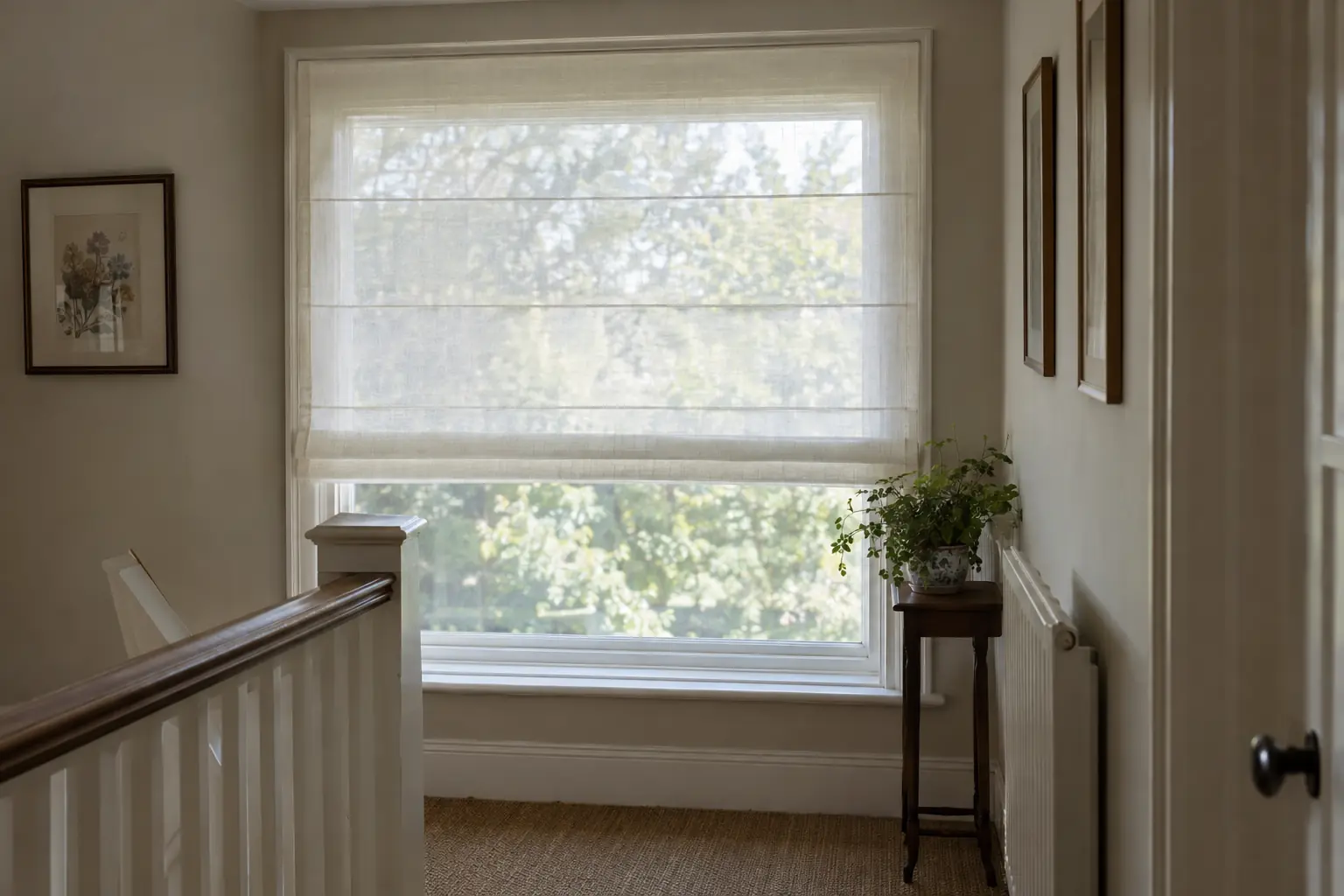
A voile roman uses sheer fabric folded in the same way as a lined roman. Lowered, it turns strong daylight into a soft, even glow and blurs the view in from the street, while you can still see out. Raised, it gives a light, airy stack that barely weighs on the window.
That makes voile romans good at a particular set of jobs: a landing or stairwell window overlooked by a neighbour, a dining room that faces the street, a garden room where you want the glare gone but not the garden, or a kitchen window where a solid blind would feel heavy.
What a voile will not do is give privacy at night. Once the lights are on inside and it is dark outside, a sheer lets people see in. For a room you use in the evening, pair a voile roman with curtains, or choose a lined roman for that window and keep the voile where daytime privacy is all you need.
Voile is also the softest, lightest fabric in the roman range, so it is worth seeing a sample against your own window. How sheer it looks depends a great deal on which way the window faces and how bright the light is behind it.
Choosing fabric and pattern for a roman
A lowered roman is a flat panel of fabric, so pattern shows almost as fully as it does on a curtain. A few things are worth thinking about.
Large patterns need width to be seen. On a narrow window a big motif may be cut off at both edges, and a smaller repeat or a plain texture can look better. Ask your advisor to hold the sample at the width of the window, not just as a swatch.
Stripes work beautifully on romans. Vertical stripes run cleanly through the folds; horizontal stripes need to line up with the fold lines or they look slightly off when the blind is raised.
Where two romans share a wall or a bay, the fabric should come from the same batch. Dye lots shift slightly from one roll to the next, and side by side in the same light the difference can show. Ordering them together means they are made together.
Think about the light the fabric will sit in. A colour that looks warm in the showroom can read grey on a north-facing window. Order up to five free samples and look at them in the morning and again in the evening, or let your advisor bring the full range to the room.
Cords, cordless controls and children
A corded roman lifts on cords that run up the back of the blind, and those cords are the part to think about in a family home. The Child Accident Prevention Trust's advice to anyone with roman blinds is to look at the back and check the cords are joined by a safety device that will break under pressure. RoSPA is blunter about children's rooms: no blind with a looped cord or chain should be fitted in a child's bedroom at all.
Corded romans leave our workshop with the child-safety devices that UK regulations call for, and the fitter puts them up and walks you through them. Where a room has a cot, a bed or a sofa under the window, or small children who climb, we usually recommend a cordless or motorised roman instead. A cordless roman is raised and lowered by hand from the bottom rail, so there is no cord hanging at the side of the window, and it gives a cleaner look with no cleat on the reveal.
Motorisation is also the sensible answer for a roman on a high window, or behind a bed or a sofa you cannot comfortably reach across. Motors carry the same 1-year guarantee as the blind.
Kitchens, bathrooms and keeping a roman clean
Romans work well in a kitchen with some thought about placement. Put one at the table end, or on any window clear of the hob and the washing-up, and a linen or cotton roman softens a room full of hard surfaces. Keep the stack well clear of the cooker, and choose a fabric that will not mind the odd splash.
Bathrooms are a different matter. A roman is face fabric with a lining sewn behind it, and repeated steam makes the two shrink at different rates. The result is a blind that puckers, hangs crooked and marks. In a bathroom or an en-suite, choose something built for steam instead, such as a wipeable roller or a faux wood venetian.
Looking after a roman is closer to caring for a curtain than a blind. Lift the dust off gently with a soft brush, or with a vacuum on its upholstery setting held just off the fabric. Sponge a mark lightly and do not soak it. Most romans should not go in a washing machine, for the same reason as curtains: the lining and face fabric shrink differently, and the rods have to come out first. If a roman needs a proper clean, ask us before you try.
Pros and cons
In its favour
- Curtain fabric and pattern in the footprint of a blind
- Linings add warmth or blackout to the same blind
- Leaves the wall either side clear for furniture or a window seat
- Voile versions soften daylight in rooms that do not need cover
- Cordless and motorised versions in some ranges, for family rooms
Worth knowing
- The stack of folds stays at the top of the window when raised
- Not for bathrooms: steam shrinks fabric and lining at different rates
- Needs gentle dusting and spot cleaning, not a wash
- Corded versions need child-safety devices and care over where they hang
Room by room
- BedroomA great fitA blackout lining and a fit outside the reveal make a roman one of the best-looking ways to get a dark bedroom.
- Living roomA great fitBrings pattern and softness to the window without curtains taking the wall space either side.
- Window seat or bayWorks wellKeeps the seat and the wall clear, and each pane of a bay can have its own roman made to line up.
- KitchenWorks wellFine on a window away from the hob and not right over the sink; keep the stack clear of the cooker.
- Child's bedroomThink twiceRoSPA advises against any looped cord or chain in a child's bedroom, so choose a cordless or motorised roman.
- BathroomThink twiceSteam puckers the fabric and lining. A wipeable roller or a faux wood venetian will last far better.