The short answer
Start with the problem you are solving. For glare on a television or low evening sun, a venetian or vertical blind that tilts is the most precise answer. For privacy after dark without losing daylight, a day and night blind, voiles, or tier-on-tier shutters on a street-facing window. For warmth and softness, lined curtains, often with a slim blind behind them. Many living rooms end up with a blind and curtains together.
- Glare is about angle: a blind that tilts beats one that only goes up and down.
- A lit room at dusk is on show, so plan evening privacy separately from daytime light.
- Sunlight fades fabrics, and the damage builds up and cannot be undone.
- Curtains add warmth and softness; a slim blind behind them handles light and privacy.
- Judge colours at the window in daylight and again under lamps.
Shutter styles
Swipe to see the whole diagram
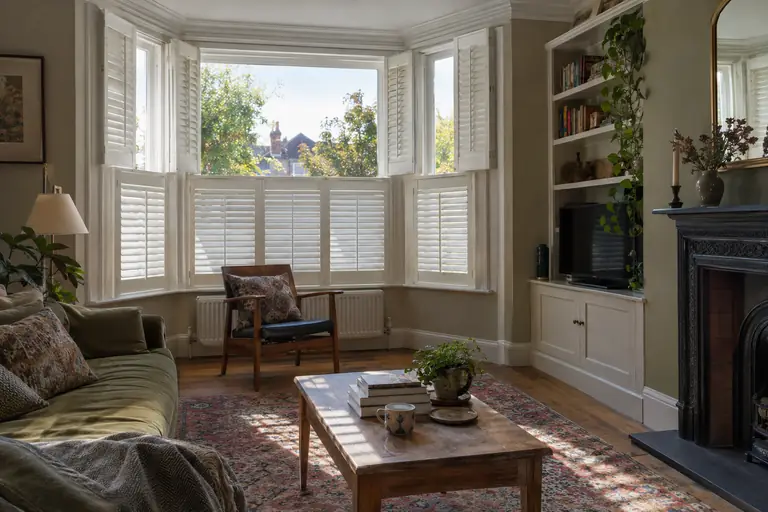
Full height covers the whole window; café style covers the bottom half; tier-on-tier opens top and bottom separately; tracked panels slide across doors.
Start with how the room is used
A living room window is judged at different times of day, often by different people. In the morning you may want every bit of daylight the window will give. In the afternoon someone is watching television or working on a laptop and the sun has moved round. In the evening the lamps are on and the street can see in.
Before choosing, notice which way the window faces and what happens at each of those times. An east-facing front room is bright at breakfast and calm by afternoon. A west-facing one is fine until the sun drops, then pours low light straight across the room, usually into someone's eyes or onto the screen. A north-facing room gets steady, cool light and rarely needs glare control, but suits warmer colours and lined curtains. A south-facing room gets strong light for much of the day, and with it the heat and fading covered further down.
Then look at what the window faces. A front room on a pavement has a different privacy problem from a back room overlooking a garden. The light and the view in decide most of what follows.
Glare on the television
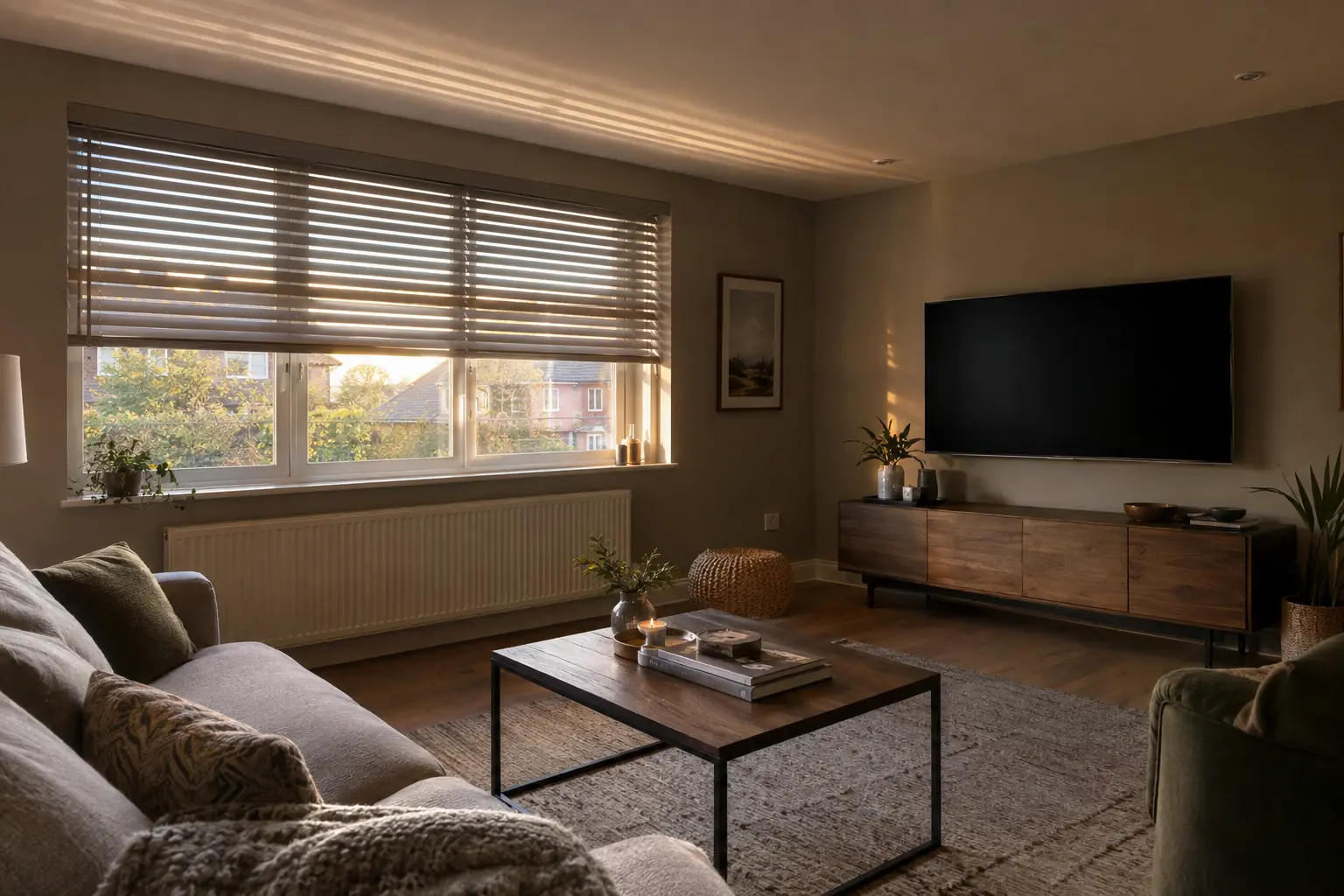
Glare is a problem of angle rather than amount. A window behind the sofa throws its light onto the screen; a window behind the television makes you squint at a bright rectangle around the picture. Lowering a blind fixes both, but takes the daylight with it, and the lamps end up on in the middle of the afternoon.
A blind that tilts is the better answer. Venetian slats angled upward lift the daylight onto the ceiling, off the screen, and the room stays bright. Vertical blinds do the same for side light: the louvres turn to cut low sun coming across the room from one side while the rest of the window stays open. In a west-facing room, that is what keeps a summer evening usable.
Where the screen faces a large window squarely, a dimout roller or a day and night blind can take the brightness down across the whole glass without blacking the room out. A blackout blind is rarely needed in a living room unless it doubles as a home cinema. For desks, laptops and video calls rather than television, our home office guide goes into the detail.
Privacy after dark
A living room with the lamps on and nothing at the window is, from the pavement, a lit stage. By day you may be happy to be seen; at dusk most people want something between them and the street, without shutting the room up like a bedroom.
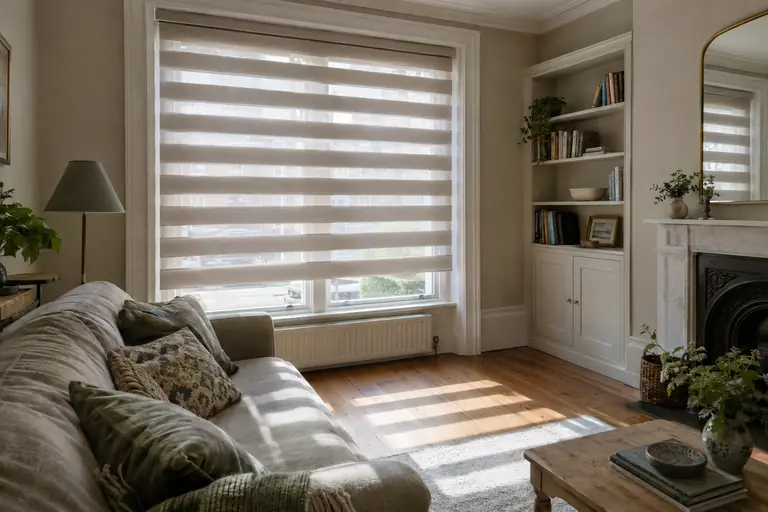
A day and night blind is the neatest single answer. Its two striped layers let you move from open, filtered daylight to a closed panel with a short pull on the control, without raising the blind out of the way. It is not a blackout product, which in a living room is rarely a drawback. Voiles, as curtains or as a voile roman behind the main pair, filter the view by day so the dress curtains can stay open.
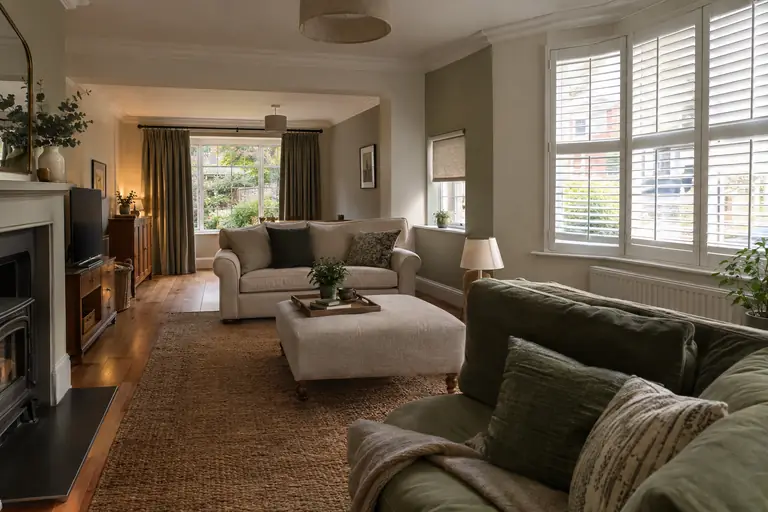
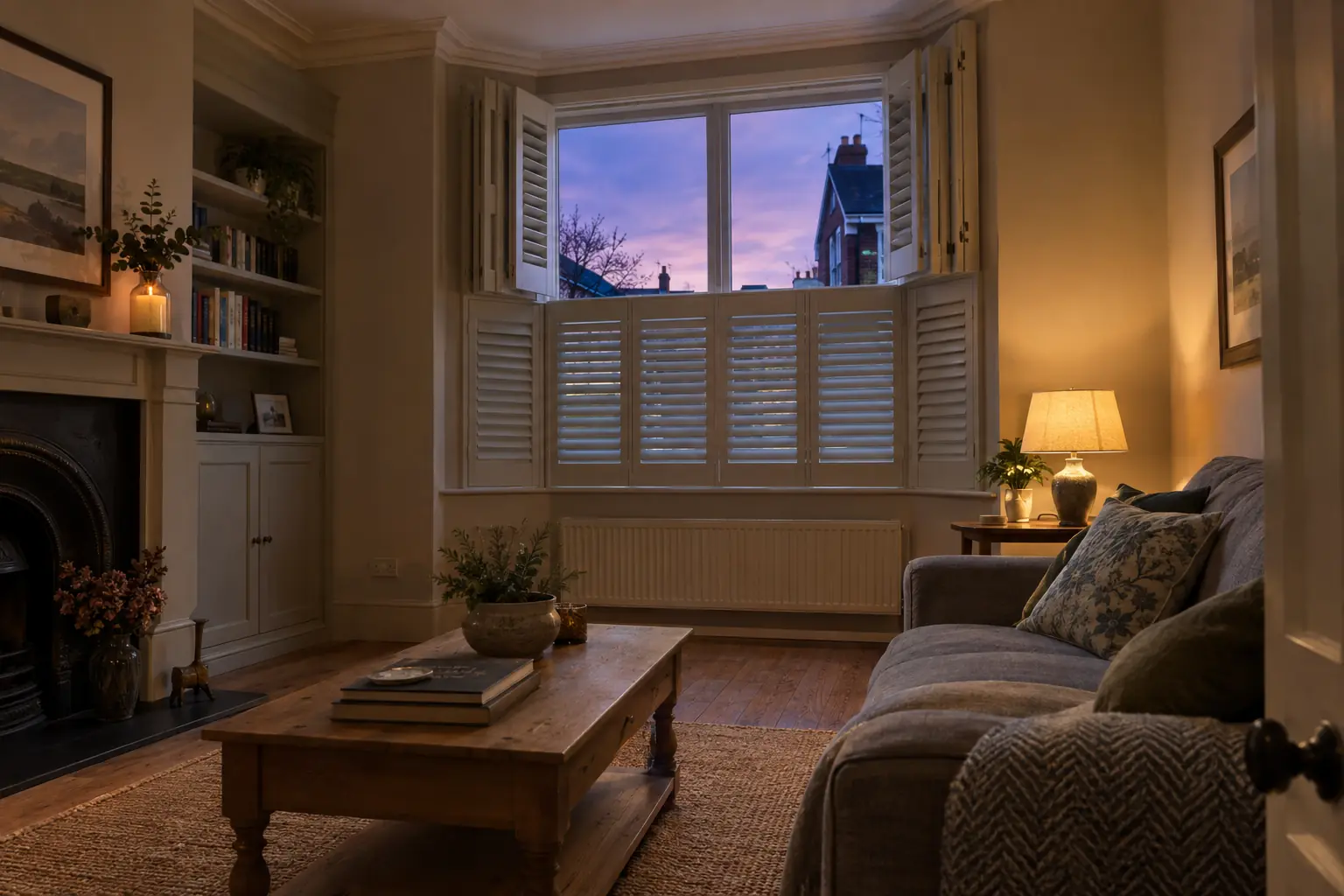
Shutters are the period-house answer. Café-style shutters cover the bottom half of the window, where the pavement is, and leave the top clear. Tier-on-tier shutters have independent top and bottom panels, so you can open the top for light and keep the bottom closed; on a front room facing a street, that is the usual choice. The louvres tilt as well, so even closed panels let light through.
Blinds, curtains, shutters, or a mix
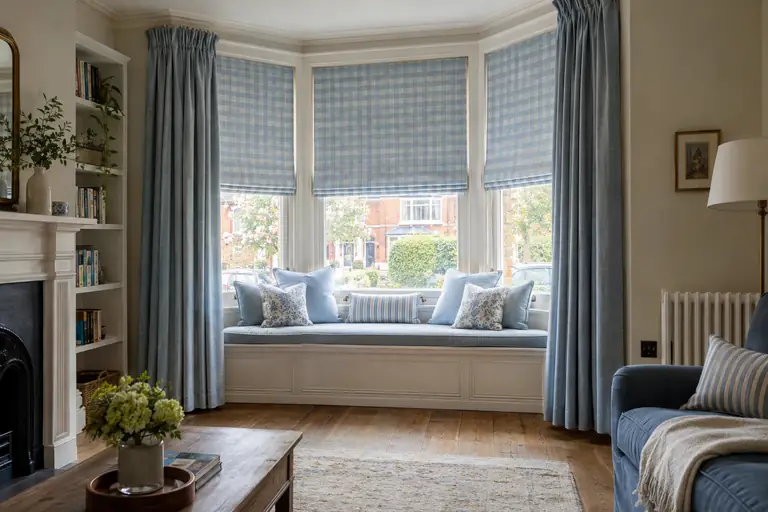
Each does something different in a living room. Blinds are slim and precise: they handle light and privacy, sit neatly in the recess and leave the wall either side clear for furniture. A roman blind adds the softness of fabric without the width of curtains, and suits a window with a radiator or a window seat below it.
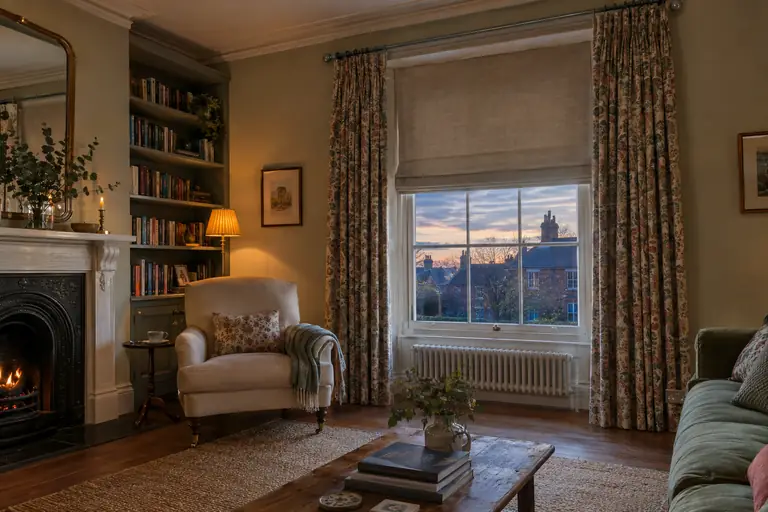
Curtains bring warmth and a sense of finish that a blind alone rarely gives. Lined, they help keep the room warm in the evening; hung wide of the window, they frame it and leave the full glass clear when open. The poles and tracks are supplied and fitted with them.
Shutters are fitted furniture rather than a soft covering. They follow the reveal, add insulation, need no cords and suit period rooms and bays.
Many living rooms use two of the three. A blind or voile in the recess does the daily work of light and privacy, while curtains outside it add warmth and dressing in the evening. Dress curtains that stay open and simply frame the window are a common partner for wooden blinds in a period room. Our guides to layering blinds and curtains, and to choosing between blinds, curtains and shutters, go into both in more depth.
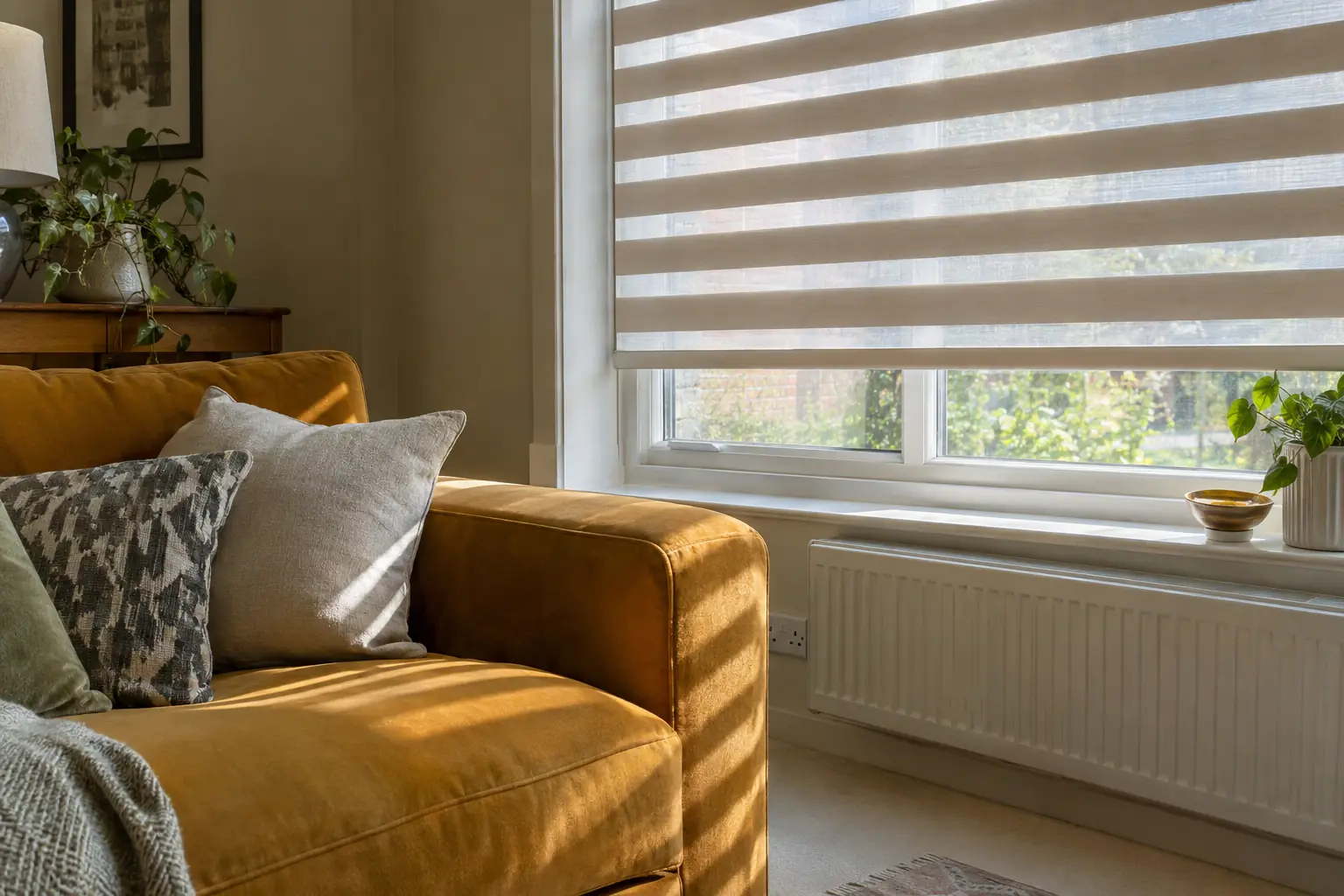
Keeping the sun off the sofa
Sunlight fades things, and in a living room you can usually point to where: the arm of the sofa nearest the window, the rug in the path of the afternoon sun, the spines of the books on the shelf, a wooden floor that is paler by the glass. The National Trust describes that damage to textiles and wood as cumulative and irreversible, so the aim is less sun on them rather than a cure.
A blind lowered or tilted through the brightest part of the day is the simplest protection, and it is what historic houses do: National Trust conservators use blinds to block the sun's damaging rays when it is bright. Curtain linings do a similar job for the curtains themselves, protecting the face fabric from the sun.
Blind fabrics are not immune either. Museums Galleries Scotland notes that some coloured blind fabrics can fade over time, and suggests natural colours where that matters. On a south- or west-facing window, ask your advisor which fabrics in a range suit strong sun, and consider a lined blind or a softer colour for the sunniest glass.
Colour, pattern and the view from outside
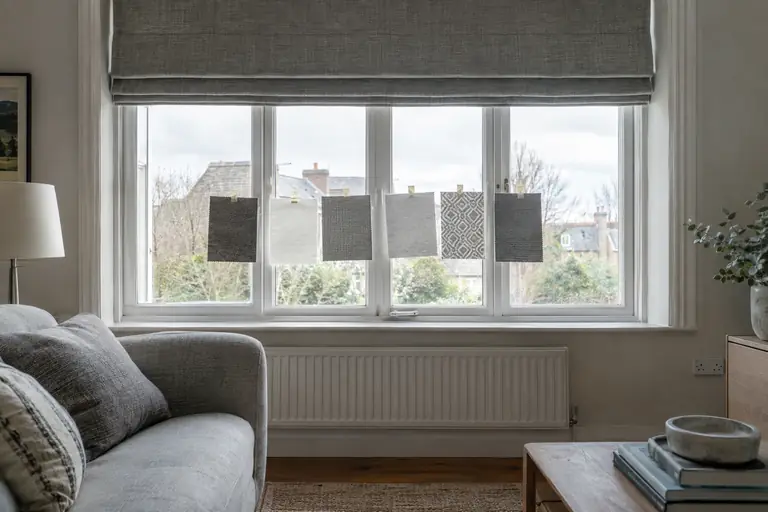
A living room is where most people are bravest with colour, and where a mistake is most visible. Colour on a screen is guesswork: a shade that looks warm on a phone can read grey against a north-facing wall and different again under lamps. Judge fabrics at the actual window, in daylight and after dark, which is why we post free samples and why an advisor brings the full range to the appointment.
A few rules of thumb help. In a room with several windows, keep the blinds consistent and put the pattern into curtains or cushions, which are easier to change later. A strong pattern on a blind works best on a single feature window. And remember the street: the lining of a curtain and the back of a blind are what the neighbours see, so ask to see those as well as the front.
Bays deserve their own thinking, with several panes at angles and curtains that have to work round corners. Our bay window guide covers them, and our guide to choosing colours and patterns goes further on colour.
Checklist
- Note which way each window faces and when the sun reaches the screen and the sofa.
- Look at the room from outside at dusk with the lamps on.
- Decide what the blind must do by day and what the curtains must do at night.
- Check what sits under the window: a radiator, a window seat, the sofa.
- Look at samples in daylight and again under lamps.
- Keep blinds consistent across windows on the same wall.