The short answer
Buy a pleated or honeycomb blind for one of three reasons: a window that is awkward to dress, such as a conservatory, a door or an angled pane; a stack that has to be small; or, with honeycomb, extra warmth. Then choose the fabric, from light-filtering to blackout or reflective, the way it moves, hanging from the headrail or held taut between rails, and how it is fixed. Your advisor checks every window before recommending one.
- Choose them for awkward windows, small stacks and shallow reveals; choose honeycomb for extra warmth.
- Fabrics run from light-filtering and dimout to blackout, with reflective backings for sunny glass.
- Hanging blinds suit ordinary windows; tensioned blinds stay put on doors, tilting sashes and sloping glass.
- Angled, arched and triangular windows are possible, though some shaped blinds are fixed rather than raised.
- In a child's room, choose a version moved by hand, with no looped cord.
Why choose a folding blind
A blind has to live somewhere when it is raised. A roller winds into a tube, a roman folds into a deep stack of fabric, a venetian gathers its slats under the headrail. A pleated or honeycomb blind folds its fabric into a concertina only a few folds deep, and that small stack is the first reason to choose one.
It matters most where space is tight. On a shallow modern reveal, a bulky headrail would stand proud of the wall and look wrong. On a short window, a roman's stack would cover a good part of the glass. On a window with a handle close to the top, a roller's tube might not clear it. A slim headrail and a small stack avoid all three.
The second reason is flexibility. Because the fabric is light and folds on its creases, a pleated blind can be held taut between two rails rather than hanging under its own weight, which lets it work on doors, tilting windows and sloping glass. And because the folds follow the fabric rather than a tube, it can be made for shapes a roller cannot cover.
The third reason, for honeycomb, is warmth. Our comparison of the two types explains why the cells make it warmer than a single-layer pleat.
Choosing the fabric
Pleated and honeycomb fabrics cover much the same range of light control as roller fabrics, and it is worth deciding what the window needs before you look at colours.
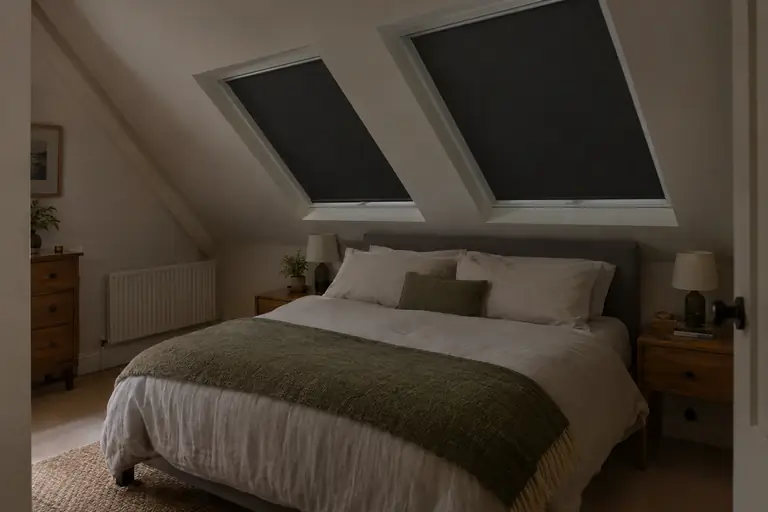
Light-filtering fabrics soften the light and give daytime privacy, with some weaves letting you see shapes outside. They suit living rooms, kitchens and conservatory side glass where you want the room bright. Dimout fabrics take a room well down and give privacy at night, and they suit dining rooms, snugs and spare bedrooms. Blackout fabrics stop light through the fabric itself. They darken a bedroom well, though the small holes where the cords pass through show as pinpricks in a dark room, and any blind inside a recess lets a little light in round the edges.
Reflective backings are the specialist option. Made for sunny glass, they turn some of the sun's heat back through the window, which is why they are so often used on conservatory walls and south-facing windows. Some fabrics are thermal as well, and some combine thermal with blackout.
The back of the fabric faces the street, so what passers-by see is often the backing rather than your colour. Order up to five free samples to see the front and back against your own windows, in daylight and after dark.
How they move: hanging or held taut
The biggest practical choice with a pleated or honeycomb blind is how it moves, and the blind safety standard reflects this: it lists pleated and honeycomb blinds among the types it covers in hanging, guided, sideways-moving and tensioned forms. For most homes, two of those matter.
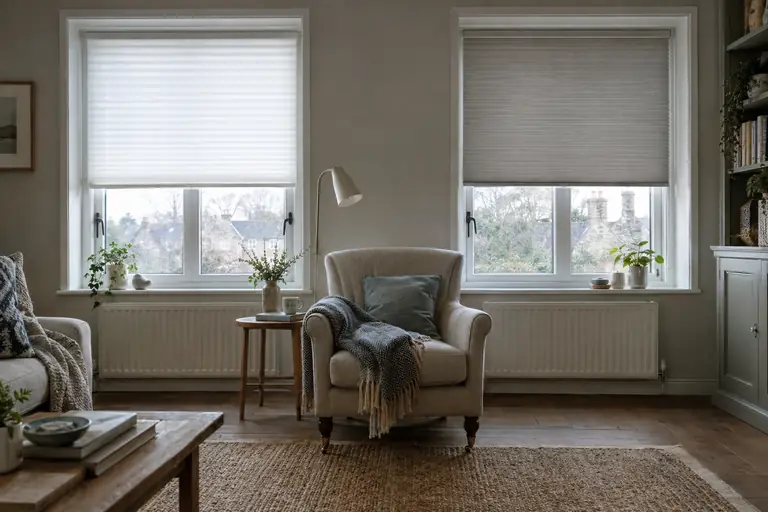
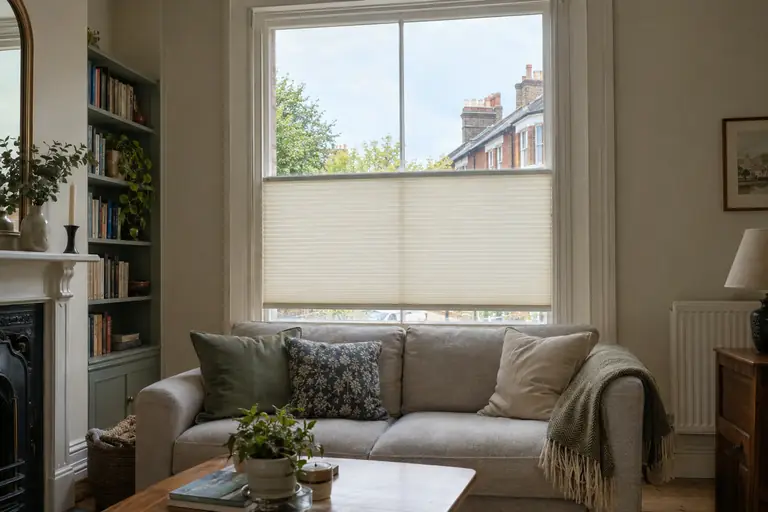
A hanging blind works like a traditional blind. The headrail is fixed at the top, and cords raise the bottom rail, gathering the fabric into its stack, while gravity lowers it again. It suits an ordinary window that does not open inwards, and it is the simplest to live with.
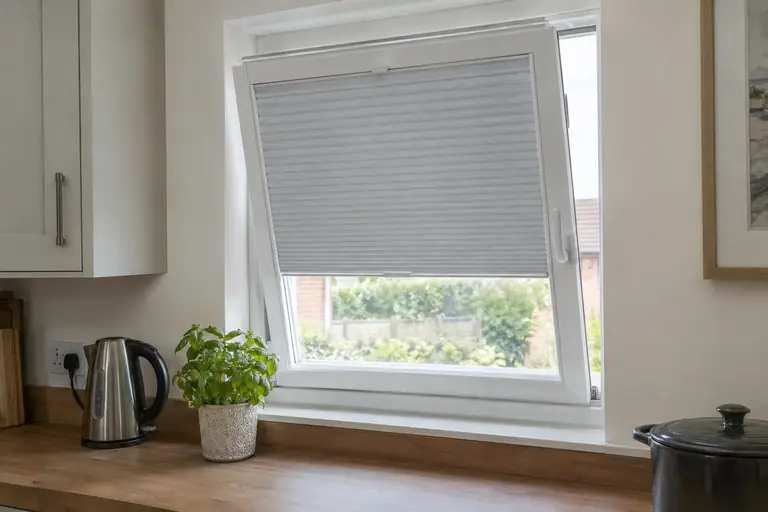
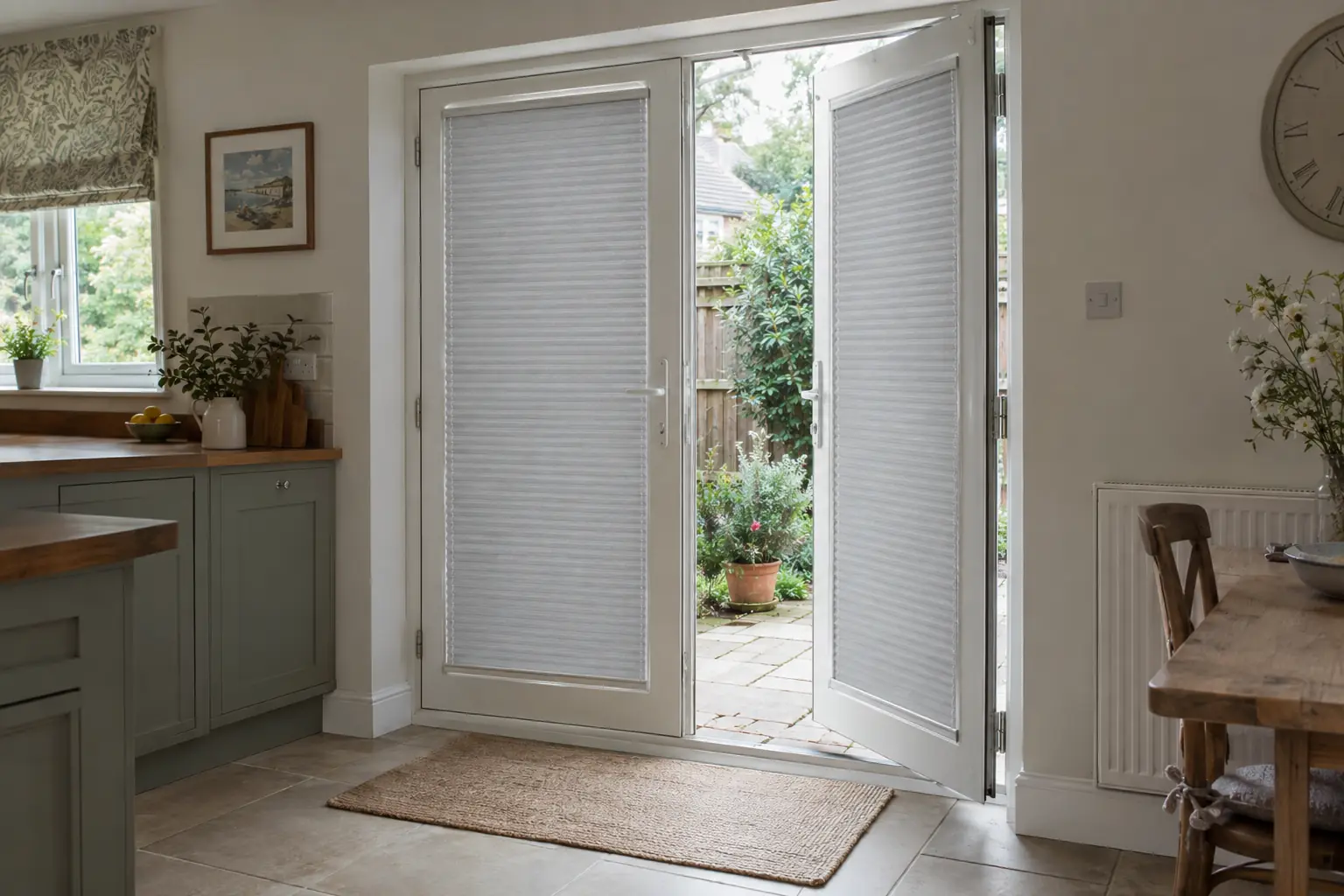
A tensioned blind is held taut between a top and a bottom rail, and cords or guides running down each side keep the fabric in line. You move the rails by hand and they stay where you leave them, at any height, on any angle. That is what lets a pleated blind sit on a door without swinging, on a tilt and turn window as it tips open, or on sloping glass without sagging away from it. In the perfect fit style, the rails sit in a slim frame clipped into the window's bead.
Top down bottom up blinds are a variation on either, with two moving rails, and they have their own guide. Your advisor will tell you which forms suit each of your windows.
Shaped and awkward windows
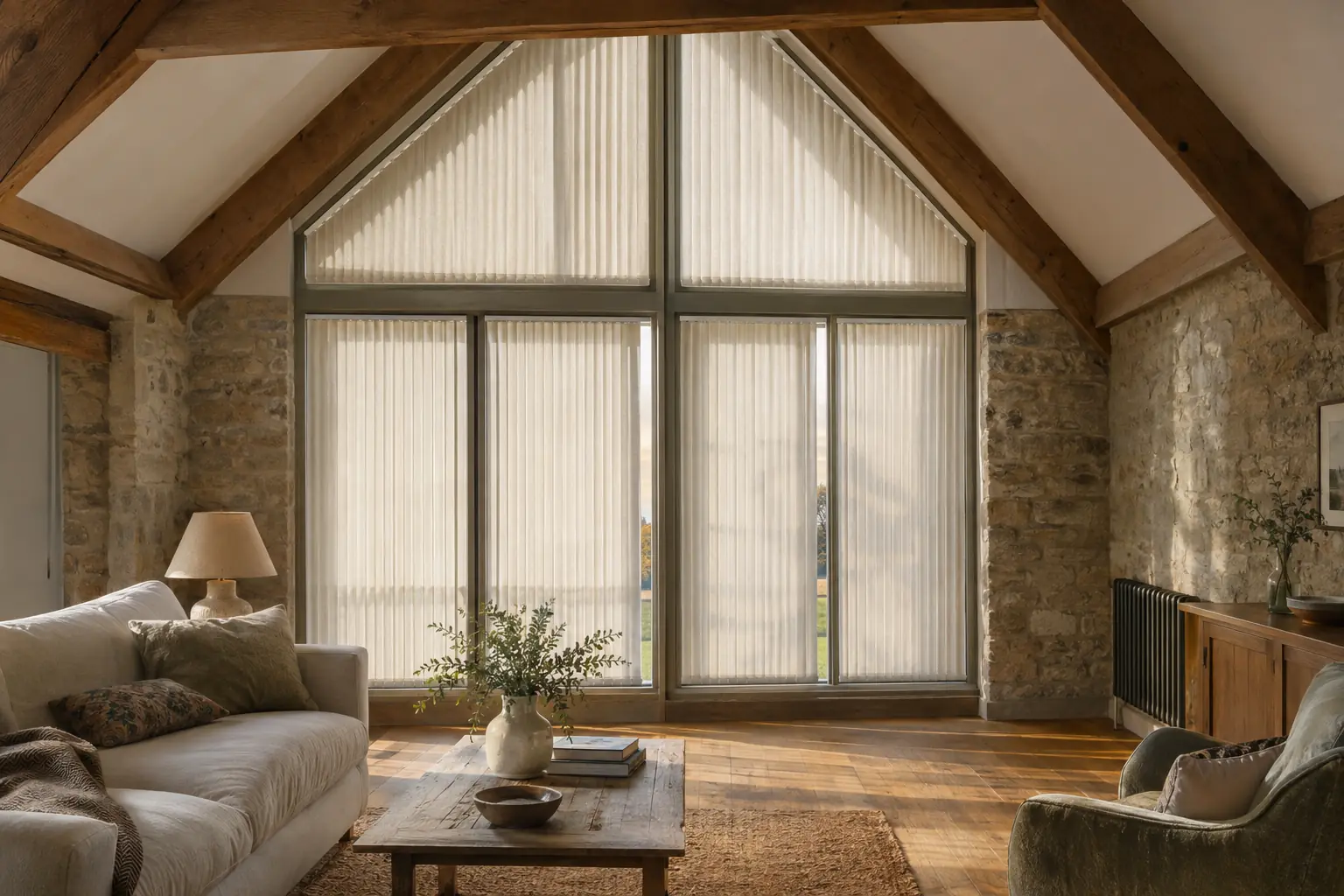
Pleated blinds can be made for windows that most other blinds cannot dress neatly: angled tops in loft conversions and gable ends, triangular panes, arched heads and the odd trapezium beside a staircase. Because the fabric folds on its creases, it can follow a sloping edge in a way a roller tube cannot, and your advisor takes the angles on site rather than working from a photograph.
It helps to know how a shaped blind behaves before you order one. On some shapes the blind raises and lowers like any other, with the shaped part moving with it. On others, such as a triangle at the top of a gable, the shaped section is fixed: it shades the glass permanently while the rectangular window below has its own blind that opens and closes. Your advisor will tell you which parts of a shape can move, so there are no surprises on fitting day.
Honeycomb can be made for some shapes too, and is worth asking about where a shaped window is also a cold one.
Slightly out-of-square windows are a different problem, and a common one in British homes. Every opening is measured on its own at several points, so the blind is made for the window you actually have, and your advisor will say whether it looks better in the recess or over it.
Doors, tilt and turn windows and conservatories
Anything that opens inwards is awkward for a blind that hangs from the top of the recess, because the blind has to be raised before the window or door can move. A tensioned pleated or honeycomb blind fixed to the door or sash solves that: it moves with the glass, stays flat and does not swing or tap as the door closes.
On uPVC and aluminium doors and windows, the neatest way to do it is the perfect fit style, where each blind sits in its own frame clipped into the bead around the glass with no drilling into the frame. It needs a bead deep enough for the clips, which most modern double glazing has and most timber frames do not, so your advisor checks every pane. Our perfect fit guide goes into the details.
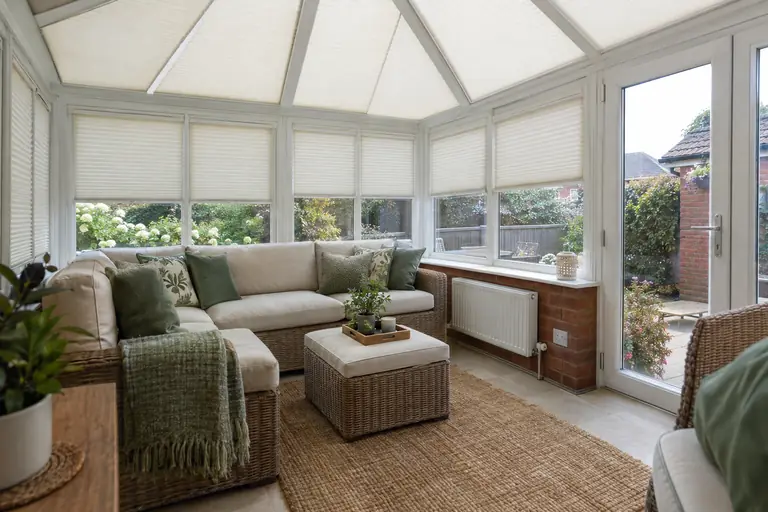
Conservatories bring the two together: rows of side windows, some opening, some fixed, with top vents and doors. Pleated blinds with reflective backings are the usual choice for the side glass, because they turn back the sun, stack small under the vents and let each pane have its own blind. The roof is a separate job, measured pane by pane once the advisor has seen the frames, and our conservatory guide covers it.
Controls and child safety
A hanging pleated blind is raised and lowered on cords, and like every corded blind we supply it comes with the child-safety devices UK regulations require, which our fitter installs and explains. Those devices work, but in a room where young children sleep or play, a blind with no looped cord at all is the better answer.
The British Blind and Shutter Association describes blinds that are safe by design as those that are cordless or have concealed or tensioned cords, including blinds that can be pushed or pulled into position. A tensioned pleated or honeycomb blind moved by hand fits that description, which is one reason they are popular in children's bedrooms and family kitchens, alongside the practical advantages on doors and opening windows.
Whichever you choose, keep cots, beds and anything a child could climb away from the window, and ask your fitter to show you how every blind is worked before they leave. They check the operation with you as part of the fitting, which is included in the price.
For very high windows, a roof lantern or a gable apex out of reach, ask your advisor whether a motorised version is available for the blind you want; for anything you cannot reach, a motor is often what makes a blind usable.
Pros and cons
In its favour
- Folds into a very slim stack, keeping almost all of the glass clear
- Can be made for angled, arched and triangular windows a roller cannot cover
- Tensioned versions stay put on doors, tilting sashes and sloping glass
- A small headrail suits shallow reveals where a bulky one would look wrong
- Fabrics from light-filtering to blackout, with reflective backings for sunny glass
- Honeycomb's air cells make it warmer than a single-layer pleat
Worth knowing
- Cords pass through the fabric, which can show pinpricks of light in a dark room
- Pleats can lose their crisp line if they are crushed or soaked
- Some shaped blinds are fixed rather than raised and lowered
- Corded hanging versions need child-safety devices fitted and used
Room by room
- Conservatory side windowsA great fitSlim, light and available with reflective backings that turn back the sun on hot glass.
- Cold or north-facing bedroomA great fitA honeycomb blind's trapped air helps most on a cold or single-glazed window.
- Shallow modern revealA great fitA small headrail fits where a roller tube or a roman stack would crowd the window.
- French doors and uPVC doorsWorks wellA tensioned or perfect fit version stays on the glass as the door opens and closes.
- Gable or angled windowWorks wellPleats can follow the angle; some shapes are fixed, so ask which parts will move.
- Steamy bathroomThink twiceWipeable rollers or faux-wood venetians usually cope better with daily steam and splashes.